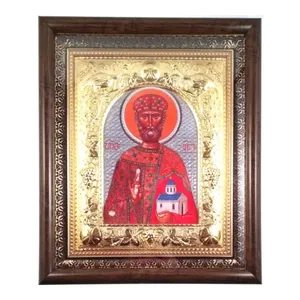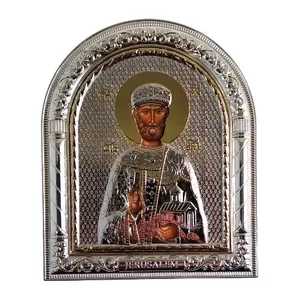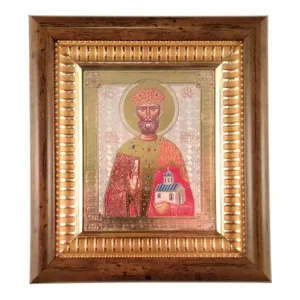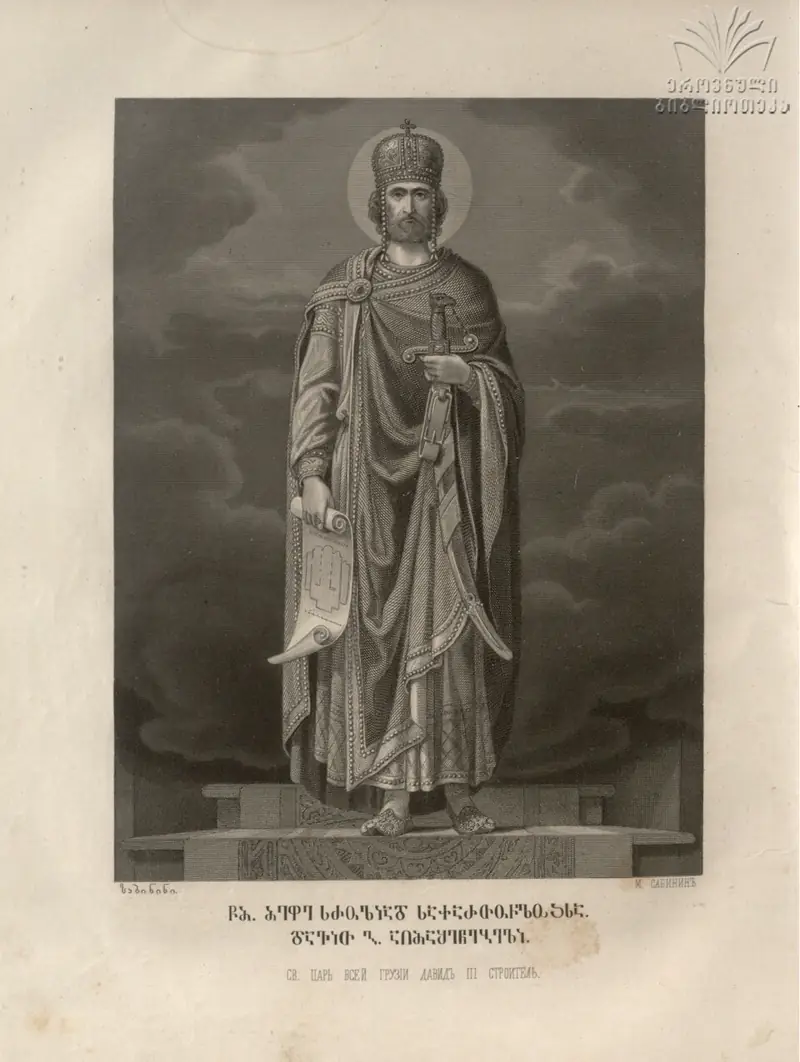
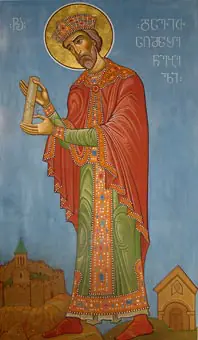
Holy Right-believing David IV, King of All Georgia, Called the Builder (+1125)
Georgia in the eleventh century found itself facing physical and spiritual catastrophe. Sultan Malik-Shah took Samshvilde, captured its ruler John son of Liparit, laid Armenia waste, and, despite some victories of King Giorgi II, took and sacked Kutaisi, Artanuji and the desert of Klarjeti. The terrified Georgians abandoned their homes and took refuge in the mountains and forests. The lawless seized the emptied land, laid waste the churches and monasteries and slaughtered the people.
The once Christ-loving nation was overcome by lawlessness and sin. “Every age and every rank sinned against God in every way and turned from the straight paths to every evil.” On the day of Pascha “the Lord looked down in wrath and shook the land to its foundations”. A terrible earthquake destroyed everything.
In such a time of hardship and misfortune “there began to dawn the sun of all kingdoms, great in name and greater in deed, namesake of David the forefather of God, and himself the seventy-ninth son of that David — David”. There appeared as Georgia’s hope and lord the learned, wise of speech, God-fearing supporter of the fallen, defender of widows and orphans, just judge, unconquered warrior, king of the Abkhaz, the Kartvelians, the Ranians, the Kakhetians and the Armenians, sword of the Messiah — the holy David the Builder.
In 1089 Giorgi II renounced the honour and burden of kingship and “set the crown of the kingdom” upon his sixteen-year-old “only-begotten son”. “The Father Himself found David His servant, and with His holy oil He anointed him.” The Lord clothed with mercy and truth the merciful king, protector of the poor, and “made him higher than all the kings of the earth”. Before him lay a thirty-six-year road of battle, toil, building and labour.
First of all King David began to bring back to their old homesteads the Georgians who had fled during the “great Turkish invasion” and taken refuge in inaccessible places; he gathered the nobles and together with them set about gathering the nation.
Four years passed. Sultan Malik-Shah died. Liparit Baghvashi, who at first had stood loyally beside the king, “began to walk again in the ways of his fathers and forefathers. Though he was a Christian in appearance, yet he bore in his mind faithlessness and hatred for the house of his lords. He set himself on every evil way.”
The king resolved to bring him back to the right way and imprisoned him for a time. The eristavi of Kldekari swore a firm oath and gave a pledge of loyalty. The king forgave him, but when he was convinced that “a dog’s tail will not be straightened, nor does the crab walk straight”, he seized him again, kept him in prison for two years, and then sent him away to Greece, stripped of honour. In the same way David successfully subdued other rebellious nobles as well, for he knew that inner peace and unity were the indispensable cornerstone of a strong state.
Meanwhile the crusaders took Jerusalem and Antioch. King David took advantage of this and stopped paying tribute to the Turks.
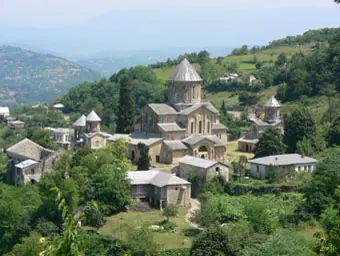
The monastery complex of Gelati
The God-wise king turned his prudent gaze upon the Church. He summoned a church council “of God-loving monks, recluses and desert-dwellers of the regions of Kartli, near the two episcopal sees of Ruisi and Urbnisi”. The council restored and strengthened the authority of the Georgian Christian Church and put an end to the wilfulness of unruly lords and unworthy clergy. The Church became the chief support in carrying out the most important political and national interests of the state. The council confirmed once more the vital importance of the Orthodox faith for the salvation of the nation and of the person. “We have not been false to thee in holiness, our mother the Catholic Church, nor have we betrayed thee, our boast, Orthodoxy, from which we too have not been cut off, since we have been made worthy of the knowledge of thee; the truth is witness,” we read in the canons of this council.
King David set energetically about the full unification of Georgia, and first of all turned to Kakheti-Hereti. The Turks and the treacherous lords had no intention of laying down their arms. Trusting in God’s mercy, the army fearlessly engaged the huge Turkish cavalry at Ertsukhi. The king fought like an ordinary soldier, cried out to the warriors like a lion and swept along like a whirlwind. Three horses were killed under him in this battle; mounted on the fourth, he finished the battle with a wonderful victory.
For several years the right-believing David devoted himself to reforming the country’s internal affairs and to building, and then he set about clearing Georgia entirely of the Turks.
The Turkish Sultan Muhammad moved an army of a hundred thousand towards Georgia. When he learned of the enemy’s invasion, the king himself went towards Trialeti with fifteen hundred men. At dawn the unequal forces met. “By the help of God the camp of the Turks was defeated.” The terror-struck invaders fled so fast that they had no time to take down their tents or drive off their cattle. Meanwhile Giorgi Chqondideli took Rustavi from the invaders as well. In 1115 the valley of the Mtkvari was wholly joined to Georgia. And a year later the Turks encamped between Karnipor and Basiani were driven out too.
The kingdom was filled with riches and glory. In that year David gave his daughter Kata as a daughter-in-law to the Greek emperor Alexios Komnenos, and sent his other daughter to Shirvan as queen, “that like two luminaries, one in the east and the other in the west, they might make the sphere radiant, receiving their brightness from their father”.
The “wonderful victories” went on, and the holy king was clothed with ever new glory. Beside the incomparable father stood a worthy son, “in wisdom, holiness, valour and courage better than his father” — Demetre (afterwards the venerable Damiane, formerly Demetre, commemorated 23 May). The prince made war on Shirvan, took Kaladzori and returned to his father with great spoil and many captives.
The following year Georgia annexed Lore and Agarani.
In spite of his successes, David the Builder saw clearly that it was hard for the victorious but small Georgian cavalry both to guard the safety of Georgia’s towns and fortresses and at the same time to serve in a standing army. A permanent army had to be created. The wise king resolved to create such an army from the Kipchaks. He knew this people well and knew of their art of war and their courage. His wife too, Queen Gurandukht, was the daughter of the Kipchak ruler Atraka son of Sharagan. Atraka gladly accepted the proposal of his renowned son-in-law. To secure a peaceful road for the Kipchaks the king and his tutor Giorgi Chqondideli went to Ossetia. In Ossetia Giorgi Chqondideli died, “the tutor of his lord and his companion in clearing all his ways, deeds and labours”. The grieving king proclaimed forty days of mourning throughout the kingdom.
David created from the Kipchaks an army of forty thousand. Five thousand Georgians were added to it, and from that day a force of 45,000 men was always at the disposal of Georgia.
David put an end to the raiding of the Turks who lived in and near Georgia. Day by day the holy king established, bound together and strengthened the country. The enemies did not dare to engage the king blessed by God. “Thus hard pressed by afflictions, the Turkmens” came before Sultan Mahmud in Baghdad. As a sign of mourning and distress they dyed themselves black, and so told of what was happening in Transcaucasia. The sultan summoned Durbeiz, king of the Arabs, gave him his son Malik, gathered an army of six hundred thousand and moved it towards Georgia.
It was August 1121. Countless as sand, the enemy came up to Trialeti, Manglisi and Didgori; “their very feet could not find room in those places”. The fearless king drew up his army quietly, calmly and wisely, so that he took care not only for victory but also to spare his small cavalry.
Before the battle began the king addressed the army: “Ho, warriors of Christ! If we fight with self-sacrifice for the defence of God’s law, we shall easily defeat not only the countless followers of the devil but the devils themselves. And I counsel you one thing that will be good for our honour and our profit: let us all, lifting our hands to heaven, vow to the mighty God that for His love we will die on this field of battle sooner than flee; and so that we cannot flee even if we wished to, let us block with thick barricades of trees the mouth of this gorge by which we came in, and when the enemies come near to attack us, let us fall upon them fiercely with steadfast hearts.”
No one even thought of retreat. The king’s astonishing battle tactics paralysed the enemy with fear. “The hand of the Most High helped him and power from on high defended him, and the holy martyr George went before him openly, in the sight of all, and with his own arm struck down the lawless pagans who pressed upon them.”
In the very first battle the enemy suffered great losses. Il-Ghazi, the ruler of Baghdad, was gravely wounded; the Georgians came so close to the renowned commander Durbeiz son of Sadaqa that they tore from his breast a precious gold collar, which afterwards, in honour of the victory won at Didgori, they offered to the icon of the Theotokos of Khakhuli.
The battle of Didgori broke the backbone of the Georgians’ enemies for a long time and thoroughly.
The next year, 1122, David the Builder took Tbilisi and after four hundred years of captivity restored the capital to the homeland. In 1123 David annexed Dmanisi too, and with this he finally completed the unification of Georgia.
Victory followed victory. The Lord helped the king who glorified God. As early as 1106 King David had begun the building of the crown of his building work — the monastery of Gelati. “He conceived the building of a monastery and established it in a place of every beauty and wholly without flaw, in which, like a second heaven, he spread out the church of the most holy and most blessed Mother of God.” This church was more beautiful than all the others. David offered it great treasure and spoil won in war, and at the same time “he gathered men honourable in their lives and adorned with every virtue, found not only in his own kingdoms but from the ends of the earth; wherever he heard of anyone’s holiness, goodness, perfection, fullness of spiritual and bodily virtues, he sought and searched them out well, brought them and settled them in it”. So he laid the foundation of a place of higher learning — the Academy of Gelati. Here laboured John Petritsi, Theophile the Priest-monk, John son of Tarichi and Arsen Iqaltoeli. This hearth of Orthodoxy and wisdom became “for all the East a second Jerusalem, a school of all good, a teacher of learning, another Athens”.
David’s caring hand reached also the many Georgian monasteries in the holy places beyond Georgia’s borders.
The king, a lover of mankind, built a hospice for the sick and provided all that was needed. Full of generosity and mercy, he himself often visited the sick, encouraged them and treated them like a father. David always carried a purse with him for giving alms. When he emptied it he was filled with joy, but if he could not give everything away by the end of the day he would say sorrowfully: “Today I could not give to Christ, through the weakness of my sins.”
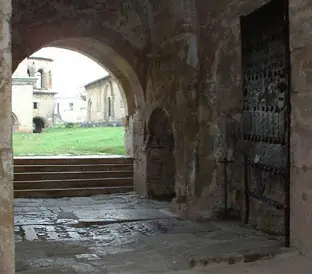
The tomb of Saint David the Builder
The learned and bookish king devoted his free time to understanding Holy Scripture and other sciences. David carried books with him even to war; he had his library carried by mules and camels, and when he grew tired of reading he had another read to him while he listened attentively. Above all he loved to read Holy Scripture. The writer of King David’s life says: “Once he took the book of the Apostle to read it through, and each time he finished it he set a mark at the end of the book. And at the turn of the year we counted by those marks: he had read it through twenty-four times.”
The wonderful bookish king was also an incomparable hymnographer. His “Hymns of Repentance” equalled in their deep spirituality the works of the greatest hymnographers of the Church. The most fearless, the most victorious and the most righteous of the Georgian kings left to posterity a wonderful confession of his soul, in which with bitter lament he recalled all his sins, voluntary and involuntary, and begged mercy of the all-ruling Judge: “When the hour comes in which moist and dry are breathed out, when the dread of kingship passes and glory dries up, delights are made idle and flowering withers, another takes the sceptre and the armies follow another — then have mercy on me, my Judge!”
In 1125, when he was thinking of undertaking “great deeds and greater campaigns”, the God-crowned king wrote his testament, with his own hand set Demetre on the royal throne, placed the crown on his head, girded him with the sword and “blessed him with a prosperous life and length of happy days”. He himself reposed at the age of fifty-three, “renowned as Nimrod among the mighty; valiant as Joshua among captains; zealous as Phinehas among priests; strong as Samson among judges; wise as Solomon among kings; meek as David among the anointed; ardent as Peter among the disciples; loving mankind as my Jesus among gods — God by nature among those called gods by grace; beloved as John among friends; swift as Paul among the apostles; the first pattern of unerring Christianity, as the great Constantine among autocrats; the firmness of piety, as Theodosius among sceptre-bearers” (Arsen the Monk).
Saint David the Builder was buried at the entrance of the monastery of Gelati, which he had built and appointed as the royal burial place. On the tombstone is carved the last wish of the right-believing king: “This is my rest for ever and ever; here will I dwell, for I have desired it.”