
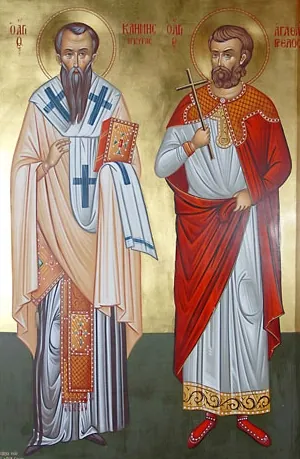
Hieromartyr Clement, Bishop of Ancyra, and the Martyr Agathangelus (+312)
The Hieromartyr Clement was born in 258 in the Galatian city of Ancyra. His father was a pagan and his mother a Christian. The upbringing of the early-orphaned child was taken on by a pious woman, Sophia. When famine was raging in Galatia, the pagans used to abandon their starving children in the streets. Sophia gathered the helpless ones, fed and clothed them. Clement stood by his God-loving foster mother: he taught the children and prepared them to receive baptism. Many of them afterwards died as martyrs for Christ.
For his pious life Clement was ordained first reader, then deacon; at eighteen he was ordained presbyter, and at twenty he was chosen Bishop of Ancyra. Soon Diocletian (284–305) began to persecute the Christians. The holy hierarch too was seized and imprisoned together with others. Domitian, the governor of Galatia, tried to turn the successor of the apostles to the worship of the pagan deities, but he courageously endured cruel torments and firmly held to his confession. They hung Clement on a tree, slashed his body with sharp knives so that even his bones showed, beat him with staves and stones, tied him to a wheel, turned it and roasted him over a slow fire. The Lord protected His chosen one and healed his wounds. At last Domitian sent the holy martyr to Rome, to Diocletian. When the lawless emperor saw Clement’s unharmed body, he did not believe that he had been tortured, and brought still more terrible torments upon him, and then shut him up in prison.
Many pagans who witnessed the martyr’s holiness and his miraculous healings believed in Christ. Those who wished for spiritual instruction or for baptism, and those afflicted with bodily illnesses, gathered in his cell; the prison became a church. Denounced by evil tongues, many of Clement’s visitors were put to death. Amazed at the holy father’s patience, Diocletian sent him to Nicomedia, to his co-ruler Maximian. On the way the hierarch’s disciple Agathangelus came aboard the ship: he too wished to die together with Clement.
The Emperor Maximian handed Clement and Agathangelus over to the governor Agrippinus, who subjected them to such savage torments that compassion for the martyrs flared up even among the pagans, and they stoned their tormentors.
Set free, the saints healed the sick by laying their hands on their heads, and baptised and instructed the pagans. At last, by Maximian’s order, they were seized again and sent to their homeland, to the city of Ancyra, where the prince of Ancyra, Curicius, tortured the confessors and then sent them to the deputy Domitius, famous for his cruelty.
In Amasea the holy martyrs were thrown into slaked lime, but after a week they came out of it unharmed. The martyrs were sent on the road to Tarsus for further torture. God revealed to Clement that he would have to suffer for Christ for another twenty-eight years; the courageous confessors were again cruelly tortured and then thrown into prison.
After Maximian’s death Agathangelus was beheaded. But Saint Clement was set free by the Christians of Ancyra and brought into a church. Here, after celebrating the Liturgy, the saint declared prophetically that the end of the persecution of the Christians was near, and that he himself would soon receive a martyr’s crown.
And indeed, a short while later soldiers burst into the church and beheaded the holy hierarch during the bloodless sacrifice (+c. 312).



