
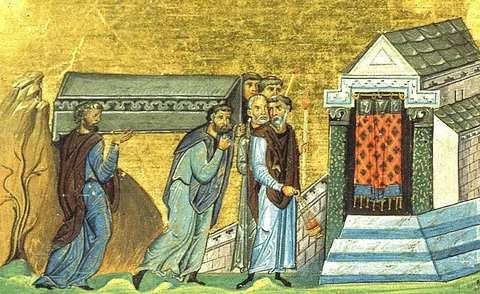
Venerable Martyr Anastasius the Persian (+628)
The Venerable Martyr Anastasius the Persian was the son of a pagan priest. As a pagan he was called Magundat, and he served in the army of the Persian King Khosrow II. In 614 Khosrow defeated the Greeks, plundered the holy city of Jerusalem, and together with countless spoil carried off to Persia the greatest holy thing, the life-giving Cross of the Lord. The great miracles worked by the power of the Cross terrified the Persians. The young Magundat was fired with the desire to learn everything about this greatest holy thing in detail, and soon he learned that the Saviour, who had become man for the salvation of mankind, had been crucified on it. In the city of Chalcedon, where Khosrow’s army was temporarily encamped, the soldier, moved by curiosity, came to know the Christian faith; he was baptised with the name Anastasius, and then took the monastic habit and spent seven years in God-pleasing labour in one of the monasteries of Jerusalem.
Saint Anastasius read the lives of the martyrs, and the desire to imitate them ripened in his heart. Once, on Great Saturday, he had a mysterious dream at night: a youth clothed in light handed him a cup full of wine with the words, “Take and drink!”, and when he had drained the cup he felt an indescribable sweetness. Anastasius took this vision as a foretelling of his martyrdom; he secretly left the monastery and went to Caesarea in Palestine. There he was seized and brought before the tribunal. The governor tried, now with threats of torture and death, now with promises of pardon and earthly good things, to turn Anastasius away from the Christian faith, but nothing could break his will. Then the blessed confessor was cruelly tortured: they beat him with staves, broke his shins, hung him up by his hands and tied heavy stones to his feet. At last the governor summoned Saint Anastasius again, and as the price of his freedom asked him only to say these words: “I am not a Christian.” But the holy martyr answered: “God forbid! Neither before you nor before others will I deny Christ, neither openly nor in secret, nor even in my sleep; no one will ever be able to force me to do this.” Then, by order of King Khosrow, Saint Anastasius was strangled (+628). After the death of the lawless king the incorrupt relics of the venerable martyr were translated to Palestine, to the monastery of Saint Anastasius.



