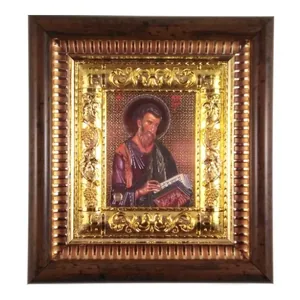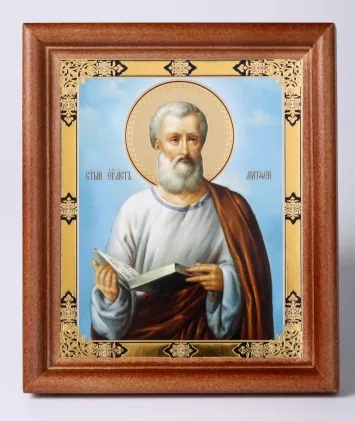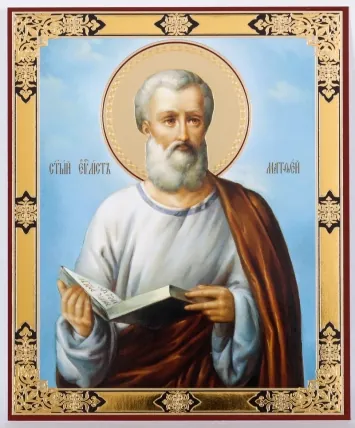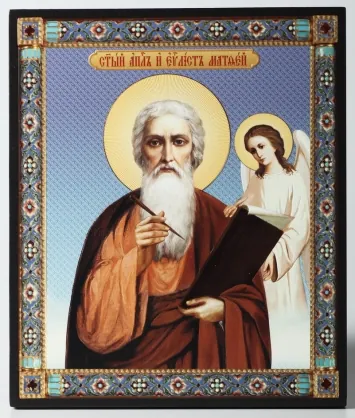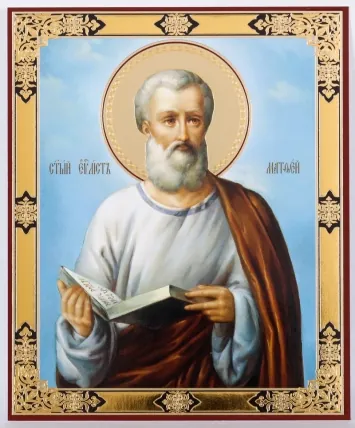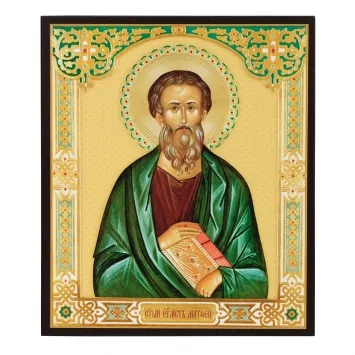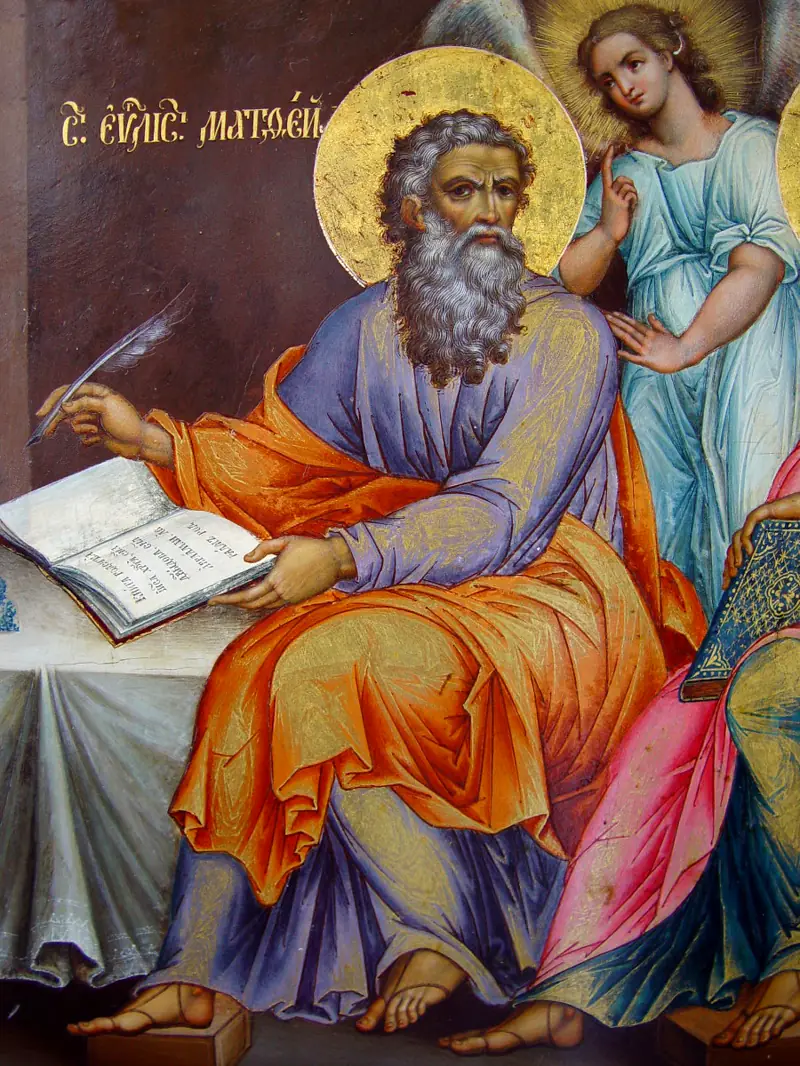
The Holy Apostle and Evangelist Matthew († 60). The Righteous Fulvian, Prince of Ethiopia, in Holy Baptism Matthew (1st c.)
The holy Apostle and Evangelist Matthew, the son of Alphaeus, lived in Capernaum, a city of Galilee. He worked as a publican, that is, a collector of taxes, and lived in some comfort. His fellow countrymen despised him like every other publican and shunned him as a man in the service of the Roman conquerors. But Matthew, though he was a sinner, was still far better than the Pharisees — those hypocritical Jews who prided themselves on their outward, pretended piety. And it was upon him, the publican despised by all, that the Lord Jesus Christ fixed His divine gaze. Once, when the Lord was in Capernaum, He went out of the city and, accompanied by a great crowd, made His way to the seashore. There, at the receipt of custom, sat Matthew. The Lord came up to him and said:
“Follow me!”
The publican Matthew heard these words not only with his bodily ears but took them into his heart as well, and at once rose from his place at the receipt of custom to leave everything and follow the Lord. Matthew did not stop to reason that the great Teacher and Wonderworker was calling him, of all people, a sinful publican despised by everyone; with his whole being he heeded the Lord’s call and followed Him without a word. At the same time he was overjoyed, and resolved to invite Jesus Christ to his house to entertain Him fittingly. The Lord did not disdain his invitation and visited Matthew’s house. That day many of Matthew’s neighbours, kinsfolk and friends gathered in his house, most of them sinners and publicans; they sat at table with our Lord and Saviour, conversed with Him and listened to Him. Some scribes and Pharisees were there too. When they saw that the Lord was not ashamed to be with sinners and publicans and to share their table, they murmured and said to Jesus’ disciples:
“Why eateth your Master with publicans and sinners?!” (Matt. 9:11).
But the Lord, hearing their words, said this:
“They that be whole need not a physician, but they that are sick. But go ye and learn what that meaneth, I will have mercy, and not sacrifice: for I am not come to call the righteous, but sinners to repentance” (ibid., 12–13).
From that time Matthew left all his possessions and estate, followed Christ, and never again parted from Him, as a faithful disciple. Soon he was counted worthy to be numbered among the twelve most chosen apostles of the Lord. With the other disciples he accompanied the Lord as He went about Galilee and Judea, listened to His divine teaching, saw the countless wonders He worked, went out himself preaching to the lost sheep of Israel, and at last became a witness of the Saviour’s Passion on the cross and of His redeeming death, and then of His all-glorious, radiant Resurrection and His Ascension into heaven.
After the descent of the Holy Spirit upon the holy apostles of the Lord, Saint Matthew at first remained with the other apostles in Palestine and preached the Gospel in Jerusalem and the country round about. But then the time came when the apostles were to leave Jerusalem and preach the word of God to the nations scattered over the whole world, to turn them to the true faith. Before Saint Matthew left Jerusalem, the Jews there who had become Christians asked him: set down for us in writing the deeds and teaching of the Lord Jesus Christ, so that we may always be able to remember them, even when you are not with us. The other apostles who were there at the time agreed to this request of the faithful of Jerusalem, and Saint Matthew set about carrying out this great work. His Gospel was written eight years after the Lord’s Ascension into heaven.
It is the earliest written of the sacred books of the New Testament (it was completed around the year 41 after the Nativity of Christ), and for that reason it holds the first place among them. The Gospel of Matthew was written in the Syro-Chaldean, that is, the Aramaic dialect of the Hebrew language, which was then the common language of all Palestine, and was intended at first for Jews who had turned to Christianity. For that reason its attention is fixed on the law and on the truth that Jesus is the true Messiah, promised by God to the patriarchs of the Hebrew people. For that reason too the Gospel of Matthew begins with the genealogy of Jesus Christ as a descendant of David and Abraham, and in general speaks chiefly of Christ’s taking flesh and becoming man. This particular character of the Gospel of Matthew is reflected also in the icons of this holy apostle, on which he is shown with a man like an angel, which symbolically characterises the Gospel he wrote.
Having left Jerusalem, the holy Apostle Matthew preached the word of God in many lands. He went with the Gospel through Macedonia (to the north of Greece), Syria, Persia, Parthia (a large country in Asia to the south-east of the Caspian Sea), Media (a country to the west of Persia, south of the Caspian Sea) and all Ethiopia, whose enlightenment with the Gospel fell to him when the apostles cast lots for who should preach the true faith where. In this country he enlightened many with the reasonable light of the Gospel, and at last came to the land of a dark-skinned people known for eating human flesh, where men were like wild beasts in their nature and behaviour. Here the holy Evangelist Matthew entered a city called Myrmene, converted a few people to faith in Christ, founded a small church for them and appointed his companion and fellow labourer Plato as their bishop, while he himself went up a mountain close by, fasted strictly and prayed earnestly to God for the conversion of this cruel, unbelieving people. And here, on the deserted mountain, the Lord Himself appeared to the holy apostle in his solitude in the form of a beautiful youth holding a staff in His right hand, and greeted His disciple. Then He handed him the staff and commanded him: go down from this mountain into the city and set up this staff at the door of the church you have founded — and He added:
“By My divine power this staff will grow into a great tree and bring forth good fruit in abundance, far surpassing the fruits of other trees in size and sweetness; washed in the water of the spring that will rise at its root, these eaters of men will gain beauty of face, and everyone who tastes the fruit of the tree will forget his beastly nature and become a kind and gentle man!”
The holy Apostle Matthew received the staff from the hands of the Lord, went down into the city and set out to do as he had been commanded. The wife and son of the prince of that city, Fulvian, were possessed by evil spirits. Mother and son happened to meet the apostle as he walked along the street, and began to cry out in savage, terrifying voices:
“Who sent you here with that staff?! Why do you want to destroy us?!”
Saint Matthew forbade the unclean spirits to cry out and drove them out. The healed mother and son bowed down to the apostle and quietly followed after him. Bishop Plato learned of Matthew’s coming and went out to meet him with his clergy. Saint Matthew came to the church and did everything just as the Lord had commanded: he set up at the door the staff he had received from Christ, which at once, before the eyes of those present, became a great tree with wide-spreading branches, laden with splendid, large and sweet fruits, and from its root flowed the water of a spring. At the sight of this everyone was dumbfounded and greatly amazed. The whole city gathered to see the miraculous tree — all ate of its fruits and drank the clear water. Meanwhile the holy Apostle Matthew stood on a raised place and preached the word of God to the townspeople in their own language. That day all believed in Jesus Christ as the true God, and the holy apostle baptised them there and then in the water of the miraculously risen spring. And indeed, according to the Lord’s word, all the eaters of men came out of the waters of baptism with beautiful faces; even their dark skin had turned white. Together with bodily purity and beauty they gained beauty of soul as well, for they put off the old man and put on the new — the Lord Jesus Christ.
When he learned of the healing of his wife and son and of the wonder that had come to pass, the ruler of the city rejoiced at first; but afterwards, at the devil’s prompting, he was filled with wrath against the apostle, because the people of the whole city were going to him and being baptised and turning their backs on their former idols. Because of this Fulvian resolved to kill him.
But that same night the Saviour appeared to Saint Matthew and told him: take courage — in the trial to come I will be at your side and will help you. The next morning, when the holy apostle was in the church with the faithful singing praise and glory to God, the prince of the city sent four soldiers to seize him. When the armed soldiers came to the Lord’s temple, darkness at once enveloped them, and in terror they barely managed to make their way back. Fulvian asked why they had not seized Matthew and brought him there. And they answered:
“We could hear him speaking, but we could see nothing. That is why we could not seize him and bring him!”
Then Fulvian grew still angrier and sent many armed soldiers to the church: bring him here by force, and if anyone resists you and defends Matthew, kill him on the spot. But these soldiers too came back put to shame; for when they drew near to the temple, a heavenly light suddenly shone upon the holy apostle, so that the soldiers could see nothing; in terror they threw down their weapons there and then and, half dead with fear, turned back to their prince to report everything. Fulvian was terribly enraged; he gathered all his subordinates and set out furiously for the church to seize the apostle himself. But when he came to the temple, as soon as he drew near to Saint Matthew he was suddenly struck blind on the spot; in terror he stumbled this way and that and begged: help me, give me a guide! And when no one dared go near him, he began to entreat the apostle: forgive me my sin and give me back the sight I have lost. Then Saint Matthew, in the sight of everyone, made the sign of the cross over the prince’s eyes, and at once his eyes were opened. But the prince’s eyes were opened only in the body, for great malice had blinded him completely: he ascribed so great a wonder not to the power of God but to sorcery. He took the apostle by the hand and led him to his house as though to do him honour, while in his heart he was craftily plotting to burn the Lord’s apostle alive as an evil sorcerer. Saint Matthew understood the evil prince’s secret design and exposed Fulvian’s treachery.
“O deceitful tyrant!” he said to the prince. “Will you soon do to me what you have planned? Do what Satan has put into your mind! As for me, as you see, I am ready to suffer death for my God!”
Then Fulvian ordered the soldiers to seize the holy apostle, throw him on the ground on his back and nail him hand and foot to a beam. When this had been done, the servants, also at the prince’s command, gathered a great quantity of brushwood and branches, brought pitch and sulphur, heaped all this upon the apostle and set it alight. But when the pyre was blazing high and everyone thought Matthew had been completely burned, suddenly the fire died down and went out, and the holy apostle appeared alive, unharmed and glorifying God the Creator. But at the sight of this Fulvian grew still more furious. He would not acknowledge in what had happened the power of God, which had kept Christ’s holy preacher alive and brought him through the fierce fire entirely unharmed. Fulvian brought unjust charges against Saint Matthew and called him an evil sorcerer and magician.
“By his evil sorcery Matthew has put out the fire!” he said to the people. “And by his magic he has stayed alive!”
Then he ordered his servants to bring still more firewood, branches and brushwood, heap them on Matthew and set them alight, and pour pitch over them from above. Besides this, he had his twelve golden idols brought and set up around the pyre, so as to undo Matthew’s “magic” by them; he himself stood right by the blazing pyre and called upon his “gods” for help: let Matthew not escape the scorching power of the fire, let him be turned to ashes! But the holy apostle, even in the flames, prayed to the Lord of powers and dominions that He would show the people gathered there His invincible almightiness, make plain the utter powerlessness of the pagan idols, and put to shame the foolish men who trusted in them.
And suddenly the flames rushed with a terrible roar upon the golden idols, and they melted at once like wax in the heat of the fire; the fire burned many of the pagans standing there as well; and from the melted idols a flame burst forth in the shape of a serpent and flew toward Fulvian. The stunned prince could not run and so escape the danger. He fell helpless to the ground and turned to the holy apostle with humble entreaty: save me from destruction! And indeed, as soon as Saint Matthew rebuked the fire, it died down at once, and the serpent-shaped flame vanished. Then Fulvian wished to bring Matthew out of the fire with honour. But the holy apostle said a prayer and gave up his holy soul to the Lord (this happened around the year 60 after the Nativity of Christ).
Then Prince Fulvian ordered a golden bier to be brought and the precious body of the holy apostle, which the fire had left entirely unharmed, to be laid upon it; then he had it clothed in costly garments, raised it up with his nobles and carried it into the palace. Yet he had not yet gained perfect faith, and so he ordered an iron chest to be forged, sealed on every side with molten tin, and thrown into the sea. At the same time he said to his nobles:
“If He who kept Matthew unharmed from the fire will also keep him from sinking in the water, then let us believe that He is the true God, let us worship Him and turn our backs on all our ‘gods’, which could not even save themselves from destruction in the fire!”
After the iron chest with the apostle’s precious relics had been thrown into the sea, Saint Matthew appeared by night to Bishop Plato and said to him:
“Tomorrow come to the seashore, to the east of the prince’s palace, and there you will find my relics, cast up on the land!”
In the morning the bishop, with a great multitude of the faithful, came to the place named, and there indeed found the iron chest with the precious relics of the holy apostle, just as had been made known to him in the vision.
Prince Fulvian too learned of this and came to the seashore with his nobles. This time he believed in our Lord Jesus Christ finally and completely, and confessed in the hearing of all that He is the one true God, who had kept His servant Matthew unharmed both in life, from burning in the fire, and after death, from vanishing in the depths of the sea. With tears in his eyes he kissed the chest in which the holy relics lay, and begged forgiveness both for his former sins and for having insulted and tormented the apostle himself; and at the same time he expressed his fervent desire to receive holy baptism. Bishop Plato, seeing Fulvian’s faith and zeal, prepared him for baptism, instructed him in the true faith, and then baptised him. And when he laid his hand upon the newly baptised man to give him a new name, suddenly a voice was heard from on high, saying:
“Call him not Fulvian, but Matthew!”
And indeed, having received in holy baptism the name of this apostle of the Lord, the prince of the city always strove to imitate his life: soon he handed over his princely authority to another, renounced all worldly cares entirely, and gave himself wholly to prayer in the church of God. For this he was counted worthy to be ordained a presbyter by Bishop Plato. And three years later, when the hierarch Plato died, the holy Apostle Matthew appeared in a vision to the former prince, now a presbyter of the Church of Christ, and gave him to understand that it was he who must take the episcopal throne after the blessed Plato.
And indeed Matthew accepted the episcopate and laboured well in proclaiming the faith: he led many away from the darkness of idol-worship and brought them to the true God; and at last, after a long life pleasing to God, he too departed to the Lord, and now with the holy Apostle and Evangelist Matthew he stands before the throne of God and entreats the Lord for us, that we may all become heirs of His eternal Kingdom and glorify Him for ever, with the Father and the Holy Spirit. Amen.
The Lives of the Apostles of Our Lord Jesus Christ, Tbilisi, 2004.
The Pharisees were one of the Jewish sects, which arose in the third to second centuries before the Nativity of Christ. The word itself means “special”, “separated”, “set apart”, and they received this name because they strove to distinguish themselves above others by zealous keeping of the law. In the course of time, as additions to and interpretations of the law, the Pharisees compiled a great many traditions, chiefly concerning the outward, ritual side of the law; they gave these traditions divine significance and put them on a level with the law of Moses. Little by little the Pharisees formed a special community, that is, took shape as a separate sect, and, the better to keep the traditions just mentioned, avoided contact with the rest of the Jewish people as their inferiors. The people too looked on them as special men, strict keepers of the divine law, who supposedly laboured to preserve faith and piety among the people, and honoured them greatly. But under the cloak of outward piety and zeal lay hidden an outrageous hypocrisy, indifference, heartlessness and immorality, which was plainly expressed in the Lord’s words of rebuke. The Pharisees did not receive the promised Messiah, the Lord Jesus Christ, and crucified Him. In modern times the sect of the Pharisees, in the opinion of some scholars, took the name of Hasidim.
Among the Jews the name of scribes was given in general to the most well-read and educated people, who explained the law to the people and publicly taught and instructed them — that is, these were the so-called rabbis (teachers) and teachers of the law; the name of scribes was given also to men learned in the law, whose task was to settle disputed questions and doubtful cases and matters, which required both knowledge of the law and practical experience; scribes too were the writers and notaries who served in the synagogues and the sanhedrins. These learned Jews appear in the New Testament as a distinct class, different from the Pharisees; but they often join with the Pharisees and are connected with the high priests. Most of the scribes were guided by tradition alone and did not understand the spirit of the divine law; therefore they interpreted the law falsely and were blind guides of the people, who kept the divine commandments hypocritically, only for show before others and to receive the glory of men.