
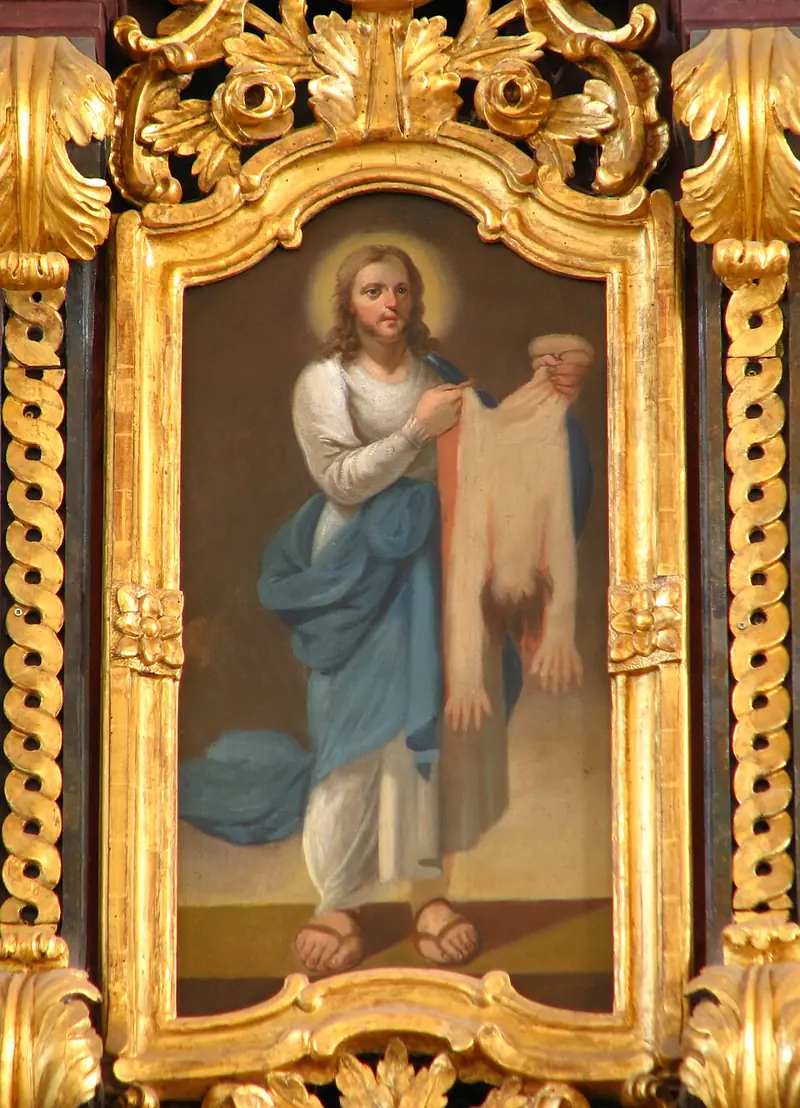
The Holy Apostle Bartholomew (1st c.)
The Holy Apostles Bartholomew and Barnabas (1st c.). The holy Apostle Bartholomew, one of the Twelve, was from Cana of Galilee. After the descent of the Holy Spirit upon the Lord’s disciples it fell by lot to him and to the Apostle Philip (commemorated on the 14th of November) to preach the Gospel in Syria and Asia Minor. Saint Philip was accompanied by his sister Mary. As they travelled through Syria and Mysia the Lord’s chosen ones had to endure many hardships and trials.
In one village the saints met John the Theologian and went with him to Phrygia. In the city of Hierapolis, by the power of prayer, they put to death a huge viper which the pagans worshipped as a god.
The preaching of the holy apostles was confirmed by many signs and wonders.
In Hierapolis there lived a man named Stachys, who had been deprived of his sight for forty years. The apostles’ prayer restored his sight. Overjoyed, Stachys believed in Christ and was baptised. The report of this wonder spread through the whole city, and crowds of people always stood at the house where the apostles were staying. Pagans freed from ailments of body and soul were baptised and glorified the true God. The enraged pagan priests brought a complaint before the court. The governor of the city ordered the preachers to be seized and locked in prison, and the house of Stachys to be burned. The Lord’s chosen ones were sentenced to crucifixion. The Apostle Philip was nailed to the wood head downward. Suddenly the earth shook terribly, the ground split open and swallowed the ruler and part of the crowd. The terrified people began to take the apostles down from their crosses. Bartholomew was saved, but Philip died under torture. After appointing Stachys bishop of Hierapolis, the Apostle Bartholomew and the blessed Mary left the city.
After this Mary went to Lycaonia, preaching the word of God, and there gave up her soul to the Lord in peace (commemorated on the 17th of February). The Apostle Bartholomew went to India, translated the Gospel of Matthew from Hebrew into the local language and converted many pagans to Christianity; he was also in Greater Armenia, where he worked many wonders and healed the possessed daughter of King Polymius. The grateful sovereign sent the apostle gifts, but the saint refused to accept them: I labour only for the salvation of men’s souls. Then Polymius was baptised together with the queen, the healed princess and many nobles. Many inhabitants of Greater Armenia followed their example. At the prompting of the priests, who were alarmed by this, the king’s brother Astyages seized the apostle and crucified him head downward in the city of Alban (present-day Baku). Drawing near to his end, the Lord’s chosen one did not stop preaching the Gospel. Then the enraged Astyages ordered that the blessed one first be flayed and then beheaded. The faithful laid his body in a coffer and buried it. Around the year 508 the incorrupt relics of Bartholomew were translated to Mesopotamia, to the city of Dara. When the Persians took the city in 574, the Christians took the apostle’s relics and set out for the Black Sea coast, but on the way enemies overtook them and they were forced to let the coffer down into the sea. By the will of God the holy relics floated to the island of Lipari. In the ninth century the Arabs took this island, and the incorrupt remains were translated to the Neapolitan city of Benevento. In the tenth century part of the holy bones was translated to Rome.
The holy hierarchs John Chrysostom, Cyril of Alexandria, Epiphanius of Cyprus and some other fathers of the Church identify Bartholomew with Nathanael (John 1:45–51; 21:2).



