
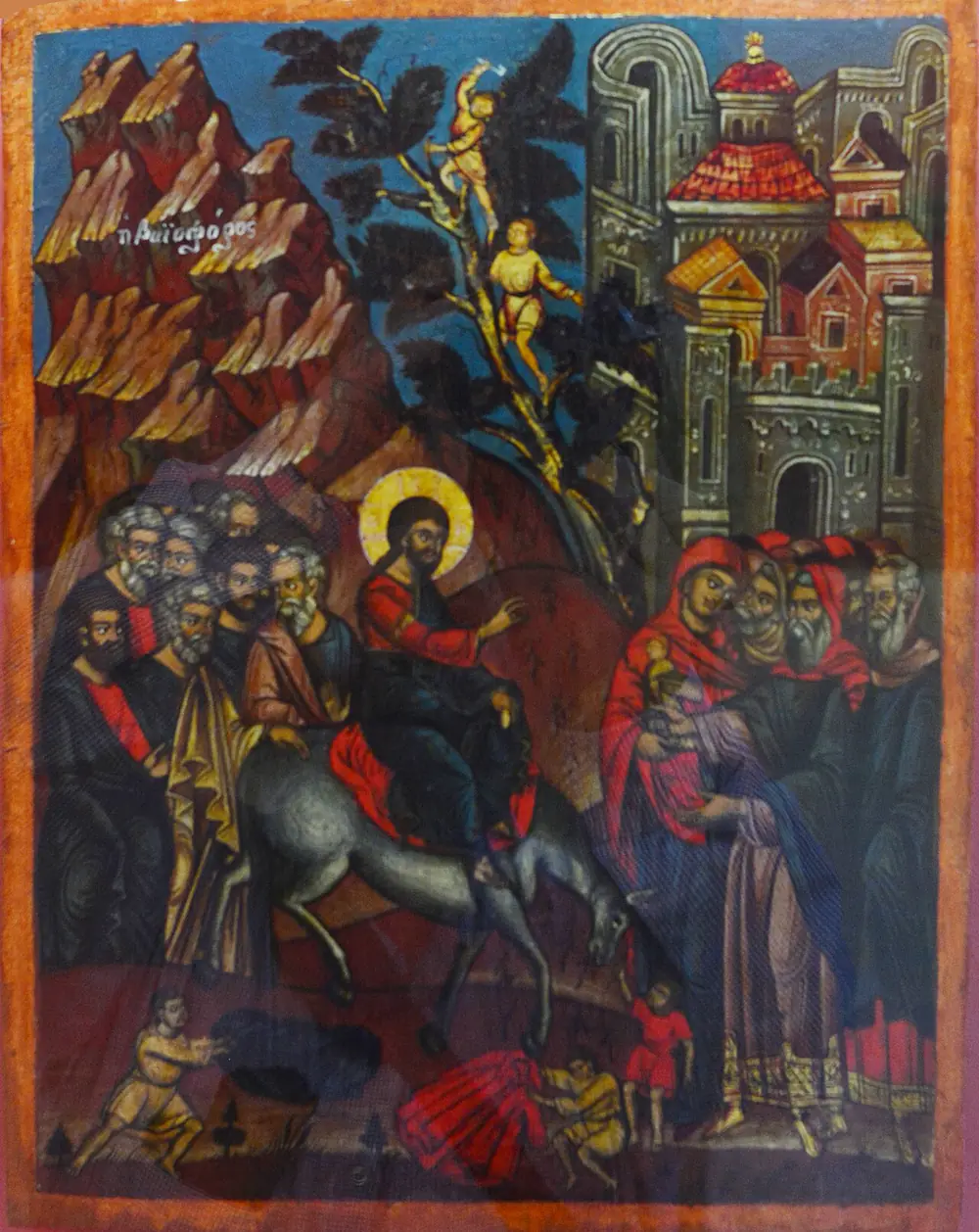
Palm Sunday — the Entry into Jerusalem
On the sixth Sunday of Great Lent the Orthodox Church celebrates the Saviour's glorious entry into Jerusalem, which Christians call Palm Sunday. It is the first of the moveable feasts among the Twelve, and always falls on the Sunday before bright Easter.
“…much people that were come to the feast, when they heard that Jesus was coming to Jerusalem, took branches of palm trees, and went forth to meet him, and cried, Hosanna: Blessed is the King of Israel that cometh!” — so John the Evangelist describes the Saviour's glorious entry into Jerusalem.
The Saviour's entry into Jerusalem was like the entry of a victorious king into his royal city. Simple people arranged a solemn welcome for the Lord. No one had prepared this celebration beforehand; it was a sudden and, one may say, God-inspired expression of the holiest and most sincere feelings of men. So it is when a man rejoices at the majesty of God and at His wondrous works.
At the same time the Holy Gospel makes plain that our Lord Jesus Christ always shunned earthly honour and glory. He covered Himself with humility and meekness against the grandeur of this world.
When the Saviour drew near to Bethphage and Bethany, at the mount called the Mount of Olives, He sent two disciples into the village nearby to bring Him an ass tied at the very entrance, and a colt whereon no man had yet sat. The apostles did as they were bidden. All this came to pass that the prophecy of Zechariah might be fulfilled: “And Jesus, when he had found a young ass, sat thereon; as it is written, Fear not, daughter of Sion: behold, thy King cometh, sitting on an ass's colt” (John 12:14–15).
The people going up in glory to Jerusalem spread their garments in the way, and others held branches of palm (box) and so went to meet the Saviour. On every side the cry was heard: “Hosanna to the Son of David: Blessed is he that cometh in the name of the Lord; Hosanna in the highest” (Matthew 21:9).
With the beauty of box or palm the Church shows forth more vividly the Lord's glorious entry into Jerusalem. This is a tradition of long standing. St Proclus, Archbishop of Constantinople, a churchman of the fifth century, says in one of his homilies: “Let us take palm branches in our hands and go out to meet our Lord, who comes in glory.”
And God asks each of us to go out and meet Him in spirit: instead of garments to spread our hearts before the King seated on the colt, to bring Him fervent prayer and worship like branches of box, and to receive the Lord into our own soul as He was received in Jerusalem.
By His glorious entry into Jerusalem the Lord gave the faithful a way to show their love, and those who hated Him and His enemies a way to know Him and turn in repentance.
Prepared by Shalva Kekelia, the journal Karibche, April 2004
In the name of the Father, and of the Son, and of the Holy Spirit.
Solemn, brethren, was the Saviour's last journey to Jerusalem. He sat upon an ass and was surrounded by a sea of people, like a king and lord. The many who had come to the Holy City for the feast, hearing that Jesus had appeared, came out with branches of trees to meet Him. Some went before Him, others followed the Saviour; some joyfully spread their garments in the way before Him, and others branches of trees. Not only the grown-ups but the little children too were filled with a particular joy. With cries of hosanna and hurrah they met the King of the Jews: “Hosanna to the Son of David! Blessed is he that cometh in the name of the Lord! Hosanna in the highest” (Matt. 21:9).
Yet despite so solemn a welcome, as the Evangelist Luke says, when Jesus drew near the city He “wept over it” (Luke 19:41). What, brethren, can such an act of the Lord mean? What made Him alone weep, when all around Him were seized with joy? Did the warmth and honour that the Jews showed Him at their meeting not gladden Him?
The people of Jerusalem did indeed go out to meet Jesus Christ as the King of Israel. They met Christ as an earthly ruler and not as the Messiah. The Jews thought that Christ, once seated on David's throne, would first free them from bondage to the Romans, then make them masters over other peoples too and bring them countless earthly riches and honour. Such was the king Jerusalem went out to meet. How often in His earthly ministry the Lord tried to scatter this false notion among the Jews, but the people could not imagine any other king and deliverer. The Lord knew this and grieved over it. While some solemnly welcomed the Son of God as their own king, others — His opponents, the scribes and Pharisees — were set against Him with still greater hatred and sought a fitting moment to kill Him. The Lord also sensed that this rejoicing people, now crying hosanna and hurrah, would in a few days abandon Him entirely and take the side of His enemies. Jesus knew that the people who solemnly met Him as the King of Israel would, a few days later, give up that same King to torment and death on the cross.
Jesus Christ looked further still: He foresaw how the enemies of the Jewish people, the Romans, would encircle Jerusalem and turn it into ruins, because the Jews would not know Christ as their deliverer and Saviour and would give Him up to be killed. Therefore He said: “If thou hadst known, even thou, at least in this thy day, the things which belong unto thy peace! but now they are hid from thine eyes” (Luke 19:42). The Lord knew all this, and so He wept. For all the solemn welcome and the joy, the Lord saw everything that lay hidden in their hearts. The Lord perceived not only what was happening before His eyes, but also what was being prepared against Him in that same city and what awaited that city in the future.
Today, beloved, we too celebrate the glorious entry of Christ the Saviour into Jerusalem; today we too go out with branches of box to meet Him as our deliverer and Saviour, and like the rejoicing people of Jerusalem we too cry out to Him: “Hosanna in the highest, blessed is he that cometh in the name of the Lord.”
But, as with the rejoicing people of Jerusalem, perhaps some even today imagine Christ as a mighty earthly king. Many even today turn to the Lord only to beg some earthly good of Him. Yet chasing after the earthly alone, as we know, lost the Jews a far greater good — the promised Kingdom of God.
Therefore I pray and beseech you, beloved: let us go out with branches of box to meet our Lord as our spiritual deliverer and Saviour; let us go out to meet the Lord as the giver of eternal life, prepared in heaven for the righteous, and let us sing solemnly: “Hosanna in the highest, blessed is he that cometh in the name of the Lord.”
1984, Svetitskhoveli
Today is one of the greatest Christian feasts — the glorious entry of Jesus Christ into Jerusalem. In the course of His earthly life Jesus Christ entered Jerusalem many times, but this was a particular entry, a solemn entry through the Golden Gate. The wall that guarded Jerusalem had several gates, and one of the chief of them was the Golden Gate. It still exists. When I was in Jerusalem I visited this gate as well. It must be some five metres wide. Today it is walled up, and, as the holy fathers say, it will be opened at the Second Coming.
In the Gospel we read that when the Lord entered the city by this gate, all Jerusalem was moved and poured out to meet Him. With one voice they cried out and glorified Jesus Christ; never before had so glorious a welcome been given in Jerusalem to any king or any Caesar. The people spread not only green branches but even took off their garments and spread them before the ass on which the Lord sat. The branches of box that you now hold in your hands are a sign that you too joyfully meet the Lord, who comes to us and will remain with us if we ourselves desire it; for where there is faith, prayer, forgiveness and love, there the Lord is too.
On this blessed day I wish to draw your attention to one fact. When the whole people glorified the Lord and met Him so, Jesus Christ, instead of being filled with joy, wept. He wept because He knew the nature of man; He knew that the same people who welcomed Him in triumph would, only three or four days later, demand that He be nailed to the cross. He wept not for Himself but for this people, because it had not seen the light that was in its midst and had rejected the grace and mercy given by God.
I wish to remind you of the Epistle read today. The Apostle Paul writes in his Epistle to the Philippians: Rejoice in the Lord alway: and again I say, Rejoice (Phil. 4:4). These are wonderful words, holding a very great mystery: rejoice alway — that is, not only today but always; not only here on earth, but here and there as well, in that other world. Rejoice alway in the Lord — that is, your joy will be unending and eternal if it is granted by the Lord, if it rests on faith in the Lord and love for Him.
“Rejoice” is, after all, not an earthly greeting but a heavenly one. You remember that when, at the Lord's command, the Archangel Gabriel appeared to the All-holy Mother of God, the first word with which he addressed her was “Rejoice”. Rejoice, Mary, full of grace, the Lord is with thee. That is when a man truly rejoices — when the Lord is with him. You will probably answer me: surely there is earthly joy too. Of course there is, and the Lord does not reject it; but the difference is that earthly joy is momentary and passing, while joy from the Lord is eternal. That is why the Apostle Paul says: Rejoice in the Lord alway. A fine house or a precious thing may gladden you for a day, two days, a month, but then the joy slowly cools and at last vanishes altogether. The same is true of the joy that the fulfilment of some long-held earthly dream gives us. You will ask me how we are to gain the eternal joy of which the Apostle Paul speaks. The Apostle himself teaches us the way to gain it when, in the same Epistle, he calls us: Finally, brethren, whatsoever things are true, whatsoever things are honest, whatsoever things are just, whatsoever things are pure, whatsoever things are lovely, whatsoever things are of good report, whatsoever is virtuous and whatsoever is praised — so, if we clothe ourselves in these qualities, in honesty, righteousness, purity and virtue, the Lord will be with us; and if the Lord is with us, then joy too will be with us. For joy flows from love. Whoever cannot love will not know joy either. Let us take an example even from earthly life. When you love someone, you want to be with them without parting, and at such a time you remember no one and nothing else. How much more lovable and gracious is the Lord, who is Himself the supreme Love. So, if God is with us, eternal joy will be with us too. It is precisely this joy that mankind today lacks, because it has lost faith and love. If it regains faith and love, joy too will return to it.
I ask our Lord Jesus Christ that we may not lose the faith and love with which He has endowed our blessed nation; I ask that He bring a happy Easter to the whole world and to all Georgia.
I wish especially to pray for the Georgians who live abroad and long for their native land. May God have mercy on you all and turn your enemy into a friend and your mourning into joy.
I remind you that the one week remaining before Easter is called Holy Week. Whoever has not fasted all this time would do well to fast at least this one week. On Monday, Tuesday and Wednesday the Liturgy of the Presanctified will be served; on Thursday there will be the Anointing with oil, which is one of the seven sacraments. It is a particular sacrament, performed rarely, once a year. As the holy fathers teach us, it is for the saving of soul and body, for a man is forgiven the sins he forgot to name at confession. After the anointing, at ten o'clock, the Liturgy will begin, for this is the day on which we remember the Mystical Supper. You remember that on this day the Lord instituted Communion and gave His apostles Communion for the first time. So try not to remain without Communion yourselves. After the Liturgy the Washing of the Feet will be performed.
On Thursday evening there will be Matins, at which the 12 Passion Gospels will be read. On Friday morning the Hours will begin, and at 2 o'clock the bringing out of the Shroud. On Saturday morning the Liturgy will be served, and at midnight the Midnight Office and the Paschal procession.
May God grant a happy and joyful Easter to you and to all Georgia, amen!
1 May 1983



