
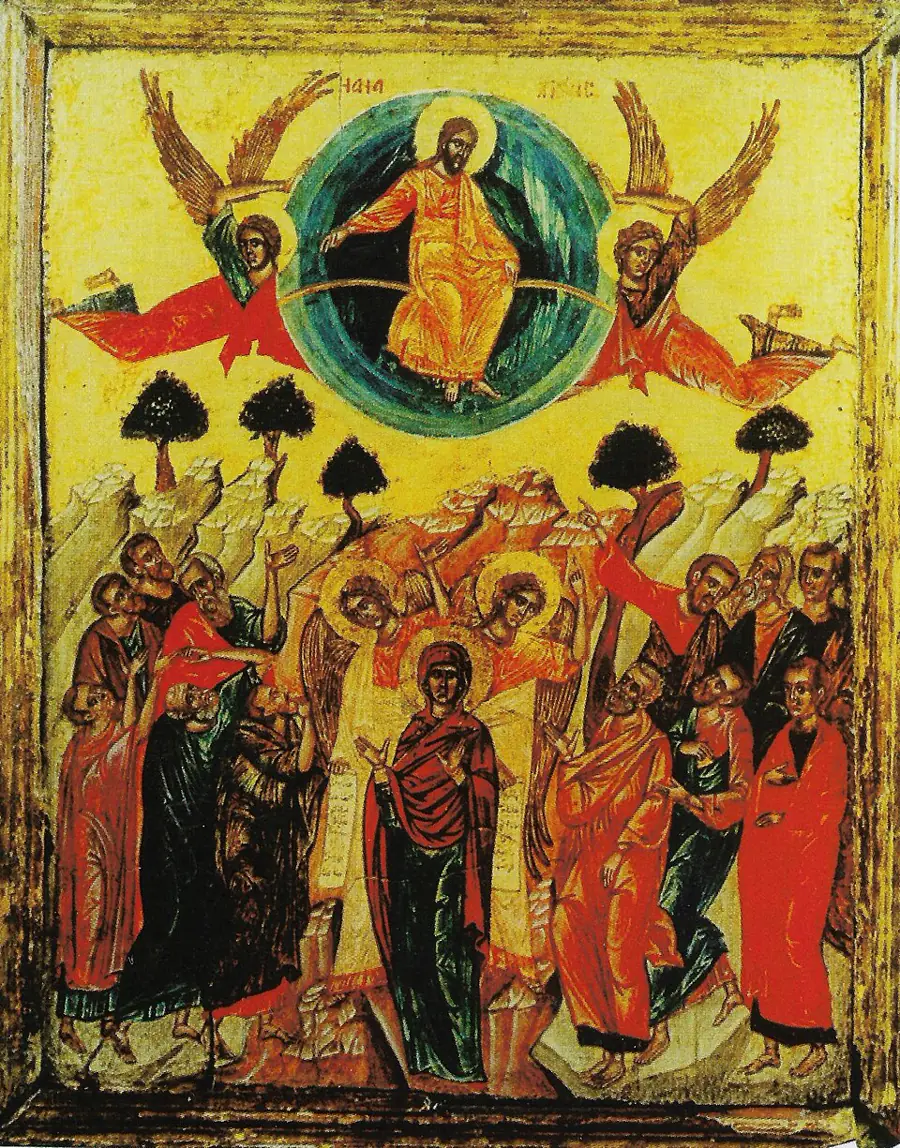
The Ascension of our Lord Jesus Christ
Thou hast ascended in glory, O Christ our God, and gladdened Thy disciples with the promise of the Holy Spirit, confirming them by that blessing: for Thou art the Son of God, the Redeemer of the world.
Thou who art seated upon the wings of the cherubim hast ascended on a cloud to the heaven of the east, and saidst to Thy disciples, O Saviour: I will not leave you orphans; I will come to you in the Spirit and be inseparable from you, who hast granted the world great mercy.
● St Gabriel (Kikodze) the Hierarch, a word on the day of the Ascension
● St Gabriel (Kikodze) the Hierarch, a word upon the Ascension
● St Gabriel (Kikodze) the Hierarch, a teaching for the day of the Ascension
● Catholicos-Patriarch Leonid (Okropiridze), a word on the day of the Ascension of Jesus Christ
● Ilia II, Catholicos-Patriarch of All Georgia, a sermon for the feast of the Ascension (2009)
● St Nikolai of Serbia (Velimirović), on the Ascension of the Lord
On the fortieth day after Pascha, the Thursday of the sixth week, the Orthodox Church celebrates the Ascension of the Saviour. As the holy Gospel tells us, for forty days after the radiant Resurrection Christ appeared to His disciples and spoke to them of the Kingdom of God. In the words of John Chrysostom, He taught the disciples “the mysteries of the Kingdom”, which before the Saviour's resurrection had been beyond their understanding and beyond their reach.
On the fortieth day after the Resurrection, the disciples, having returned from Galilee to Jerusalem, gathered in one house. There the Saviour appeared to them and promised those assembled that He would soon send them the Holy Spirit, and commanded them not to depart from Jerusalem.
As He spoke with the disciples, Christ led them out towards Bethany, to the Mount of Olives; then He lifted up His hands to heaven and blessed those gathered. As He blessed them He was parted from them little by little and began to ascend into heaven, and in a short while He was hidden in the clouds.
While the disciples were looking up into heaven, two men appeared to them in white apparel and said to them: “Ye men of Galilee, why stand ye gazing up into heaven? This same Jesus, which is taken up from you into heaven, shall so come in like manner as ye have seen him go into heaven” (Acts 1:11). The disciples returned to Jerusalem with joy, awaiting the Holy Spirit; they were in prayer without ceasing, glorifying and thanking God.
The meaning of the Saviour's Ascension may be considered from several sides.
The first is the ontological side of the event: the Son of God took human nature, raised it to heaven and made it a partaker of divine glory. In the words of John Chrysostom, the Lord's ascension made man like the angels, joined man to the ranks of the bodiless powers, and settled in heaven one who was not worthy even of the earth. The nature of men, from which the cherubim guarded paradise, became higher than the cherubim themselves. By the ascension of Jesus Christ into heaven, heaven and earth were joined and the heavenly reconciled with the earthly. In the Ascension the prophecy of the Old Testament was truly made manifest: “God is gone up with a shout, the Lord with the sound of a trumpet” (Ps. 46:5); and after the Ascension, in the words of the Apostle Paul, “our conversation is in heaven” (Phil. 3:20).
The Lord's Ascension has an eschatological meaning as well, for the Ascension was the end of Christ's earthly life, while His second coming will be the end of mankind's earthly existence. The Ascension has a moral meaning too. We must remember that we belong not to the earth alone but to heaven also; that we belong both to time and to eternity, both to matter and to spirit; and that in this earthly life we must rise above all that is earthly and low.
In the Symbol of Faith (the Creed) we read: “And ascended into heaven, and sitteth at the right hand of God the Father.” What do these words mean? Is not God beyond time and space? How are we to understand this anthropomorphic metaphor? When an emperor chose a co-ruler, or when his son came of age, a particular rite was performed: the enthronement. In the hall of the palace two thrones were set. On one sat the emperor, and on the other, at his right hand, the co-ruler. To sit at the right hand meant a dignity and a power equal to the emperor's. These words, then, point to the equal power of God the Father and God the Son. This image makes the value of the Ascension plainer still: in the person of the God-man, all mankind was given the possibility of an ascent of the spirit that has no end.
Christ ascended into heaven with His hands outspread in blessing. The disciples standing by the Mount of Olives were the first Christian Church. Filled with love and hope, this scene is a sign and a promise that the blessing of God abides in the Church for ever.



