
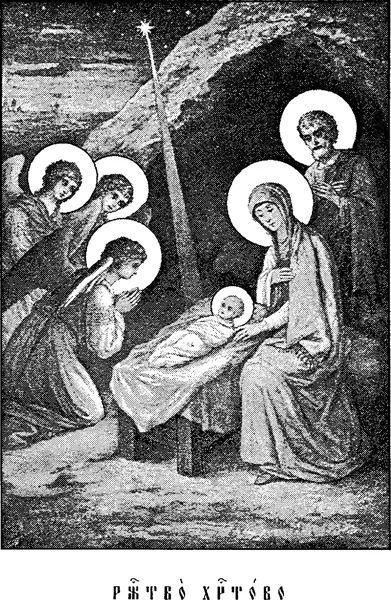
The Nativity according to the Flesh of Our Lord God and Saviour Jesus Christ
The Saviour of the world, our Lord Jesus Christ, was born of the Most Holy Virgin Mary in Bethlehem of Judaea in the time of the Emperor Augustus Octavian. In those days a decree went out that the population of the whole Roman Empire, of which Palestine was one province, should be registered. The Jews had the custom of holding general censuses by tribes and families. Each tribe and family had its own towns and places connected with the names of the patriarchs. Since Mary and Joseph were descendants of King David, they went for the census to the city of David, Bethlehem of Judaea. When Mary and Joseph arrived in Bethlehem, there was no free place for them in any inn, and they were forced to take refuge in a cave on the edge of the town, which served as a shelter for cattle in bad weather. In this cave, on the hay and straw strewn about as fodder and bedding for the cattle, on a cold winter night, the Saviour of the world was born. The Most Holy Theotokos herself wrapped in swaddling clothes the Child born without pain, and laid Him in a manger, “because there was no room for them in the inn” (Luke 2:7). In the midnight stillness, nearby, in the countryside, shepherds were “abiding in the field, keeping watch over their flock by night”. It was to them first that the angels announced the good news that the Deliverer had become man: “Fear not: for, behold, I bring you good tidings of great joy, which shall be to all people. For unto you is born this day in the city of David a Saviour, which is Christ the Lord” (Luke 2:10–11). The shepherds worshipped the newborn Child with their hearts and with true faith. After them, guided by an unusual newly shining star, “there came wise men from the east to Jerusalem ... to worship Him” (Matt. 2:1–2), and when they saw the Child Saviour, “they fell down, and worshipped Him: and when they had opened their treasures, they presented unto Him gifts; gold, and frankincense, and myrrh” (Matt. 2:11): gold as to a King, frankincense as to God, and myrrh as to a man.
The Church has celebrated the feast of the Nativity of Christ since the first century. In the Apostolic Constitutions we read: “Let them keep the feast of the Nativity as a holiday, for it gives men joy through the birth of God the Word from the Virgin Mary for the salvation of this world.”
Since the fourth century both the Eastern and the Western Churches have celebrated the Nativity of the Saviour on 25 December.



