
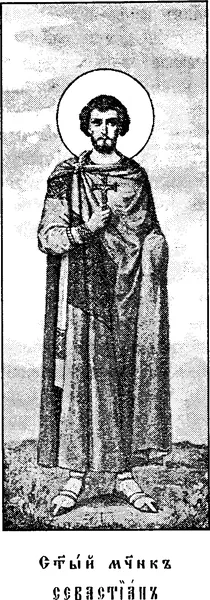
Holy Martyrs Sebastian and His Companions: Nicostratus, His Wife Zoe, Castor, Tranquillinus the Presbyter and His Sons Marcellinus and Mark the Deacons, Claudius the Jailer, His Son Symphorian and His Brother Victorinus, Tiburtius and Castulus (+c. 287)
The holy Martyr Sebastian was born in the Gallic city of Narbonne and was educated in Mediolanum. In the time of the co-ruling Emperors Diocletian and Maximian (284–305) he commanded a detachment of the palace guard. The valiant and wise Sebastian was greatly loved and respected by all. He confessed the Saviour in secret and laboured much to help his brothers in Christ. The Christian brothers Marcellinus and Mark, who were shut up in prison, at first confessed Christ courageously; but the tearful entreaties of their pagan parents, Tranquillinus and Marcia, and of their wives and children cooled their desire to suffer for Christ. Then Saint Sebastian went to the house of Nicostratus, the royal treasurer, where the Christian brothers, released from prison, were staying. Shining with divine grace, he strengthened them and again awakened in them the desire for a martyr’s end. His words also moved those who were present. They clearly saw the saint’s face shine with an unearthly light, and then seven angels came to him and clothed him in a spotless garment. Nicostratus’s wife Zoe, who had been dumb for six years, fell at the saint’s feet, bowed down to him, and was healed. Zoe said that she had seen an angel with an open book, from which Sebastian was reading his preaching.
Nicostratus and his wife asked for baptism. Saint Sebastian advised Nicostratus to arrange for as many people as possible to be baptised. Then the latter asked Claudius, the chief of the prisons of Rome, to send all the prisoners to his house. In talking with the prisoners Sebastian became convinced that all of them were worthy of baptism, and he summoned the presbyter Polycarp. Father Polycarp instructed the catechumens, appointed them a fast, and decided to celebrate the holy Mystery in the evening.
Meanwhile Claudius informed Nicostratus that Agrestius, the eparch of Rome, was summoning him to find out why the prisoners had been transferred to his house. Nicostratus told Claudius of his wife’s healing, after which the latter brought his son Symphorian, tormented by illness, to Sebastian. In the evening Saint Polycarp baptised Marcellinus, Mark and their father Tranquillinus, Nicostratus with his family, Claudius and his sons, and, besides them, sixteen condemned men. Tranquillinus was by then very old and ill. Before baptism Polycarp asked him: “Do you believe that the Only-begotten Son of God, the Lord Jesus Christ, can restore your health and forgive your sins?” Tranquillinus replied: “I believe that Christ, the Son of God and Lord, can do all things; but I ask only one thing of Him, the forgiveness of my sins, and I do not even think about my illness.” As soon as the Mystery of baptism began, Tranquillinus was completely healed.
Standing before the eparch, Nicostratus told him how Sebastian had converted them to the faith of Christ. Nicostratus’s words shook Agrestius’s belief in the pagan deities too. He summoned Saint Sebastian and the presbyter Polycarp, listened to their instruction, after which he confessed Christ and was baptised. Together with the eparch his whole household was baptised, among them his son Tiburtius. The number of the newly converted rose to one thousand four hundred. On the Christians’ advice Agrestius resigned the office of eparch. At that time the Bishop of Rome was Saint Gaius (afterwards, in 283–296, Pope of Rome; commemorated 11 August); he blessed Agrestius to go with Polycarp to his estates, together with those Christians who did not have the strength for martyrdom. Agrestius’s son Tiburtius wished to shed his blood for Christ and stayed in Rome with Saint Sebastian. With them there also remained the hierarch Gaius, the presbyter Tranquillinus, the deacons Marcellinus and Mark, Nicostratus, his wife Zoe and his brother Castor, Claudius, his son Symphorian and his brother Victorinus. The saints gathered in the imperial palace at the house of a rich secret Christian, Castulus, and began to prepare for a martyr’s end.
The pagans seized Zoe first. They threw her into prison, tortured her for six months, and then hung her up by her hair, choked her with foul smoke and threw her into the River Tiber. The lamb of Christ appeared to Saint Sebastian in a divine vision and told him of her end. After the blessed Zoe the presbyter Tranquillinus was martyred: the pagans stoned him at the tomb of the Apostle Peter, and then threw his holy body too into the Tiber. Saints Nicostratus, Castor, Claudius, Victorinus and Symphorian were seized on the river bank while they were searching for the bodies of the martyrs. The Lord’s chosen ones were brought to the eparch. The godless ruler demanded that they offer sacrifice to the idols, and when he received a firm refusal in answer, he drowned them all in the sea with stones tied round their necks. Saint Tiburtius was betrayed by a false Christian, Torquatus. The judge could not persuade the handsome youth to deny Christ, after which he ordered him to be made to stand on red-hot coals. The Lord protected His chosen one: Tiburtius walked on the coals without feeling any heat at all. At last the executioners beheaded him.
The holy deacons Marcellinus and Mark and the noble courtier Castulus were also betrayed by Torquatus. After torture Castulus was thrown into a pit and buried alive, while Marcellinus and Mark, after cruel tortures, were run through with a sword.
At last Saint Sebastian too was led out to torture. The Emperor Diocletian questioned him in person, and when he was convinced of his firmness, had him taken out of the city to be put to death. There the holy martyr was tied to a tree and shot with arrows. Irene, the wife of the nobleman Castulus, went out at night to bury Sebastian, but found him alive and took him to her house. The saint soon recovered completely. The Christians asked Sebastian to leave Rome, but he was still zealously seeking death for Christ. Burning with the desire for martyrdom, the presbyter noticed the emperor on his way to a pagan temple and publicly denounced his lawlessness. Diocletian ordered the blessed one to be taken to the hippodrome and put to death. The executioners beat him until he gave up his soul, and then threw him onto a rubbish heap. The holy martyr appeared in a vision in her sleep to a Christian woman, Lucina, and commanded her to take up his body and bury it in the catacombs. The pious mother reverently carried out the saint’s bidding.



