
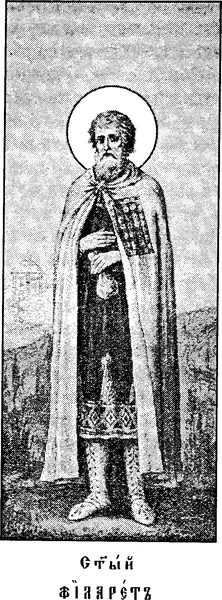
Righteous Philaret the Merciful (+792)
The righteous Philaret the Merciful was born in the eighth century in the village of Amnia in the region of Paphlagonia (Asia Minor). His parents brought him up in piety and the fear of God. The saint’s wife, Theosva, came from a rich and noble family. They had children: a son, John, and two daughters, Hypatia and Evanthia.
Philaret owned great wealth and gave alms generously.
Once the Arabs attacked Paphlagonia, laid the country waste, and robbed Philaret too. The saint was left with only two oxen, a horse, a few beehives, a small estate and his house. He worked the land himself, so as to earn a living for his family by his own sweat, and thanked the Lord for everything. Little by little life became very hard for Philaret’s family, but he shared even his last possessions with the poor, for which he often had to listen to reproaches from his wife and children.
At that time the Byzantine Empress Irene (797–803) began to look for a bride for her son, the future co-ruler Constantine Porphyrogenitus (780–797), and sent envoys throughout the empire. From afar the envoys noticed Philaret’s mansion, which stood out among the other houses for its size, and decided to stop there. The saint asked his neighbours for food and drink, and soon a rich table was spread. In conversation with their host the envoys learned that he had three granddaughters; they called them, and one of them, Maria, was presented to the king together with other chosen maidens. Maria, who surpassed the others in goodness and humility, became empress, and Constantine Porphyrogenitus rewarded Philaret generously. So both glory and honour returned to the Lord’s chosen one.
The saint had a servant make three boxes, for gold, silver and copper coins. From the first box he gave alms to those who had nothing at all, from the second to those who had become impoverished, and from the third to those who tried to extort money by flattery.
So the blessed Philaret spent ninety years of life. The approach of his end was revealed to him beforehand by the Lord; he set out for Constantinople, went to the Rodolphia monastery, gave part of his property to this monastery, distributed the rest to the poor, and committed his soul to the Lord in peace (+792). The saint was buried in Constantinople, in the Rodolphia monastery. The holiness and God-chosenness of the righteous Philaret were made manifest by the miracles that took place after his death too.
After the repose of the blessed Philaret his wife Theosva laboured much in Paphlagonia to restore the churches and monasteries ruined during the invasions of foreigners.



