
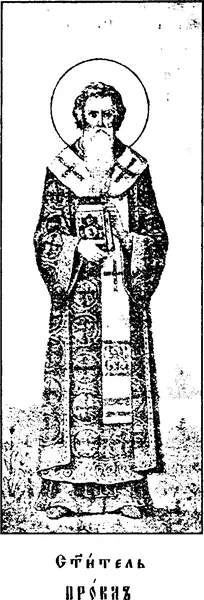
St Proclus, Archbishop of Constantinople (+446–447)
Saint Proclus, Archbishop of Constantinople, from his youth devoted all his time to prayer and the study of Holy Scripture. The Lord counted him worthy to be a disciple of Saint John Chrysostom (+407; commemorated 13 November), who ordained the blessed one first deacon and then priest.
By the Lord’s permission Saint Proclus saw with his own eyes how the Apostle Paul appeared to Saint John Chrysostom while he was writing his commentaries on the Apostle’s epistles. With the help of his holy teacher Proclus wonderfully deepened his knowledge of Holy Scripture, and also acquired the ability to express his thought in perfect form.
After the exile and death of John Chrysostom, the holy Patriarch of Constantinople Sisinnius (426–427) consecrated Proclus Bishop of the city of Cyzicus; but through the influence of the heretical Nestorians he was driven out of his eparchy, and Proclus returned to the capital. The holy chief shepherd preached in the churches of Constantinople, strengthened the faithful in the Orthodox faith, and fearlessly exposed the lawless heresy.
After the death of Patriarch Sisinnius, Proclus was enthroned on the patriarchal throne of Constantinople. For twelve years (434–447) the blessed father steered the Church of Constantinople. Through his efforts, in the reign of the holy Emperor Theodosius II (408–450), the holy relics of John Chrysostom were translated from Comana to Constantinople.
During Proclus’s patriarchate a devastating earthquake struck the empire, which lasted for several months. In Bithynia, the Hellespont and Phrygia whole cities were ruined, rivers vanished beneath the earth, and in once waterless places destructive floods occurred. The people of Constantinople, led by the patriarch and the emperor, would go out of the city, hold services of supplication, and ask the Lord to put an end to this unheard-of calamity. During one such service an invisible power caught a little boy up into the air. Afterwards the lad returned to the earth completely unharmed and told those gathered that there, on high, he had seen and heard the angelic hymn: “Holy God, Holy Mighty, Holy Immortal.” The whole people took up the thrice-holy hymn, adding: “Have mercy on us”, and the earthquake stopped. From this came the beginning of this prayer, which has become an inseparable part of every divine service.
Surrounded by universal love and respect, the patriarch reposed in deep old age in 446–447.



