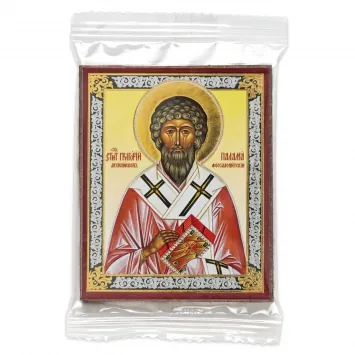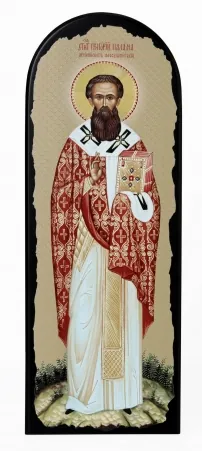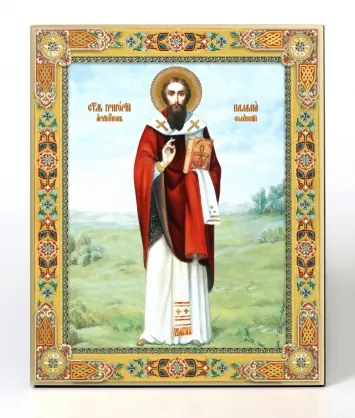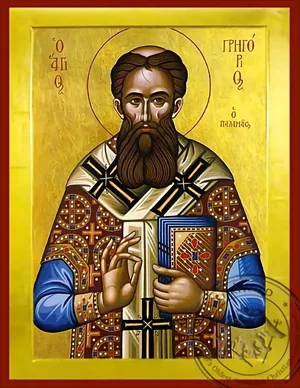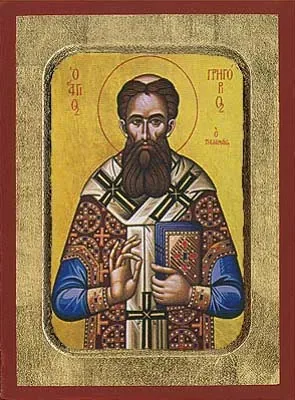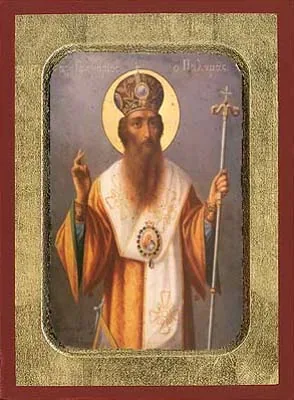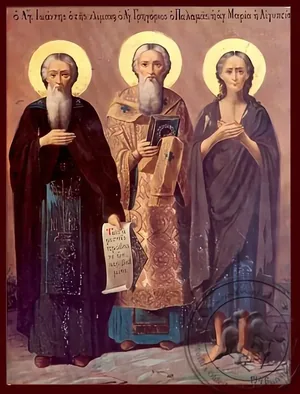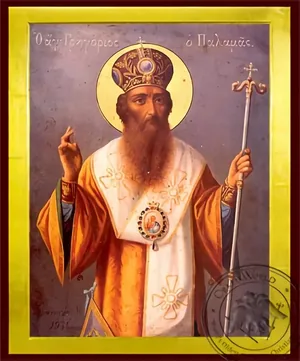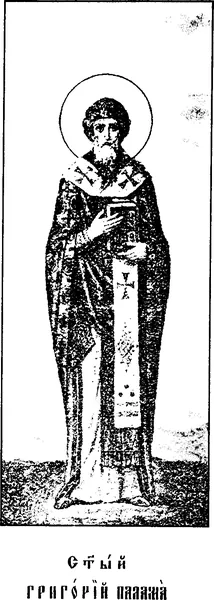
Saint Gregory Palamas, Archbishop of Thessalonica (+c. 1360)
Saint Gregory Palamas, archbishop of Thessalonica, was born in 1296–97 into a distinguished, wealthy and devout Christian family. His parents first lived in Asia Minor, but at the time of the Turkish invasion they moved to Constantinople and found refuge at the court of the Emperor Andronicus II Palaeologus (1282–1328). Gregory’s father, Constantine, became a high court official, but soon died. After this the saint’s upbringing and education were taken on by his mother and by the emperor, who was faithful to the memory of his late courtier. Thanks to his wonderful understanding and diligence, Gregory mastered every subject easily. The emperor wished to prepare the young man for the service of the state, but at the age of twenty, in 1316 (according to another account 1318), Gregory went with his two younger brothers to Mount Athos and became a novice in the monastery of Vatopedi. There the blessed father laboured under the guidance of the Venerable Nicodemus of Vatopedi (commemorated 11 July), and was tonsured a monk by him. A year later the holy Evangelist John the Theologian appeared to the Lord’s chosen one in a divine vision and promised him help in his godly labours. Soon Gregory’s mother and sisters were also tonsured nuns.
After the death of Saint Nicodemus the venerable father continued his labours of prayer for eight years under the direction of the elder Nicephorus, and after his death he moved to the lavra of the Venerable Athanasius. There the saint served first as refectorian and was then appointed a singer. So three years passed. In 1321 Gregory, who longed for higher degrees of spiritual perfection, moved to the small house of Glossia. There he became wholly imbued with the spirit of hesychasm and made it the foundation of his life (as early as the fourth to eighth centuries the ascetics of Egypt and Sinai had worked out a whole system of religious and ethical-ascetic teaching. It involved the mastering of certain methods and techniques that brought a person close to God; this very distinctive mystical meditation required keeping a set posture during prayer, the repeated saying of the Jesus Prayer, regulation of the breath, singing at appointed times and so on. Only at the highest degree of perfection could a person attain spiritual union with God, the Lord Jesus Christ, which made him experience the greatest blessedness and joy. Since this joy was beyond words, the monks preferred silence. The name of this way of prayer is linked with silence too: hesychasm, a Greek word meaning silence, stillness, solitude). In 1326 Gregory Palamas, escaping the danger of Turkish attack, moved with his brotherhood to Thessalonica, where he was ordained priest.
Saint Gregory combined the duties of a priest with the labours of a hermit: five days a week he spent in silence and prayer, while on Saturday and Sunday he came out to the people, celebrated the services and taught his flock. The blessed father’s sermons made a deep impression on the faithful in the church. For all his way of life, complete withdrawal from public life was foreign to Saint Gregory. Sometimes he attended the theological disputations of the educated youth of the city, which were led by the future Patriarch Isidore. Once, on his way back from Constantinople, the saint discovered near Thessalonica a place called Beroea, very well suited to monastic labour. Soon he gathered a small brotherhood there, which he led for five years. In 1331 Gregory went to Athos and withdrew into the skete of Saint Sabbas near the lavra of Athanasius. In 1333 he was appointed abbot of the monastery of Esphigmenou, and in 1336 he returned again to the skete of Saint Sabbas and began the theological work which he did not stop until the day of his death.
In 1328–30 a learned monk, Barlaam, came to Constantinople from Calabria: the author of treatises on logic and astronomy. He received a chair at the university of the capital and began to expound the works of Dionysius the Areopagite (commemorated 3 October), whose apophatic theology (Greek: invisibility, unknowability, inaccessibility) was universally recognised. Soon Barlaam moved to the Holy Mountain of Athos as well, where he became acquainted with the hesychasts’ way of spiritual life and, on the basis of the dogma of the incomprehensibility of God’s essence, declared their inner activity to be a heretical error. Barlaam argued with the monks and tried to prove to them that the light of Tabor was a created phenomenon; besides this he did not even refrain from ridiculing the monks’ accounts of the methods of prayer and of spiritual illumination.
At the request of the monks of Athos, Gregory Palamas set out his theological arguments in writing. So the well-known “Triads in Defence of the Holy Hesychasts” came into being (1338). In 1340 the ascetics of Athos, under the blessed father’s guidance, drew up a joint reply to Barlaam’s attacks, the so-called “Hagioritic Tome”.
At the church council of Constantinople in 1341, in the church of Hagia Sophia, the debate between Saint Gregory and Barlaam turned mainly on the light of Tabor. Barlaam’s teaching was condemned as heresy, but the dispute went on for a long time. Barlaam’s disciple, the Bulgarian monk Akindynos, wrote several treatises in which he accused Saint Gregory and the monks of Athos of stirring up strife in the Church. Gregory Palamas gave the heretic a fitting answer and convincingly refuted his accusation. But Patriarch John XIV excommunicated the Lord’s chosen one (1344) and had him thrown into prison, where he was kept for three years. In 1347, when Isidore (1347–1348) ascended the patriarchal throne, Saint Gregory Palamas was released and appointed archbishop of Thessalonica. In 1351 the church council of Blachernae solemnly confirmed the Orthodox nature of his teaching, but the people of Thessalonica did not accept the new hierarch at once, and at first he had to live in various places. Once the ship on which the blessed Gregory was travelling to Constantinople fell into the hands of the Turks. For a year the holy hierarch was sold like a slave in various cities, but even then he tirelessly went on preaching the Christian faith.
The blessed Gregory returned to Thessalonica only three years before his death. Before his repose he saw the holy hierarch John Chrysostom in a divine vision. Gregory Palamas committed his soul to the Lord on 14 November 1359, at the age of sixty-three. The blessed hierarch was numbered among the saints at the Council of Constantinople held in 1368. His Life and the canon for his commemoration were composed by Patriarch Philotheus (1354–1355, 1362–1376).
The Church also commemorates Saint Gregory on the second Sunday of Great Lent.