
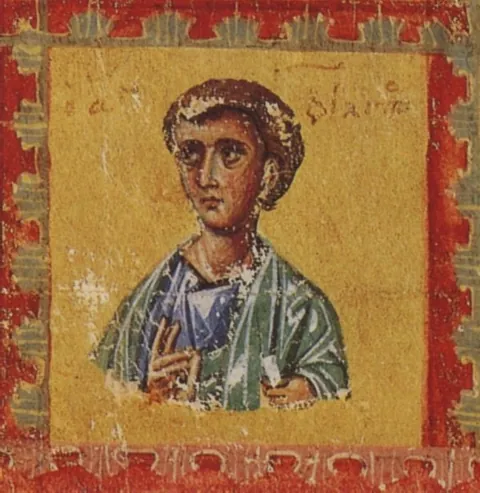
Holy Apostle Philip (I)
The holy Apostle Philip, a native of Bethsaida in Galilee, was deeply versed in Holy Scripture. He rightly understood the meaning of the prophecies of the Old Testament and lived in expectation of the Messiah. Philip followed the Saviour at the very first call (John 1:43); he brought the Apostle Nathanael to Christ (John 1:46); the Lord asked him how much money would be needed to buy bread enough for five thousand men (John 6:5–7); he brought to Him the Greeks who wished to see Christ (John 12:21–22); he asked the Saviour: “Lord, shew us the Father, and it sufficeth us” (John 14:8).
After Christ’s Ascension the Apostle Philip preached the word of God in Galilee. The blessed one’s teaching was accompanied by wonderful miracles. From Galilee the Apostle Philip went to Greece and preached among the Jews who had settled there. Pharisees came to Hellas from the holy city, led by the high priest, to put Philip on trial. The Apostle Philip exposed the lie of the Jewish high priest, who claimed that Christ’s disciples had stolen and hidden the Saviour’s body: the saint told those gathered that the guards from whom this rumour had spread had been bribed by the Pharisees. When the Jewish high priest and his companions began to blaspheme God and attacked the Apostle Philip, they were struck blind, but at the apostle’s prayer they all received their sight again. Many who saw this miracle were converted to Christianity.
From Hellas Philip went first to Parthia, and then to the city of Azotus. From Azotus the Apostle Philip went on to Hierapolis in Syria. There Jews bribed by the Pharisees burned down the house of Heros, who had given the holy apostle shelter. They meant to kill Philip himself, but when they saw the miracles worked by the Lord’s chosen one they fell into repentance, and many of them were baptised. The holy apostle appointed Heros bishop of Hierapolis, while he himself continued on his way and travelled through Syria, Asia Minor, Lydia and Mysia. Everywhere he preached the word of God, for which he had to endure many torments. Saint Philip was accompanied inseparably by his sister Mariamne, who shared her brother’s hardships.
Then the apostle came to the city of Hierapolis in Phrygia, where there were many pagan shrines, among them a temple dedicated to serpents, in which a huge viper had its lair. By the power of prayer the Apostle Philip killed the reptile and healed many people who had been bitten by snakes. Among those healed was the wife of the head of the city, who believed in Christ and was baptised. When the governor of the city learned of this, he ordered Philip, his sister Mariamne and the Apostle Bartholomew, who was travelling with them, to be seized. At the urging of the priests of the viper’s temple the pagan ruler ordered Philip and Bartholomew to be crucified. At that moment the earth shook terribly, and those at the tribunal were swallowed up by the earth. Philip, nailed upside down to a cross by the viper’s temple, prayed that the Lord would deliver his tormentors from the calamity that had fallen upon them. The people who saw what had happened believed in Christ and demanded that the apostles be taken down. When he was taken down from the cross, Bartholomew was still alive. After his release the blessed one baptised the new converts and appointed a bishop for them; but the Apostle Philip died on the cross.
The saint’s sister Mariamne committed her brother’s body to the earth, and then set out with the Apostle Bartholomew to preach the Gospel in Armenia. There Saint Bartholomew was crucified (commemorated 11 June), while Mariamne continued preaching the word of God among the pagans until she met her blessed end in Lycaonia (commemorated 17 February).



