
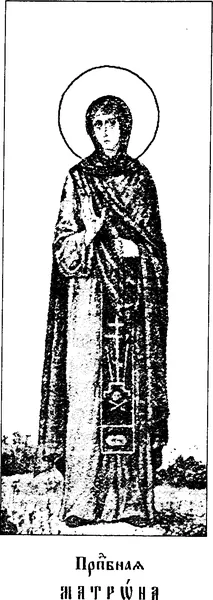
Venerable Matrona (+c. 492)
The Venerable Matrona was born at Perge in Pamphylia (Asia Minor) in the fifth century. She was married to a wealthy man, Domentian. When a daughter, Theodotia, was born to them, the couple moved to Constantinople. The twenty-five-year-old Matrona loved to go to church, where she often spent whole days.
In church the saint came to know two devout nuns, Eugenia and Susanna. Following their example, the Venerable Matrona began an ascetic life, for which she often had to endure her husband’s outbursts. The saint’s soul longed to withdraw from the world. After long hesitation she resolved to leave her family and fervently besought the Lord to show her whether her intention was pleasing to Him. Once Matrona saw in a vision that she was fleeing from her husband, mingled with a group of monks, and remained unnoticed by him. The Venerable Matrona took this vision as a blessing from heaven. She gave her daughter to Mother Susanna to be brought up, while she herself cut off her hair, put on men’s clothing and made her way to the monastery of the Venerable Bassian (commemorated 10 October), in the hope that her husband would not learn she was there. The saint, who introduced herself to those who met her as the eunuch Babylas, was received into the brotherhood.
Some time later it was revealed in a vision to the abbot of the monastery, the Venerable Bassian, that the eunuch Babylas was a woman. The same revelation was given to the abbot of the neighbouring monastery of Saint Abraham, the blessed Acacius. The Venerable Bassian sternly demanded that Saint Matrona tell him for what purpose she had come to the monastery: was she not intending to tempt the monks and bring shame on the monastery? With tears the saint told the abbot the whole of her past life. When the abbot was convinced that the blessed mother’s intentions were holy and pure, he blessed her and sent her to a convent in the city of Emesa. In this house the saint spent many years in strict and unwearying labour, by which she won the great respect and love of the sisters. When the abbess died, the nuns unanimously wished the Venerable Matrona to be appointed in her place.
The report of the virtues of the Lord’s chosen ascetic, and of the gift of miraculous healing granted her from on high, spread far and wide. Domentian too learned where his wife was and made his way to the monastery. When she heard of this, Matrona secretly left the house and went to Jerusalem; from there she moved to Mount Sinai, and then settled in Berytus, in an abandoned pagan temple. When the local people heard of the mother living in seclusion, they began to come to her. The blessed one delivered many of the lawless from the darkness of godlessness and converted them to the Christian faith. Soon a new monastery was founded near the saint’s dwelling. At last, at a sign from God, Matrona left Berytus and went to Constantinople, where she learned that her husband had died. With the blessing of her spiritual father, the Venerable Bassian, the ascetic founded a convent in Constantinople. The mothers of the monastery of Berytus founded by Matrona moved there too. The Venerable Matrona’s house in Constantinople was known for its strict rule and the devout life of the sisters.
The blessed mother, having reached a hundred, committed her soul to the Lord in peace around 492.



