
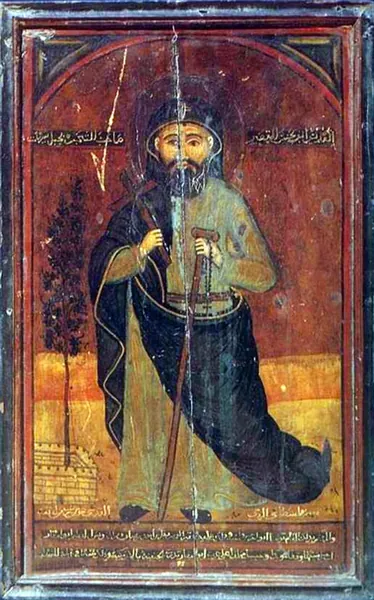
Venerable John the Short (Kolobos) (V)
The Venerable John Kolobos (in Greek, “the Short”) laboured in the fifth century in Egypt, in the monastery of the Venerable Poemen the Great (commemorated 27 August) in the desert of Scete (it was from the name of this desert that the secluded houses at a distance from a monastery, where monks labour in solitude, afterwards came to be called “sketes”). He came to the monastery with his brother Daniel. Once the Venerable John, as if in imitation of the angelic life, resolved to take no more thought for clothing and food; he took off his clothes and left his cell. At night, when it grew very cold, he could not bear the chill, came back and knocked on Daniel’s door. For some time his brother would not open the door to the blessed one. He told him that angels do not take thought for the body. The saint understood that he had trusted in himself too much. After this lesson John went to the Venerable Poemen, a teacher of firm and unshakeable will, asked for his spiritual guidance, and promised to obey him in everything.
To train the young monk’s patience, Saint Poemen gave him a strange obedience: for three years the blessed John carried water to water a withered tree, which at last put on green leaves and was laden with fruit. This miraculously revived tree was called “the tree of obedience”. Afterwards the Lord’s chosen one himself guided ascetics who sincerely sought salvation. His spiritual children were the Venerable Arsenius the Great (commemorated 8 May), the blessed Thaisia (commemorated 10 May) and many other well-known ascetics.
The holy father was marked by wonderful love of mankind and understanding. Once he set out from Scete with a few brethren. Night overtook them on the way. In the darkness their guide lost his way. “Father, what shall we do? Such wandering may even be the death of us,” the monks complained to the Venerable John. The saint answered: “Say nothing to the guide: the poor man will be ashamed, grieved and offended, and may even begin to murmur. Better let us do this: I will pretend to be ill, I will say I cannot go on, and that we should stay here until daybreak.” John did so, and the others declared that they would stay with him: they all stopped, spent the night in that place, and did not wound their neighbour.
Many wise sayings, parables and exhortations of the Venerable John have come down to us. In one parable the saint says: in a certain city there lived a charming but dissolute woman. The head of the city loved her, wished to make her happy and asked for her hand on condition that from then on she would live purely and chastely. The woman made the promise, and the head of the city married her. When the woman’s former lovers learned of this, they said to one another: “The governor of the province has stolen our darling; how shall we lure her out? If we come to the house, the governor will recognise us and punish us severely. Better let us pass near our friend’s house, give a signal by whistling and call her out. She will know us by the sound and come out to us of her own accord.” And so they did. But their hopes were disappointed: when the woman heard the whistling, she stopped her ears, ran into her husband’s inner room and locked herself in.
The meaning of this parable is this: the dissolute woman is the soul, her lovers are the passions, the lord of the city is Christ; the marriage is repentance; the whistling is the temptations of this world; and the inner room is life according to the Lord’s commandments.
The Life of the Venerable Paisius the Great (commemorated 9 June) is also the work of Saint John.
The Lord’s chosen father died in the first half of the fifth century, in 422 or 430.



