
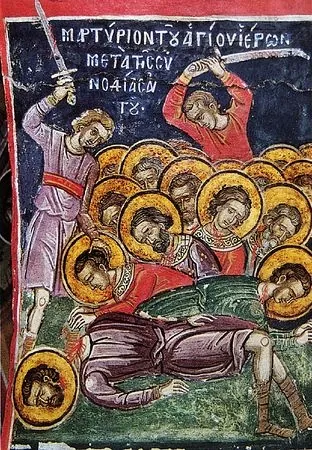
The Holy Thirty-three Martyrs of Melitene: Hieron, Hesychius, Nicander, Athanasius, Mamas, Barachius, Callinicus, Theogenes, Nicon, Longinus, Theodore, Valerius, Xanthius, Theodulus, Callimachus, Eugene, Theodochus, Ostrychius, Epiphanius, Maximian, Ducitius, Claudian, Theophilus, Gigantius, Dorotheus, Theodotus, Castrychius, Anicetus, Themelius, Eutychius, Hilarion, Diodotus and Amonitus (III)
The holy Martyr Hieron the Great, a Cappadocian, was born in the city of Tyana. Brought up by a devout mother, the young man was marked by gentleness and good morals.
The co-ruling emperors Diocletian and Maximian (284–305) sent a large troop of soldiers to Cappadocia under the command of Lysias. They were charged with rooting out the Christian faith, which was widespread there, and at the same time with gathering healthy and strong soldiers for the emperor’s army. Lysias ordered that Hieron, endowed with great physical strength and agility, be taken into military service along with others, but the holy young man refused to serve the emperors who persecuted the Christians. When they tried to bring the blessed one to Lysias by force, he drove off the attacking soldiers armed with a pole, and took refuge in a cave with eighteen like-minded companions. Lysias’s soldiers could not take this cave. At last, on the advice of one of Hieron’s friends, Cyriacus, the godless man lifted the siege of the cave and withdrew his troop from the place, while Cyriacus calmed Hieron and persuaded him to submit to the authorities. After this the saint, together with other new recruits, was sent under escort of soldiers to the neighbouring city of Melitene. Soon the Lord’s chosen one saw a vision in his sleep in which his approaching martyrdom was revealed. When the soldiers had gathered in Melitene, Lysias ordered them to offer sacrifice to the pagan gods; Hieron and thirty-two other soldiers with him refused to carry out this order and boldly confessed Christ. Then the tormentor gave orders for the saints to be beaten mercilessly, and for Hieron’s hand to be cut off. When the order had been carried out, the executioners threw the dying martyrs into prison, and in the morning they were all beheaded.
The Christians secretly buried the remains of all the soldiers who had been put to death. Later, in the reign of the Emperor Justinian, during the building of a church in the name of Saint Irene, the relics of the blessed martyrs were brought up incorrupt.



