
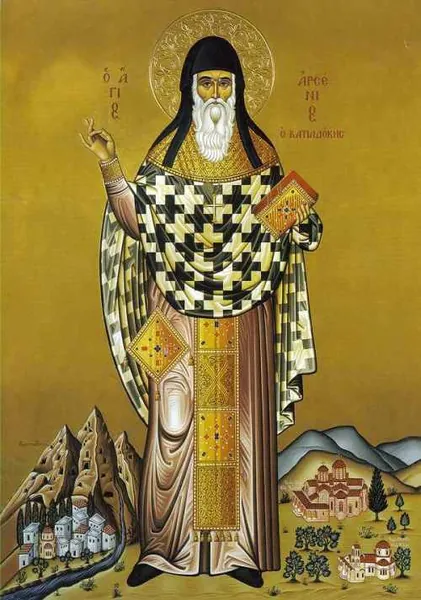
Venerable Arsenios of Cappadocia (+1924)
Father Arsenios (Anitsalichos) was born around 1840 in Cappadocia, in the district of Farasa. His God-fearing parents were called Eleutherios and Barbara. His father, because he had made the pilgrimage to Jerusalem, was called Hadji-Eleutherios, as a pilgrim to the Holy Land. They had two sons, Vlasios and Theodore. The parents died early, and their aunt cared for the children. Once Vlasios took his brother to their father’s field. They had to cross a small but swift river. Suddenly the water swept Theodore away. Nearby stood a chapel of Saint George. Vlasios asked the saint for help. In the midst of his weeping he saw his brother standing beside him. He told him: a horseman who looked like a monk put me on his horse and brought me out. From that time Theodore conceived the desire to become a monk. Vlasios too devoted his life to God. He became a teacher of Byzantine music and eventually died in Constantinople.
When Theodore had grown a little, his aunt sent him to his father’s sister in Nigde to study. She, seeing the boy’s intelligence, consulted her family, and they decided that when he had finished his studies in Nigde they would send him to Smyrna (present-day Izmir). Coming home to his father’s house for the holidays, Theodore would gather his friends and teach them what he himself knew. Once his aunt decided to keep him with her and marry him off, but the girl his aunt had chosen refused to marry Theodore: he is from a good family, but he is a monk. When Theodore heard this, he said to his aunt: you see, even a stranger has understood that I want to be a monk, but you do not understand me. The very next day he left the place and went to Smyrna, where, besides Greek and church subjects, he learned Armenian, Turkish and French. At twenty-six he was tonsured a monk in a monastery in Caesarea. He was named Arsenios.
The monk Arsenios was not left long in peace. Teachers were very scarce at that time, so Metropolitan Paisius II ordained Arsenios deacon and sent him as a teacher to his native Farasa. Arsenios set to work with great zeal. He set up the school in his own room. After the Russo-Turkish war, in 1878–79, Russia by the peace treaty took under its protection the Orthodox Greek population living on Turkish territory; but even then, and all the more ten years earlier, the Greeks were very careful not to provoke the Turks. So Father Arsenios hid his school carefully, and often took the children to a cave some way from the village, where he taught them to read and write.
At thirty Arsenios was ordained priest and raised to the rank of archimandrite. Now the venerable father’s work spread wider: he went round the villages of the Christian Greeks and encouraged his countrymen. The desolate condition of the Greeks under the Turks gave the venerable father courage and strength. Many miracles took place through his prayer; he read prayers over everyone, whether the sick person was a Christian or a Turk. The Turks too felt the great power of Orthodoxy and respected him. Once he was in some village with his reader. The Turks there would not allow him to speak with the Christians. Father Arsenios said nothing, and then told his reader: let us leave here, and the Turks themselves will bring us back. They walked for half an hour and left the village behind. Hadji-Efendi (as the Turks called Father Arsenios) knelt and began to pray. Suddenly the clear sky filled with clouds and a downpour began, followed by a terrible storm. The Turks at once realised their mistake and sent two horsemen after the elder. They fell on their knees and asked forgiveness in the name of the village. Father Arsenios went back to the village, made the sign of the cross towards all four sides, and the rain suddenly stopped.
But the Greek Protestants were no less dangerous than the Turks. Once they sent a man of their own to Farasa as a teacher. Father Arsenios told him: go away from here; one Protestant is enough for us, the Turk who lives in Farasa. When he got nowhere, he warned the people of Farasa: whoever greets that Protestant will not be saved. Isolation from the people, and his separate talks with Father Arsenios, made the Protestant think again, and he returned to the faith of his fathers.
Pray, children, Father Arsenios would instruct his pupils, and he taught them prayer. Whoever sinned in anything had to ask God’s forgiveness with repentance. He took great care of people’s souls. Often, when baptising children, against their parents’ wishes he gave them names whose feast did not exist in the calendar, for example Jordan, Gethsemane, Jerusalem. He knew that name-day celebrations often ended in drunkenness, which became a cause of quarrels between brothers. If you can do anything, there is the enemy, the Turks: fight them, he used to tell the young men. “This behaviour of his, a ‘stumbling block’ to some, moved me more than the miracles he worked by the power of God. He tried to appear stern (especially towards women) or greedy, so as to hide his soul from people’s eyes and from empty praise,” says Father Paisios the Athonite of him. But he could not altogether hide the grace of God with which he was filled.
In those hard times, among the Christians of Cappadocia, that little island in a Muslim sea, where would you find a doctor? Instead the people of Farasa had another “doctor”: Father Arsenios. All kinds of sick people were brought to him, and through his prayer they were all healed. When someone could not be brought, they sent Father Arsenios the sick person’s clothing; he blessed it and sent it back to the sick person. The sick person put it on with reverence and was healed. Often, to comfort them, Father Arsenios would send them some prayer, which they hung on their breast as an amulet. When he could not find a suitable prayer in the Euchologion for an illness or for other human troubles, he read them psalms. But the Gospel he read over a sick person only in grave cases, such as blindness, deafness, paralysis or demonic possession. If a person was sick in soul as well as in body, he had him come to him several times: first he healed the soul, and then the body too. Of course, he never took money for this. “Our faith is not for sale,” he would say. Once a possessed Turkish woman was brought to him for healing; she was tightly bound, but even so they could not hold her. Father Arsenios ordered her to be untied. Freed of her ropes, the woman flew at the elder and bit him on the leg. Father Arsenios had the Gospel in his hands at that moment; without opening it, he struck the woman lightly three times, and the demon went out at once. The woman’s father laid a purse full of money before Father Arsenios. He gave it back. Once a Turk brought him two donkeys “as a gift”, because, it seemed, through his prayer the Turk’s barren wife had borne two children. Father Arsenios told him sternly: is there no poor person left in your village, that you have brought them to me? Through his prayer Father Arsenios healed barrenness in women especially. Women sent Father Arsenios their headscarves; the elder blessed them, they put them on, and within a year they bore children. Often they sent him ropes too. The barren women tied these round their waists as belts and gained the grace of childbearing. Sometimes they asked for the wick of a lamp, sometimes for ashes from the censer, which they dissolved in water and gave to the sick to drink, and they were healed.
Merciful to others, Father Arsenios was merciless to himself. He had a tumbledown hut with an earth floor. He would spread a thin blanket on the ground and rest like that. God knows when he slept. Worn out by the troubles of the world, two days a week he would shut himself in his cell and receive no one. If people had come from far away and disturbed him by knocking at the door, he would open it, look at what was wrong with the sick person, then silently read the appropriate prayer, and the sick person was healed. The people of Farasa knew this and avoided disturbing him on those two days. They would go to his cell, take earth from the threshold of the door, sprinkle it on the sick place and be healed. Hadji-Efendi’s cell seemed to take into itself the illnesses of these suffering people. In his cell Father Arsenios always had a sack slung on his back; however great a person came to visit him, he would not take it off: it is a present from my mother, he would say. Perhaps there were ashes in it, for in his cell before the icons there were always ashes and cinders, on which he stood as a sign of humility and prayed. Often Turks who did not consider themselves worthy of Hadji-Efendi’s prayer took only these ashes from the reader, drank them dissolved in water, and recovered. Once, on a Wednesday, a Muslim woman brought her blind daughter to Father Arsenios. The elder did not open the door. The woman left her daughter at the door and went off to the centre of the village. At that moment a woman of Farasa, whose hand was cramped with pain, came running to Father Arsenios’s cell. She took earth from the threshold of the cell, rubbed it on her hand and was healed. And she said to the Muslim girl: what are you waiting for? Don’t you know that Hadji-Efendi does not open his door on Wednesdays and Fridays? Take earth from the threshold and put it on your eyes. The woman went about her business. The girl felt her way to the threshold, took earth, put it on her eyes and could see. In her joy she began to bang on the door. When the knocking would not stop, Father Arsenios looked out and signed to her with his hand, asking what she wanted (on these days he kept silence). When he learned the reason, he took the Gospel, laid it on her head, read, and she too was completely healed. The overjoyed woman bowed down to him and kissed his foot. Then the venerable father said to her: if you want to bow down, kneel before Christ, who has given you your sight.
When he healed a paralysed or possessed child, he laid a penance on the parents, whom he considered the cause of the child’s illness. In other cases he hardly ever laid a penance on a sinner, but instead brought him to a sense of his sin. Once a Turk was brought to him who had defiled the spring of Saint John and because of this his neck had become twisted. Father Arsenios kept him for a week and did not heal him. Why are you keeping the Turk so long, father? they asked him. So that he may feel repentance, he answered. After a week he read a prayer over him, and the man’s head went back into its place. Father Arsenios told him: from now on, when you see anything Christian, bow your head from a distance, go on your way and do not touch it. Another time a mute Turk was brought to him. Father Arsenios began to read the Gospel over him. He had not finished the prayer when the mute man began to speak.
The venerable father offered the Bloodless Sacrifice every day. And during prayer, so it was said, his heart seemed to leave his body, rise to Christ, embrace His feet, and not let Him go until He granted his request.
The power of Father Arsenios’s word was felt many times. Once two sheikhs visited him. The venerable father offered them coffee, and they offered him an amulet they had made. Father Arsenios told them sternly: I have greater power. By the power of Christ I can turn you to stone on the spot, so that you cannot get up. Then he rose and left his guests. The sheikhs drank their coffee but could not get up. They had to call Father Arsenios. The venerable father only signed to them: go. The sheikhs got up freely and went away ashamed.
Once thieves got into his cell. The venerable father was praying right there. He said nothing. They took Father Arsenios’s blanket and wanted to go out, but could not find the door. Father Arsenios got up, took one of them by the hand and said: here is the door by which thieves come in; but they go off to hell.
This happened too: three Turkish robbers wanted to rob Father Arsenios. They thought he must have a lot of money. They chose a Wednesday for the robbery. Two stayed outside, one climbed in through the window and opened the door of the cell. Father Arsenios was praying at the time. At the noise he looked round. His gaze turned to stone in the middle of the doorway the Turk with his dagger at the ready. Father Arsenios calmly went on with his prayer. Meanwhile day broke. The robbers left outside grew anxious, climbed in through the window themselves, and saw their companion frozen in a strange pose. They began to beg Father Arsenios: have mercy on us. He signed to them: go; and the frightened robbers left the place.
Once the Turks seized their moment and raided Farasa when the men were not in the village. They took ten people captive. Father Arsenios stood in their way and demanded that they return the people, or else, he said, I will turn you into stones. And indeed his word turned the Turks into statues. Only after the captured countrymen had been returned did he take off their “chains”.
Along with his other “oddities”, the venerable father had one more: he never mounted an animal. Several times he travelled barefoot to Jerusalem.
The patriarchs valued him highly and even offered him a bishopric, but he refused.
In 1923, by the Treaty of Lausanne, Turkey and Greece exchanged populations: the Greeks of Asia Minor moved to Greece, and the Turks living there to Turkey. The news threw the people of Farasa into turmoil. Father Arsenios calmed them. First of all he baptised all the unbaptised children. Father Paisios the Athonite was baptised at that time too. Father Arsenios gave the infant his own name. I know you want to leave an heir, he said to his parents; I too wanted to leave a monk after me, who will continue my path.
After the baptisms he spent a whole week burying the holy things of the church in the ground, so that the Turks would not defile them. Some he buried in the church, some in the cemetery. There was no means of taking them along.
The resettlement began on 14 August 1924 (Old Style). They had gone sixty kilometres when Father Arsenios remembered that in Farasa, in the church, on the holy altar, the holy relics of Saint John Chrysostom had been left behind. He went back to Farasa alone, took the holy relic, and caught up with his people.
In Nigde many sick people of the place were waiting, together with the people of Farasa. The venerable father healed them, and they went on their way. After five days of exhausting travel they saw that Father Arsenios could no longer walk, and they sat him on a cart by force. On the way he comforted everyone. He also said: when we reach Greece, the people of our village will be scattered in different directions. I shall live forty days and die. They reached Greece at the Exaltation of the Cross. The people of Farasa were lodged temporarily on the island of Corfu. Three weeks later Father Arsenios fell ill. His fellow villagers put him in hospital by force. On the day before his death the Mother of God appeared to him and showed him the monasteries of the Holy Mountain of Athos. She showed him that blessed land “for which he had longed all his life and of which he had not been counted worthy”.
On 10 November 1924 (New Style) Father Arsenios reposed. None of the people of Farasa were with him at the time…
It is told that once Father Arsenios celebrated the Liturgy far from Farasa, on a sheer cliff, in a cave chapel of the Mother of God. After the service he went out onto a wooden balcony. Suddenly a plank broke and Father Arsenios fell into the abyss. Peasants saw this from a distance. They went down into the gorge. They thought Father Arsenios could no longer be alive, but they found him unharmed: as I was falling into the abyss, suddenly a woman took me by the hand, gently set me down on the ground, and left me. Afterwards he often said: I felt then like a baby in its mother’s arms. Such is the lot of one obedient to the Mother of God: the Mother of the Lord always helps and stretches out her hand to her children in grace…
Father Paisios the Athonite loved his great fellow countryman dearly. In 1958 he visited the venerable father’s grave on Corfu, dug it up, and translated the holy relics to Konitsa. In 1970 he placed the holy relics in a newly built convent. It was evening when he first laid the holy relics in his cell and began to pray before them. Father Paisios heard someone’s menacing voice: what are these bones?! Then some force wrapped itself round him and tried to strangle him. Father Arsenios, help me! he cried. Father Paisios felt that this dark force was driven off by another, stronger power.
Father Paisios gathered material on the life of Saint Arsenios. It was 21 February 1971, the day of the commemoration of the two Saints Theodore. Father Paisios was sitting reading this material. The sun had not yet set. At that moment Father Arsenios visited him and caressed him: he stroked his head, as a teacher caresses a pupil for a lesson well learned. This visit filled Father Paisios’s heart with an indescribable divine joy.
On 11 February 1986 the Patriarchate of Constantinople numbered Father Arsenios among the saints.



