
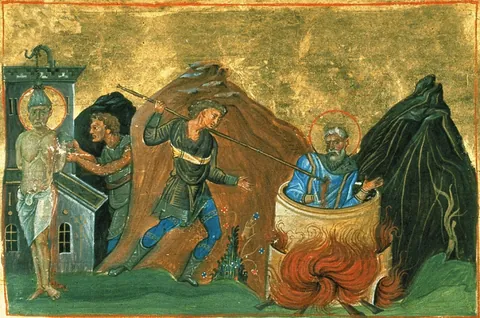
Hieromartyr Cyriacus, Patriarch of Jerusalem (+363)
The holy Martyr Cyriacus, Patriarch of Jerusalem, was a Hebrew by birth and was named Judas. He was one of those who knew where the Life-giving Cross of the Lord was buried. Two feelings fought in his heart: loyalty to the false Jewish outlook, and the suspicion that Jesus Christ was indeed the promised Messiah whom the Hebrews had crucified.
When the Empress Helena came to Jerusalem to seek the Cross of the Lord and other holy things (see the reading for 14 September), Judas gathered his fellow tribesmen and warned them: “Know that she intends to seek the wood on which our fathers crucified Jesus. Take heed lest any of you reveal it; otherwise the law given to our fathers will indeed be abolished. For Zacchaeus, my father’s father, charged my father Simon and said, and my father charged me and said: ‘Take heed, my son: when there is a search for the wood on which the Messiah was crucified, show it before thou art tortured, for no longer shall those born of the Hebrews reign, but thenceforth the kingdom shall be theirs who worship the Crucified, for He shall be King for ever: Christ, the Son of the living God.’”
Soon the Empress Helena summoned the Jewish elders. The Hebrews took counsel and decided not to tell the empress the secret, but when they stood before her they were afraid and pointed to Judas: “This man is the son of a righteous prophet and knows the true law. We beseech thee, O queen, let him fulfil the desire of thy heart.” The Empress Helena let them all go, and said to Judas: “If thou desirest life both on earth and in heaven, tell me where the Cross is hidden.” At first Judas refused: what should we know about something that happened two hundred years ago? Helena ordered him to be thrown into a pit and starved for a week. The solitude sharpened Judas’s doubts still more. He resolved to entrust everything to the God of the Jews and promised to help the Lord’s chosen empress. Judas himself did not know for certain exactly where the holy relic was buried. He went up to Golgotha, which had been turned into a rubbish heap and then covered with heathen buildings, and cried out to God, Creator of heaven and earth: “If Thou wilt, reveal unto us the hidden treasure, and cause a smoke of sweet savour to rise from this place, for He is the King Jesus Christ for ever. Amen.” When he had finished his prayer, the place where the holy relic was hidden shook, and a wonderful fragrance spread all around. Then Judas believed in the crucified Lord, raised his hands to heaven and said: “Truly, O Christ, Thou art the Saviour of the world.” He dug the earth with his own hands, and became a witness of the Life-giving Cross and of the raising of a dead man by it. The enraged devil cried out: “O Judas, what hast thou done? Through the first Judas I made the people sin, and now by this Judas I am driven out. Now I too shall find what to do to thee: I will raise up another king, who will make thee deny the Crucified and will do my will, and will give thee over to the cruellest torments, and under torture thou shalt deny the Crucified.”
After his baptism Judas was named Cyriacus. Afterwards, for his holy life, he was appointed Patriarch of Jerusalem. In 363, in the reign of Julian the Apostate (361–363), a fierce persecutor of the Christians, he bore witness to his faithfulness to the Saviour by shedding his blood: when the blessed one refused to worship the idols, the godless poured molten tin into his mouth, laid him on a red-hot iron bed, threw him into a boiling cauldron, and at last hacked him to pieces with the sword.



