
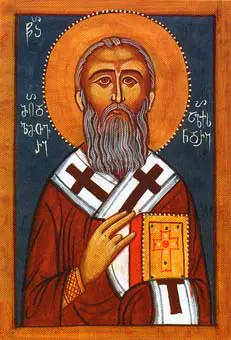
Holy Hierarch Alexander (Okropiridze), Bishop of Guria and Mingrelia (+1907)
The holy Bishop Alexander (Aleksi, son of David, Okropiridze) was born in 1824 in the village of Disevi in the Gori district, into a priest’s family. Having shared in the life of the Church from childhood, he continued his studies first at the Gori church school and then at the Tbilisi Theological Seminary. In 1845, as soon as he had finished the course of the Tbilisi Seminary, he was tonsured a monk in the monastery of the Transfiguration in Tbilisi and named Alexander, and on 18 August of the same year the saint was ordained hierodeacon.
To continue his studies Alexander went to the Kazan Theological Academy, graduated with distinction and returned to his homeland with the degree of candidate of theology. At first, until 27 June 1851, he taught Holy Scripture and Latin, moral theology and archaeology at the Tbilisi Theological Seminary. After this, by order of the Holy Synod (21 September 1851), the hieromonk Alexander was appointed superintendent of the Abkhazian church school, and the direction of the hieromonks among the clergy of the Abkhazian diocese was also entrusted to him; at the same time he also carried out the duties of inspector of the Kutaisi church school.
Alexander considered his chief task to be the conversion of those around him and their strengthening in the Christian faith, and the founding of schools for them; as soon as he arrived in Abkhazia he showed great zeal in helping the schools founded for the Abkhaz at Ilori to work successfully. His work — first as a teacher, then as archimandrite (from 26 February 1856) and bishop (from 4 March 1862) — was duly valued by the local people and by all Georgia, which without any exaggeration called him the second apostle of Abkhazia. Between him and his flock there was a bond of father and children, founded on true Christian love.
In 1869 Bishop Alexander was transferred from Abkhazia to be bishop of the diocese of Kartli-Kakheti, twice (in 1869–1882 and 1886–1898). Alexander Okropiridze was bishop of Gori for twenty-five years and the first chorepiscopus of the diocese of Kartli-Kakheti. In 1882–85 he governed the diocese of Guria, and until 1903 the diocese of Guria-Mingrelia.
Bishop Alexander’s ministry as a hierarch fell in the hardest of periods for the country: Georgia had come to the edge of being and not being — divine service was no longer celebrated in Georgian in Georgia, and because of this the Georgian nation, already put into the hardest conditions of life, had turned its back on the Church as well. The Georgian churches and monasteries, held from of old to be centres of learning and culture, had become deserts; the Georgian language was not taught in the schools; the impoverished population had no means to give their children an education; it was necessary to multiply the publication of books in Georgian useful for the soul and enlightening the mind; the country needed tireless and unceasing labour to restore its national consciousness, which had died away.
Saint Alexander made a special contribution to the restoration and renewal of churches and monasteries. He began his building work in Abkhazia: in Sukhumi he restored two churches by his labour and at his own cost; while serving in Kartli-Kakheti and then in Guria-Mingrelia he renewed and rebuilt the monasteries of Shiomghvime, Zedazeni and David Gareja, gave a large sum to begin the restoration of the monastery of Shemokmedi, restored and renewed the monastery of Jvari at Mtskheta, the great church of the Twelve Apostles at Mtskheta, the church of his native village of Disevi, and a great many churches in Guria-Mingrelia, Adjara and Imereti. His special labour and care were directed to the monastery of Shiomghvime, which had become almost a wilderness, and its surroundings. He restored the monastery completely, built dwellings for the monks, had a road made to Shiomghvime, set up a ferry on the river Mtkvari, got a railway platform built at Dzegvi for the train to stop at, bought gardens and vineyards for the monastery around it and at Mtskheta along the Mtkvari, and revived the old traditional monastic economy: viticulture, gardening, bee-keeping… Other bishops and monasteries followed his personal example and began to plant gardens and vineyards at the monasteries.
With the financial help of Saint Alexander a diocesan school for girls was founded in Tbilisi in 1878, which brought up for our nation many educated women and fine mothers.
At Saint Alexander’s expense, on his initiative and with his recommendation, many spiritual and historical books, textbooks and collections of hymns were printed.
During Saint Alexander’s long life not one religious and national undertaking was begun in Georgia without his support and participation.
All his life the hierarch was a devoted defender of the Georgian language. He was one of the first to stand up for the teaching of Georgian in the parish schools of Mingrelia. After this the aged bishop did not remain long in the diocese of Guria-Mingrelia. By decision of the exarch and the Holy Synod, on the basis of his “own request”, he was relieved of the government of the diocese and sent “to rest” in the monastery of Shiomghvime, which he himself had restored. He left the monastery only once, in 1907, for the funeral of Saint Ilia the Righteous (commemorated 20 July), and wept over his spiritual son. The eighty-three-year-old hierarch, the most reverend Alexander, himself fell asleep in the eternal sleep on 9 November of that same year in the house of Shiomghvime which he had restored. He was buried on 16 November in the same monastery.



