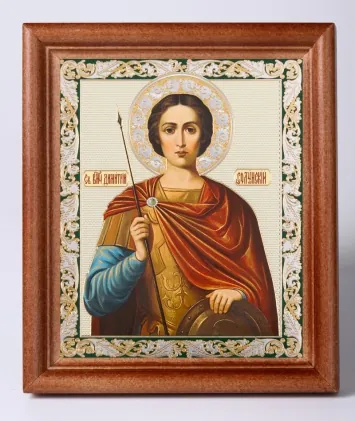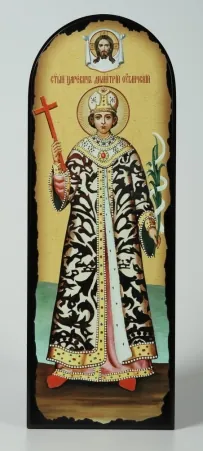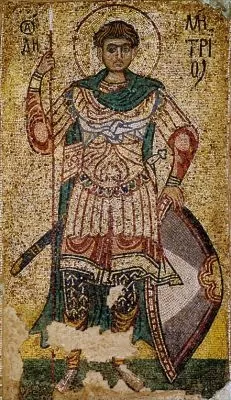
Great Martyr Demetrius of Thessalonica, the Myrrh-streaming (+c. 306)
The parents of the holy Great Martyr Demetrius of Thessalonica were secret Christians. His father, the Roman proconsul in Thessalonica, had a secret church in his house. The boy was baptised in this church and brought up in faithfulness to the Saviour’s commandments. When the saint, orphaned of his father, came of age, the Emperor Maximian Galerius (305–311) summoned him, was convinced of the blessed one’s learning and gift for command, and gave him his father’s post, the proconsulship of the province of Thessalonica. The chief task laid on the new official was to defend the city from invading barbarians and to wipe out every last Christian.
Having received his appointment, Demetrius returned to Thessalonica and, instead of persecuting the Orthodox, began openly to preach Christianity and to wage an implacable struggle against pagan customs and idol-worship. When Galerius learned of this, he was terribly angry. Returning from a campaign by the Black Sea, he resolved to pass through Thessalonica with his army and deal cruelly with the Christians there. Demetrius was told of the emperor’s intention in advance and made his preparations: he ordered his servant Lupus to distribute all his property to the poor, saying, “Share out the earthly treasure among them, and let us seek the heavenly”, while he himself gave himself to fasting and prayer in expectation of a martyr’s end.
When the lawless Galerius entered the city, Demetrius was at once brought before him. The saint boldly confessed Christ and exposed the falsehood and vanity of Roman paganism. The furious autocrat threw the confessor into prison. An angel of the Lord appeared to the blessed one, comforted him and strengthened him for the struggle ahead, while meanwhile Galerius staged loathsome gladiatorial shows and delighted in watching his favourite strongman, the German Lyaeus, defeat Christians in single combat and throw them off a platform onto the soldiers’ swords. A valiant young man, the Thessalonian Christian Nestor, went to Demetrius in prison and asked his blessing to fight the barbarian. With the blessing and prayer of the Lord’s chosen one he defeated the godless German, throwing him off the platform just as he himself had thrown the Orthodox, and impaling him on the soldiers’ swords. The enraged Galerius ordered Nestor (commemorated 27 October) to be put to death at once, and then sent guards to the dungeon to kill Saint Demetrius, who had given Nestor his blessing for this feat.
On 26 October 306, at dawn, soldiers burst into the cell of the saint, who was locked in an underground prison, and brutally killed the Lord’s chosen one. The blessed one’s faithful servant Lupus gathered his master’s blood and kept it together with the ring the emperor had given him.
With the ring and other holy things sanctified by Saint Demetrius’s blood the blessed Lupus afterwards worked many healings. The body of the holy Great Martyr Demetrius was thrown to the beasts to be torn apart, but the Christians of Thessalonica secretly carried it away and committed it to the earth.
In the time of the holy Emperor Constantine, equal to the apostles (306–337), a church was built over the tomb of the Lord’s saint. A hundred years later, during the building of a new and magnificent church on the site of the old one, the great martyr’s incorrupt relics were brought up. In the seventh century myrrh began to flow from the saint’s reliquary. Venerators of Saint Demetrius more than once tried to translate his relics to Constantinople, but by the wonderful providence of God the great martyr always made his will known: to remain the protector and guardian of his native Thessalonica.