
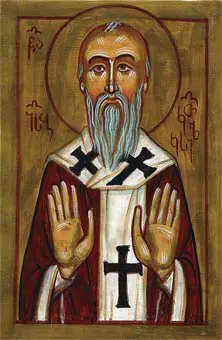
Saint Joseph, Catholicos-Patriarch (+1770)
The holy Catholicos-Patriarch Joseph (Jandierishvili) laboured in the monastery of Dodo. “For his many virtues” he was installed as hierarch on the see of Rustavi. Saint Joseph had been granted by God the gift of working miracles: once his deacon fell ill with a swelling of the belly. The illness grew so grave that death was inevitable. When the hierarch went in to the sick man, he could no longer breathe or speak. Saint Joseph “saw the sickness, and his tender heart was wrung”; he left the sick man and withdrew into the chapel to pray. After fervent prayer he returned to the sick man and, since he shunned glory from men, said as if in an ordinary way that for such a sickness the charcoal of a hazel stick should be taken as medicine. He threw into the fire the staff carved from his hazel stick, ground it in water, made the sign of the cross over it and gave it to the sick man to drink. The swelling went down that very minute, and on the third day the sick man recovered completely. The hierarch, distinguished by such humility and working of miracles, was elected catholicos in 1755 in place of Anton I. Saint Joseph, despite the burden and honour of the catholicosate, remained the greatest of ascetic monks: “During his patriarchate, however often they made his bed, they would secretly put a mark on it and see the next day that he had not lain on the bed at all, but had prayed all night alone with compunction.” He, as Prince Ioane writes, “shepherded his Church well, and afterwards left his throne”.
In 1764 the holy Catholicos Joseph, like Saint Gregory the Theologian, humbly left the throne of the catholicos for the peace of the Church, went to Akhmeta and “lived in true monasticism”. The saint worked a vineyard with his own hands and distributed most of the harvest to the poor. In that region droughts and hail are very frequent, and the hail often destroyed almost the whole harvest. While Saint Joseph laboured there, “neither did rain ruin the vineyards nor did harmful hail come”. By prayer he healed the sick and gave the light of their eyes to the blind, and for this the people there loved him very much.
Saint Gabriel the Less (commemorated 17 March) writes with joy that he “saw him once” and “twice kissed that holy hand”.
In 1770, “having thus grown old in holiness, he commended his soul to God”.



