
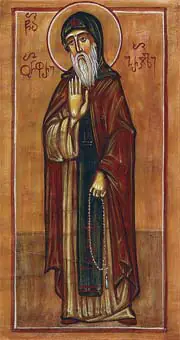
Venerable Onuphrius of Gareji, Wonderworker (XVIII)
Saint Onuphrius of Gareji (in the world Otar Machutadze) was an aznaur of Kartli. The rich and renowned nobleman was distinguished by wonderful hospitality, kindness to strangers, almsgiving and comfort for those in need. Otar had a godly zeal for monasticism: under the clothes of an aznaur he wore a hair shirt, and he constantly besought the Lord to grant him the strength for the monastic life. Once the saint said to his wife: “Now I wish to renounce the world and follow Christ. For this I ask of thy good faith that I may receive forgiveness from you all and pardon of my sins, voluntary and involuntary.” The right-believing woman did not hinder her husband, gave him her forgiveness and let him go in peace.
Otar went down to Tbilisi with his two elder sons, blessed his sons, instructed them and took leave of them. Having parted from his sons, Otar made his way to the monastery of Gareji, whose archimandrite was Germanus, a man whose heart was with God. The abbot received the newcomer with joy and told the assembled brethren: “This man is to attain a great measure, for already by leaving the world he has fulfilled the word of the holy Gospel which the Lord speaks: ‘Every one that hath forsaken houses, or wife, or children, or lands, for my name’s sake, shall receive an hundredfold, and shall inherit everlasting life.’”
A little later Germanus tonsured Otar a monk, named him Onuphrius, and joined him to the ranks of the brethren. The blessed Onuphrius was a meek, humble, obedient and tireless ascetic. In the stillness of the night he prayed without ceasing; after Matins he would go down into the gorge, where no noise reached, and there he went on reading the psalms. He took food — and that only water and bread — after Vespers.
Once the Leks fell upon the monastery of David Gareja, laid it waste, plundered it and carried off several monks captive, among them the hieromonks Maximus and Joachim, the monk Onuphrius, and four subdeacons besides. They wanted to kill him, but the good Lord protected him. By the providence of the all-merciful God the monks were freed and returned to the monastery.
The monastery grew very poor from the raids of the Leks. Once the archimandrite called the Venerable Onuphrius and said to him: “For the love of the brethren, go into the land of Kartli and labour to find food, that thou mayest receive the crown of unflagging obedience; and I too will go elsewhere and gather what I can.”
It was hard for the Venerable Onuphrius to leave the monastery, but he obeyed the abbot’s command, and the man who had once been the foremost aznaur of Kartli began to go from door to door asking for alms. “Truly this man will take the kingdom by force which God has prepared for those who love Him,” said those who knew him.
As he drew near to Tskhinvali, the venerable father’s attention was caught by an agitated crowd: a certain young man had become possessed, and they were taking him to the Jews to find out the cause. The Venerable Onuphrius said gently to those gathered there: “Children, this is not the way of Christians at all; but bring him here to me.” The sick man’s mother fell at the saint’s feet and asked for help. Onuphrius raised the woman up and comforted her: “I have here dust from the grave of the holy David of Gareji as a blessing.” He mixed the earth taken from the saint’s grave with water and gave it to the young man tormented by the evil one to drink, and the sick man was healed.
Once an Arab came to the monastery who had one eye injured, and since no one but Onuphrius knew Arabic, he spoke with him. The Venerable Onuphrius washed his diseased eye with water from the spring of Saint David of Gareji. A couple of days later the Arab, healed, came back to the monastery and gave thanks to the Lord and to the Venerable Onuphrius.
The Venerable Onuphrius wished to be clothed in the great schema. The archimandrite of the monastery hesitated, but after thirty days of prayer and fasting the Lord revealed to him that Onuphrius was worthy of it.
After being clothed in the schema, the Venerable Onuphrius took on the labour of silence; all day long he read the psalms and slept on a torn mat, and wore an iron chain on his bare body; he left his cell only at the time of divine service.
At last the blessed Onuphrius became so ill that he could not stand on his feet. The brethren begged him to lie down in bed and rest his head on a pillow. Then for the first time the blessed one opened his mouth and said: “I have made a vow that my end shall be on this mat.”
The Venerable Onuphrius bore his illness with gratitude; he did not let the prayer rope out of his hand and repeated the Jesus Prayer without ceasing. People came to him to venerate him, but the humble monk would ask his visitors: “Give me the hem of your garment, that I may kiss it, and give me your feet, that I may wash them with tears.”
The Venerable Onuphrius sensed beforehand the approach of death, called his confessor Maximus and asked for Communion. After receiving Holy Communion Onuphrius lost consciousness. With the archimandrite’s blessing the brethren began to read the prayers for the departing soul. The venerable father’s mind “was caught up and turned towards lofty visions”.
On the feast of Theophany, after the Liturgy, the saint fell asleep with the sleep of the righteous. The remains of Saint Onuphrius were buried to the south of the grave of Saint David of Gareji, by the window of the sanctuary.



