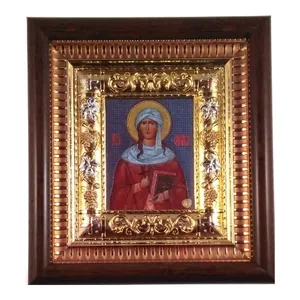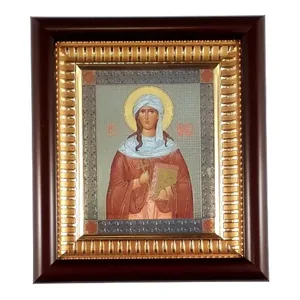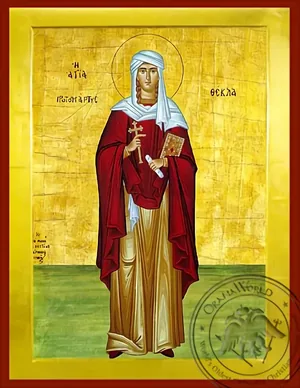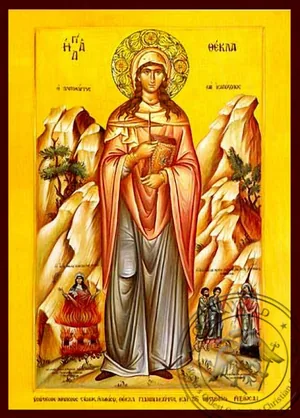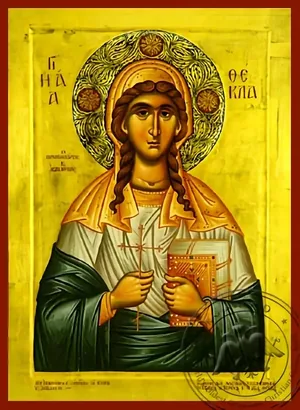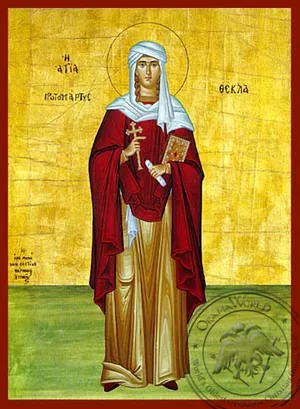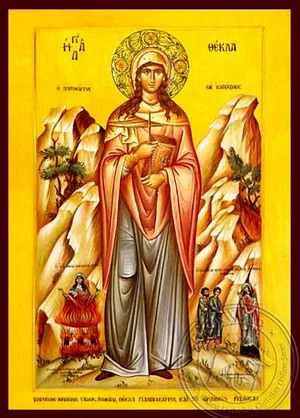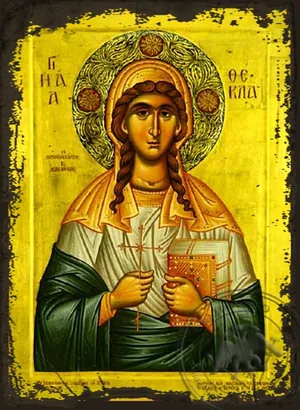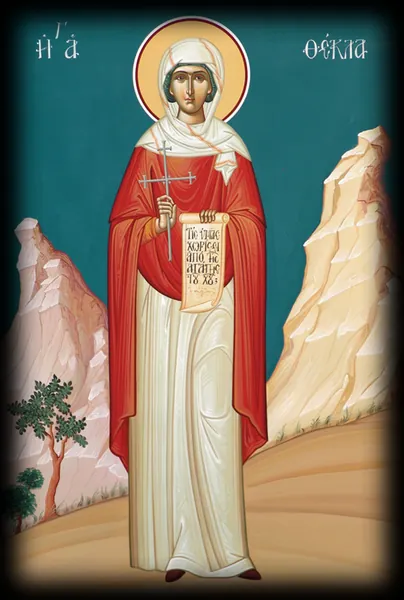
Holy Protomartyr Thecla, Equal to the Apostles (I)
The holy Protomartyr Thecla, equal to the apostles, was born in the city of Iconium. She was the child of a noble and wealthy family and was distinguished by her wonderful beauty. At eighteen Thecla was betrothed to a young nobleman, Thamyris; but at that time the blessed one heard the preaching of the Apostle Paul, who had come to the city, loved the Saviour with all her heart, and firmly resolved to keep her virginity for Christ. Her mother tried to force the saint to marry. Thecla’s betrothed denounced Paul to the head of the city: “He deprives young men of wives and maidens of husbands, for he makes a law of not marrying.” The chief of the apostles was bound and thrown into prison. Saint Thecla slipped out of the house by night, bribed the guards of the dungeon and made her way into Paul’s cell. For three days the virgin sat at the saint’s feet, listening to his teaching, “sweeter than all honey and the honeycomb”, and grew strong in the faith. When Thecla’s escape was noticed, her parents sent servants everywhere to look for her. At last the blessed one was found in the prison and taken home by force.
The ruler “had Paul scourged and drove him out of the city”. For a long time they went on urging Thecla to consent to the marriage, but neither her mother’s tears and anger nor the ruler’s threats could wither in her the love of the heavenly Bridegroom, the Lord Jesus Christ. Then her mother forgot everything and in her fury herself demanded that the judge put her daughter to death. Thecla was sentenced to be burned. The martyr made the sign of the cross and fearlessly went up onto the pyre. At that moment the Saviour Himself appeared to her; He blessed the saint’s coming labours, and her soul was filled with unspeakable joy. The flames leapt high, but did not touch Thecla: they encircled her like a ring. Suddenly the sky thundered, a downpour mixed with hail came down and put out the fire. The frightened executioners scattered, and the martyr, kept unharmed, left the city and with the help of a young Christian found the Apostle Paul. Saint Paul and his companions, among them the Apostle Barnabas, had taken refuge in a cave near the city and were praying fervently that the Lord would strengthen Thecla amid her torments. The holy virgin went with them as far as Antioch. There a nobleman named Alexander was captivated by her beauty and wished to take possession of her. The young man could not rein in his passions; “he shamelessly embraced her and kissed her so, in the streets”. Thecla “turned him about and thrust him away”, and at last tore his cloak, pulled off his crown, and he “was made a laughing-stock before all”. Alexander could not bear the shame and brought the saint before the ruler. The tormentors resolved to put her to death. Twice starving beasts were let loose on the blessed one, but they did the saint no harm. At last Thecla was tied between two bulls, and then the animals were goaded with red-hot irons so that they would run in different directions and tear the virgin apart; but by the will of God the bulls did not move from the spot, and the strong ropes broke like a spider’s web, and the saint took no harm. The people cried out: “One is the God of Thecla, one is God, who has delivered Thecla!” The ruler himself understood that the martyr was protected by the Almighty God, and ordered the handmaid of Christ to be set free. With the blessing of the Apostle Paul the saint settled in a cave on the desolate mountain of Calamon near Seleucia in Isauria, and spent many years there preaching the word of God. Thecla converted countless idol-worshippers to the law of Christ; the Church rightly calls her equal to the apostles.
Thecla was also granted by the Lord the gift of miraculous healing, and she healed everyone without payment. Because of this the pagan priests rose against her. The godless believed that the “goddess” Artemis loved Thecla for guarding her purity, and that her wonderworking power too had been given her by Artemis; so they bribed “men foul in their lives and young in years” and sent them to the saint to do her violence. When the lawless men, “many, like dogs”, were already very close, the blessed one asked God for help. In reply a voice sounded from on high: “Fear not, Thecla, for I am with thee!” The rock split open, sheltered the handmaid of Christ and closed again. So the Lord’s chosen one committed her soul to Him (1st century).
“Lives of the Saints”, vol. III, Tbilisi, 2001.
The holy Apostles Paul and Barnabas, preaching the Gospel, came to Iconium [1] and lodged in the house of Onesiphorus. It is this Onesiphorus whom Saint Paul mentions in his epistle to Timothy: “The Lord give mercy unto the house of Onesiphorus; for he oft refreshed me, and was not ashamed of my chain” [2]. Here the apostles often went to the synagogue and fearlessly preached the word of God, setting the people of the place on the way of salvation and planting in them faith in Jesus Christ. Many heeded their teaching and believed in Christ the Lord at the sight of the signs and wonders they worked. So it is told in the Acts of the Apostles: “And it came to pass in Iconium, that they went both together into the synagogue of the Jews, and so spake, that a great multitude both of the Jews and also of the Greeks believed… Long time therefore abode they speaking boldly in the Lord, which gave testimony unto the word of his grace, and granted signs and wonders to be done by their hands” [3].
At that time there lived in Iconium a virgin named Thecla. She came of a noble and distinguished family. Her mother’s name was Theoclia. The most beautiful eighteen-year-old girl was betrothed to one Thamyris, one of the leading young men of the city, distinguished for his wealth and good looks. Thecla too saw the miracles worked by the hands of the apostles, and she too, sitting at the window of Onesiphorus’s house, listened to their preaching. The virgin gave her whole attention to their words.
The seed of the Lord’s word fell on good ground; by the working of the Holy Spirit it put down deep roots in Thecla’s heart and sprang up: she received faith in the Son of God, loved the Lord and cleaved to Him with all her soul. Just at that time Paul, by divine inspiration, was preaching about virginity and chastity. Among other things he said that if a young woman remains a virgin for the love of Christ, she becomes like an angel, is betrothed to Christ, and the immortal Bridegroom will lead her into the Kingdom of Heaven. Paul preached so much on this theme that he stirred Thecla to keep her virginity. The holy virgin at once chose to leave her betrothed over all the sweetness of this vain world, and made a vow to serve Christ in purity to the end of her life. So the wise virgin was betrothed to the heavenly Bridegroom and followed Him, burning with fiery love. With the desire to draw near to the incorruptible Bridegroom her heart melted like wax, as though David’s song were fulfilled in her: “My heart is like wax; it is melted in the midst of my bowels.” Thecla was so carried away by Paul’s preaching that for three days and nights she put nothing in her mouth; she no longer remembered sleep, or food and drink. As Mary once “sat at Jesus’ feet, and heard his word” [5], her mind cleaving to God alone, so Thecla too fed on the word of God alone, as it is said in Holy Scripture: “Man shall not live by bread alone, but by every word that proceedeth out of the mouth of God” [6]. When Theoclia learned of this, she rushed in a rage to Onesiphorus’s house, tore her daughter away by force from the work that profited her soul, and heaped reproaches and abuse on the holy apostles. She snatched from the flock of Christ her daughter, who had already come alive in Christ, and took her home. There she summoned Thecla’s betrothed, Thamyris, and rebuked him: “Do you no longer care about your bride? Can’t you see she has lost her mind? See how those vagrant deceivers have bewitched Thecla, the ones who muddle the minds of foolish people with high-flown words! Three days now she has not left them, and does not even want to come home.”
Thamyris spoke tenderly and sweetly to Thecla, but the virgin no longer wished to hear anything, and even avoided looking at her betrothed. For her heart was already given to another Bridegroom, who is “fairer than the children of men” [7]. Him alone she beheld with the eyes of the spirit, with Him she conversed in thought. This fleshly betrothed now filled her only with disgust. Thamyris understood that Thecla no longer loved him, and grew very downcast. Theoclia, beside herself with rage, threw her daughter to the ground, beat her and tore her hair in bitterness. When she had finished beating her, she locked her daughter in a room and left her there a long time without food or drink. She herself, her heart full of a mother’s natural love, secretly mourned her daughter’s fate. When her heart softened, she brought Thecla out, pressed her to her breast, kissed her and begged her with tears not to abandon her handsome, rich, noble betrothed, respected by all. She brought Thamyris again and sat him beside Thecla at table. The virgin sat silent with her back to her betrothed, her eyes lowered; she did not touch the food, and in her heart thought only of her heavenly Bridegroom. Thamyris drew her to him affectionately and wanted to kiss her; Thecla at once spat in his eyes and slipped out of his arms like a bird escaping a snare. Her daughter’s behaviour so enraged Theoclia that she fell upon the virgin and almost beat the life out of her. Thamyris, bitterly aggrieved, went to the ruler to complain of the Apostle Paul.
“A vagrant has appeared in our city,” Thamyris told the ruler. “With his sorcery he has led the people astray, turned them from the worship of the gods and made them believe in Christ, whom the Jews crucified. He has bewitched my bride Thecla too. He has turned the virgin’s former love into hatred. She does not even want to see me. She loathes me like a leper and shuns me as if I were a wild beast. It is this sorcerer who has put out the fire of her love for me.”
The ruler summoned Paul and questioned him: who are you, where are you from, and what business have you in my city? Paul opened his apostolic lips and, as was his custom, began to preach the word of God. For some reason the ruler no longer wished to hear the case, and put off the trial to another time. He had Paul put in chains and thrown into the dungeon: let him stay there until I have time to question him more closely. When Thecla learned that Paul had been imprisoned on her account, she slipped quietly out of the house by night and went to the prison. She offered the guard her gold jewellery if only he would let her in to see the apostle. This is what Saint John Chrysostom tells us: “Hear what I tell thee of Saint Thecla: to see Paul she gave the guard her gold, while thou wilt not give even one farthing [8] to see Christ” [9]. The prison guard gladly took the jewels and led the virgin to Saint Paul. At the sight of the apostle Thecla burst into tears of joy; she knelt before the prisoner for Christ and kissed his chains. At first Saint Paul was troubled to see the virgin, but when Thecla told him what she had endured from her mother and her betrothed, moved as she was to keep her virginity, he rejoiced with great joy. He praised the young woman’s courage, kissed her head and blessed her: “You are a bride of Christ,” he told her, “and my first daughter, whom I have begotten a second time through the Gospel.” Thecla stayed a long time in the prison. As a daughter sits at her father’s feet and listens, so she settled beside Paul, listened to his fatherly instruction and kept it in her heart like “a pearl of great price”. The apostle for his part taught her tirelessly in the faith of Christ, trained her in the love of God and urged her to keep her chastity. So he strengthened Thecla in the teaching of Christ. Saint Gregory of Nyssa [10] also tells of this: “The apostle once sprinkled into the holy virgin’s ears the ointment (that is, the teaching) adorned with the white lily of chastity. With the drops poured from the lily of the heart Thecla put to death in herself the outward man, quenching every vain thought and desire.”
Saint Epiphanius [11] testifies to the same: “Thecla had a betrothed: handsome, the first man of the city, quite wealthy, respected and distinguished; but she found Paul, and his words made her leave the betrothed to whom she had been promised. So the saint rejected all earthly goods to gain the heavenly.”
Meanwhile in Theoclia’s house they began to search for Thecla. When they could not find her anywhere, they began to shout and lament. The mother wept for her daughter, Thamyris for his bride, the slaves for their mistress. The servants rushed this way and that, asking everywhere for Thecla, in the streets and in the houses, but in vain. Only after a good while did they discover that she was in the prison. At once they hurried to fetch her. When they entered the cell, they found Thecla sitting at Paul’s feet, as if the virgin were fastened to the spot, listening breathlessly to the apostle’s instruction. At once they seized the girl and took her home, and immediately reported what had happened to the ruler. He at once held a trial and ordered Paul to be brought. At the apostle’s appearance the people shouted:
“Ruler, this man is a magician; put him to death!”
Thamyris demanded the death sentence most furiously of all. He complained that Paul had separated him from his bride. Then they called Thecla and asked her:
“Why have you come to loathe so fine and noble a betrothed? Why do you no longer want to marry?”
The virgin gazed silently at Paul and gave no answer. Then Theoclia lost her head altogether; she forgot even a mother’s natural love, raged like a lioness, became like a furious she-bear, and cried out to the ruler like a wild beast:
“Burn this wicked slave-girl, who deserves to die! She is no longer my daughter; she doesn’t listen to a word I say. Have her burned as an example to others! Let the sight of such a punishment frighten the daughters of the whole city, so that they no longer defy their mothers’ will as this wicked, disobedient girl has done. No, she is not my child, not the fruit of my womb; she is an accursed branch and a withered shoot. Burn her!”
So the mother insistently demanded that her daughter be burned, and Thamyris that Paul be punished. The ruler examined the holy apostle’s case for a long time, but could find no fault in him except the preaching of Christ. He did not put him to death, but only had him scourged and expelled from the city, so that he should not persuade other virgins too not to marry. Barnabas was driven out together with Paul, and Onesiphorus too was expelled with his sons. Paul himself was eager to leave the city, for besides the ruler, Theoclia and Thamyris, the unbelieving people too persecuted him for his witness to Christ. Saint Luke mentions this in the Acts of the Apostles: “But the unbelieving Jews stirred up the Gentiles, and made their minds evil affected against the brethren… But the multitude of the city was divided: and part held with the Jews, and part with the apostles. And when there was an assault made both of the Gentiles, and also of the Jews with their rulers, to use them despitefully, and to stone them, they were ware of it, and fled unto Lystra and Derbe, cities of Lycaonia, and unto the region that lieth round about” [12], and from there to Antioch. At first they spent several days in a cave on the road to Daphne [13] near Iconium, wishing to learn what had become of Thecla. They fasted and prayed from the heart that the Lord would strengthen the virgin and grant her mercy. And so it came to pass:
For a long time the ruler tried to persuade Thecla to return to her betrothed, but achieved nothing. Then, at Theoclia’s insistent demand, he sentenced the virgin to be burned. They brought dry firewood, hay and brushwood and made a great pyre. The servants took hold of Thecla and made to lead her to the pyre. The martyr freed her hand and walked quickly to the fire of her own accord; she made the sign of the cross, climbed up and stood on top of the pyre, ready to die. Her fear of material fire vanished, for the immaterial flame of divine love itself was burning in her. As she gazed intently, the Lord appeared to her in the likeness of Paul and commanded her to stand firm. Therefore Saint Cyprian says in prayer: “Appear to us, as to Paul in prison, and as to Thecla in the fire” [14].
Meanwhile the fire was stoked and the pyre blazed up. But to everyone’s amazement the flames shot upward and encircled Thecla. They were still more amazed when suddenly it thundered and a downpour began. The pyre went out. The ruler, together with the people watching, quickly left the place. Everyone took refuge in their houses, so frightened were they by the thunder. Thecla came down. The fire had not harmed her in the least. She did not go back to her mother’s house, nor did she linger in Iconium; she left the city and hurried off to look for her spiritual father, Paul. On the way she met one of Paul’s disciples, whom she had seen at Onesiphorus’s house; he was going to the city to get bread. The holy virgin recognised him and asked:
“Where is Paul, the apostle of Jesus Christ?”
The disciple brought Thecla to the cave where Paul and those with him were giving themselves to fasting and prayer for the holy virgin. When they saw Thecla whole and unharmed, they rejoiced with great joy, lifted up their eyes and hands to heaven and gave thanks to God for saving His handmaid. They gave Thecla bread to eat, and took a little food themselves. From there Paul and Barnabas passed through Lystra and Derbe, preaching the Gospel and healing the sick. Thecla followed them as far as Antioch. As they came to this city, they happened to meet on the road the head of the city, Alexander. Like pagans in general, he was a young man led by his desires and given to lawless deeds. When he caught sight of the holy virgin, he was captivated and filled with impure desire. He thought Thecla was Paul’s wife and offered the apostle much gold not to stand in his way in the matter. When he learned that she was an unmarried virgin, his passion grew still greater and he wished to take Thecla as his wife. He tried to persuade the virgin to love him, but Thecla fled from him “as from a roaring lion, walking about, seeking whom he may devour”. Alexander did not slacken his efforts to win Thecla’s heart. Once, seeing Thecla among the people walking along the road, he could no longer restrain his inflamed heart; he lost his head, forgot all shame, seized the virgin and threw his arms round her neck. With tears the saint begged the young man who had lost his mind:
“Do not force me; I am a stranger. Do not make me hate you; I am a handmaid of God. I have left my betrothed for the Lord’s sake. Can I then follow your desire?”
No sooner had she said this than she slipped out of the young man’s hands, tore his clothes and put him to shame before everyone. The head of the city was filled with rage; learning besides that she was a Christian, he quickly brought her before the ruler. When the virgin was asked why she refused marriage, she answered:
“My Bridegroom is Christ, the Son of God. I am united to Him in a spiritual union.”
The ruler tried to force her to leave Christ and marry. When he received a firm refusal, he pronounced sentence: let the virgin be fed to the beasts. Two charges were laid against Thecla, piety and chastity: that she believed in Christ, and that, so young and beautiful a virgin, she refused marriage. The punishment was put off until morning, and meanwhile a woman, Tryphaena, took Thecla to her house. Tryphaena was of royal descent and enjoyed great honour in the city. Afterwards she too believed in Christ. It is she whom the holy Apostle Paul mentions in his epistle to the Romans: “Salute Tryphena and Tryphosa” [15].
Tryphaena and Thecla spent the whole night in spiritual conversation. Morning came. A huge crowd flocked to the spectacle. The ruler came too with his subordinates. Saint Thecla was led out like a sheep to the slaughter and set up to be torn by the beasts. The beasts were let loose, but they only circled round the martyr and did not touch her. As once in Daniel’s den, so now God shut their mouths. This wonder astonished the onlookers: the bloodthirsty beasts had laid aside their fury and become as gentle as sheep. Some glorified the God of Thecla, while others blasphemed and said:
“She has a charm in her clothes; that is why the beasts will not touch her.”
The ruler and his subordinates insisted on the same: she is a sorceress and has bewitched the beasts. They decided to let loose the next day more numerous beasts, maddened by hunger. And Thecla was sent back to Tryphaena. Tryphaena was overjoyed to see Thecla return unharmed from the place of punishment.
The ruler kept the beasts starving all night, so that in their hunger they would quickly tear the virgin apart. And the next day the saint was again brought to the place of execution. Tryphaena followed her in tears, grieving that so holy a virgin was to be put to death though innocent. Thecla was set on a raised place. The shameless ruler ordered the virgin to be stripped.
“She has a charm in her clothes,” he said, “that is why the beasts will not touch her. Strip her and let us see whether she survives.”
They stripped Thecla of her clothes and set her before the people. Only shame covered the modest virgin; she repeated the words of David: “The shame of my face hath covered me” [16]. Lions and bears maddened with hunger were let loose. Coming out of their cages, the beasts, at the sight of the naked virgin, bowed their heads to the ground, lowered their eyes as though ashamed to look on a virgin’s nakedness, and drew back. It was a wonderful sight! The beasts were ashamed and could not look at the naked virgin, while men stared at her shamelessly. In this spectacle the dumb animals became the accusers and judges of men. Those bloodthirsty by nature became like sensible people, and people endowed with reason like wild beasts. Did they achieve anything by this? They stripped the modest virgin before everyone to dishonour her, but by this they only increased her honour. This is what Saint John Chrysostom says, speaking of the stripping of two women, Potiphar’s wife and Thecla: “What profit did the passionate Egyptian woman gain by undressing in the bedchamber? What harm came to the Protomartyr Thecla by being stripped before the eyes of the whole city? Thecla, stripped of her clothes, did not sin, nor was she filled with lawlessness like the Egyptian woman. On the contrary, she was exalted as a saint. Her nakedness, seen by many eyes, was crowned, while the secret undressing of the foul woman was a shame” [17]. A lioness came up to the stripped saint, lay down on the ground and licked her feet, as though paying honour to her virginal chastity. Saint Ambrose [18] mentions this: “You could have seen the beast lying on the ground and licking the saint’s feet, testifying without words that it would do no harm to the virgin’s body. The beast lay down before the one to whom it had been thrown as food; it forgot its natural instincts and took on the character that men had lost.”
The people saw that the beasts dared not even touch the holy virgin, and began to shout:
“Great is the God whom Thecla confesses!”
Even so the tormentor did not recognise the divine power, and now devised another way of putting Thecla to death. He had a deep pit dug, had it filled with all kinds of reptiles, snakes and vipers, and ordered the saint to be thrown into it. But He who had shut the mouths of the lions before now blunted the forked tongues of the snakes, quenched their fury and destroyed their venom. To everyone’s amazement the martyr came up out of the pit safe and sound. For a long time the wicked tormentor was at a loss and did not know what else to do; at last he had two strong bulls brought, had Thecla tied between them by her feet, and ordered the bulls to be jabbed with red-hot rods so that they would run off in different directions and tear the martyr in two. But this torment too did Thecla no harm: the strong ropes with which she had been tied to the bulls broke like a spider’s web. The bulls charged off this way and that, while the saint remained in the same place, whole and unharmed. Then the dumbfounded ruler acknowledged that the power of God was at work in the virgin. He called her and asked:
“Who are you? What power is this you have, that nothing can harm you?”
She answered:
“I am a handmaid of the living God!”
She said nothing more. The ruler feared the God who protected Thecla, and ordered her to be clothed with honour and set free. And he decreed: “I grant freedom to Thecla, the handmaid of God.”
The saint went to Tryphaena’s house. What joy came upon the whole household when they learned that Thecla had been released in peace! The virgin stayed there a little while, preaching the word of God and teaching those in the house the faith of Christ. Longing to see her spiritual father and teacher, Paul, she at last sought him out; she wished to go with him, but the apostle would not allow it:
“One does not go into battle with one’s bride.”
Thecla received the apostle’s blessing to go to Seleucia [19]. There she settled on a mountain in the wilderness near Seleucia. She laboured in fasting, prayer and contemplation of God, worked countless miracles and healed every kind of illness. The people living round about brought the sick to her. Thecla planted in them faith in the Lord and healed them. Once a pagan priest rode past not far from Thecla’s dwelling. Thecla was gathering herbs for food. The priest was captivated by her beauty and filled with foul desire. He spurred his horse and rushed at the virgin to carry out his wicked purpose. The saint, armed with the power of God, quickly caught hold of the rider and threw him to the ground so hard that the priest lay unconscious for three days. Passers-by looked in astonishment at the priest sprawled on the ground as if dead, and could not understand what had happened to him. On the third day the news reached the city. A great crowd gathered. The priest came to his senses, stood up and said:
“I saw a goddess, and she threw me down.”
Racked with pain, he barely made it home. He summoned a painter and had him paint the young woman. By the providence of God the painter made the picture resemble Saint Thecla, and the image came out very lifelike. The painter brought the finished picture to the man who had ordered it. When the priest saw such a likeness, he exclaimed:
“That is exactly the virgin I saw!”
He took the icon, kissed it, and was at once completely healed. After this he kept the saint’s image in his house with honour. Afterwards, through the holy virgin’s preaching, he believed in Christ together with his household. The one equal to the apostles spent a long time in those parts; she set many on the way of salvation and helped many in trouble and illness. The physicians and sorcerers of Seleucia were left idle and lost their income, because all the sick were brought to Thecla. Their devilish tricks came to an end. They were troubled and angry with the virgin who healed without silver. Filled with envy and spite, they decided to hire foul young men to violate Thecla. Her haters took counsel thus:
“The virgin Thecla is pure, and that is why she is pleasing to the great goddess Artemis. The goddess hears her prayers and gives her power to heal the sick. If we defile her, Artemis will leave her, she will lose the power of healing, and then our art of medicine will flourish.”
To carry out their foul plan they did indeed find young men who had lost all shame. They made them drunk and charged them with dishonouring Thecla. They offered them much money for this loathsome deed, and promised more if they carried out their commission. The foolish unbelievers did not know that it was not Artemis who gave Thecla the power of healing, but the grace of Christ! The depraved, drunken young men hurried towards Saint Thecla. As soon as Thecla saw them, she asked:
“What do you want, children?”
In reply she received filthy language; she at once understood their wicked intent and fled. She who had not feared the wild beasts now fled from shameless men. As wolves chase a sheep, so they rushed after the virgin, led by foul desire. They were just about to catch her when Thecla asked the Lord to deliver her from the hands of the lawless. At God’s command the rocky mountain nearby at once opened and sheltered the holy virgin. This mountain became the resting place of her precious body. There Saint Thecla committed her soul to the Lord. She was ninety years old then. And now in the life without end she glorifies Christ our God, the Giver of life, together with the Father and the Holy Spirit, now and ever and unto the ages of ages. Amen!
Notes:
1. This took place in AD 45–46, during Saint Paul’s first journey. The city of Iconium lay in Lycaonia, south-west of Cappadocia, in the region of Asia Minor. This journey is told in chapters 13 and 14 of the Acts of the Apostles. The holy apostle came to Iconium from Antioch. 2. 2 Tim. 1:16. 3. Acts 14:1 and 3. 4. Ps. 21:14. 5. Luke 10:39. 6. Matt. 4:4. 7. Cf. Isa. 52:14. 8. Farthing: a coin of small value. 9. St John Chrysostom, Commentary on the Acts of the Apostles, Homily 25. 10. In the 4th homily on the Song of Songs. 11. St Epiphanius was bishop of Cyprus for 36 years. He was a contemporary of John Chrysostom. 12. Acts 14:2, 4–6. 13. A place near Antioch. 14. These words are read in St Cyprian’s discourse on the martyrs. 15. Rom. 16:12. 16. Ps. 43:16. 17. These words are read in the homilies on the man born blind. 18. St Ambrose of Milan is known for his victorious struggle against Arius and for his care of his flock. He died in 397. Commemorated 7 December. He tells of St Thecla in his second book “On Virgins”. 19. Seleucia: a city in Syria on the Mediterranean coast.
“Lives of Holy Women”. Tbilisi, 2006. Publisher: © “Orthodoxi”.
Georgian translation by Rusudan Kobakhidze.