
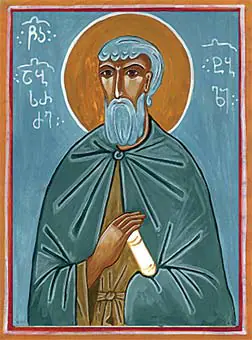
Saint Tbeli Abuseridze (XIII)
Saint Tbeli Abuseridze lived and laboured in the thirteenth century. The saint’s father Ivane, eristavt-eristavi of Upper Adjara, was killed in battle with the Turks. After she was widowed, Saint Tbeli’s mother was tonsured a nun with the name Catherine. Saint Tbeli had two brothers, Abuser and Vardan, who were well-known figures of their time.
Saint Tbeli received an excellent education, as befitted his family. As a hymnographer, prose writer, astronomer, expert in church music and, in general, a man of letters distinguished by deep scientific thought, he left an indelible mark on the history of Georgian culture.
As can be seen from the saint’s writings, he built a church of Saint George in the village of Khikhani in Upper Adjara. It is thought that Saint Tbeli served there as a clergyman and wrote most of his works there. Saint Tbeli had seven children, and, as he writes in his family chronicle, if more children were born to him, their names too were to be entered in the chronicle.
Saint Tbeli had lively cultural ties with the academy of Gelati; it is thought that he received there that many-sided education which enabled him to speak his wise and holy word in genres quite different from one another.
In Saint Tbeli’s hymnographic collection, “Hymns of Saint John the Baptist, Saint John the Evangelist and Saint John Chrysostom”, the image of the author as a very great theological writer and a saint is clearly seen. The deep theological thought of the hymns, their metaphors, their symbolic and mystical understanding of events, “the knowledge of things visible” and “the understanding of things invisible”, show Saint Tbeli as a scholar and theologian of world standing.
Saint Tbeli was interested in the problems of chronology and compiled a “Koronikon with Full Explanation and Ordering”, in which, together with knowledge of astronomy and history, a cosmic understanding of the calendar and Christian eschatology are set out.
Saint Tbeli Abuseridze’s hagiographical work “The New Miracles of the Holy Great Martyr George” is well known; it is important for its historical value too, as it gives information about the activity of one of the oldest and greatest families of feudal Georgia, the Abuseridzes, and about their cultural and building work.
Besides his literary and scholarly work, which Georgian scholars have duly valued, Saint Tbeli is known as a holy and God-clad father; and by his canonisation the Apostolic Church of Georgia made his veneration as a holy father canonical for ever, and so fittingly honoured the labour by which he justly won the love of the Georgian people.



