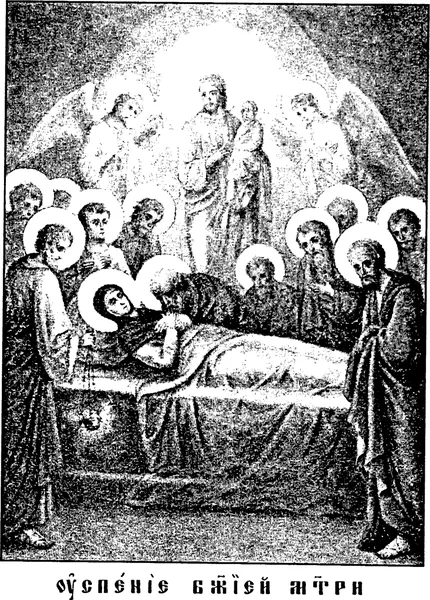
The Dormition of Our Most Holy Lady the Mother of God and Ever-Virgin Mary. Mariamoba. Sionoba; Veneration of the Icons of the Mother of God of Atskuri, Gaenati, Tsilkani, Metekhi, Kvabtakhevi, Mozdok and Blachernae
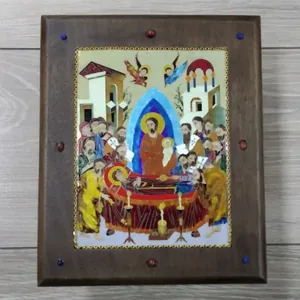
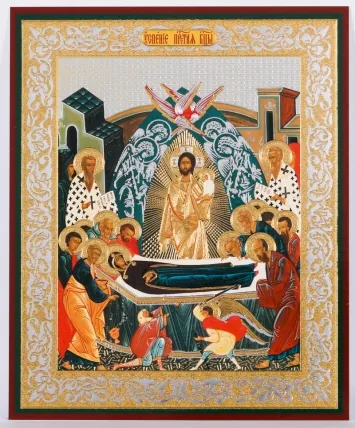
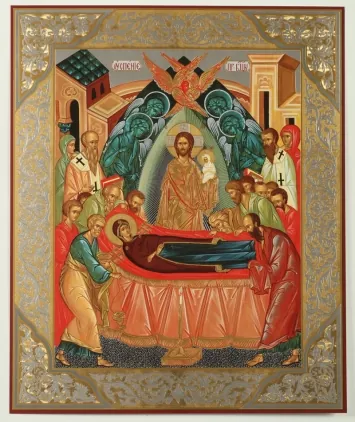
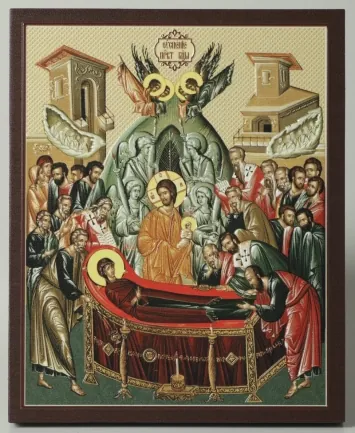
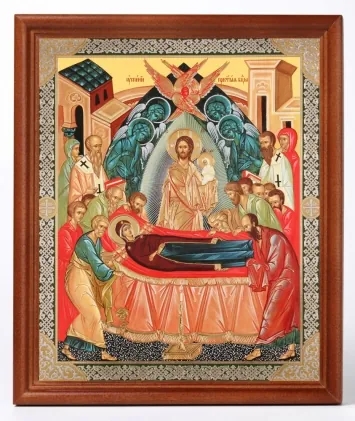
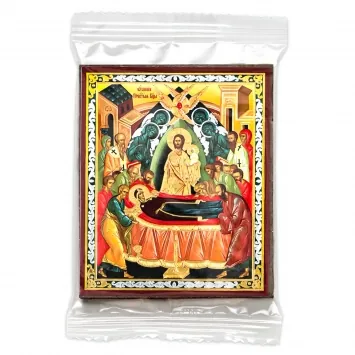
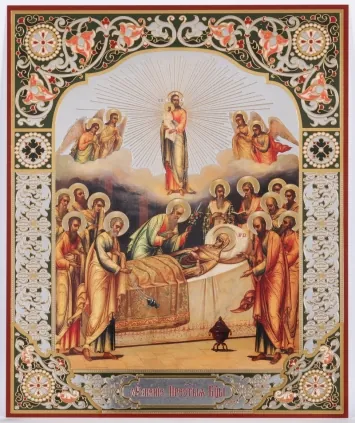
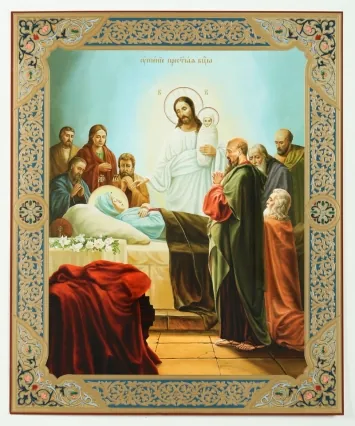
The Dormition of the Mother of God. After the Ascension of Jesus Christ the Most Holy Mother of God lived in Jerusalem, in the house of John the Theologian. The spotless Virgin prayed together with the apostles, told them about the Son of God, comforted and strengthened them. All felt a wonderful reverence for the Mother who had contained the Uncontainable. People came from other countries too to see her and to hear her grace-filled words.
When King Herod began to persecute the Christians, in 43, the Most Holy Mary went with John the Theologian to Ephesus; she was also on Cyprus, with Lazarus who had been raised from the dead, and preached Christianity on the holy land of Athos. At last, by God’s will, she returned again to Jerusalem. She often besought the Lord to receive her soul into the Kingdom soon. And then, once, when Mary was praying at the Saviour’s tomb, the heavens opened, the Archangel Gabriel came down with an olive branch in his hand and announced to the spotless Virgin: “Rejoice, Mary, who didst bear our God; thy prayer hath gone up before thy Son and hath been accepted; henceforth thou shalt leave the world, O blessed one, and go up to heaven!” The Mother of God rejoiced greatly at this news and began to prepare for her repose.
At this time the apostles were not in Jerusalem, but were preaching in various lands; yet Mary greatly desired to see them all together before she departed this world. The Lord fulfilled this wish of the blessed one too: He at once gathered to her all the disciples of the Saviour. Five of them had been raised from the dead. The apostles greeted her and told her how they had been caught up from the places of their labours. Rejoicing, the spotless Virgin gave thanks to God, and then began to speak of her repose.
At this very time the Apostle Paul too stood miraculously before them, accompanied by his disciples, Dionysius the Areopagite, the wondrous Hierotheus, the divine Timothy and others of the Seventy. Mary called each by name, praised their faith and blessed them. Then the holy Mother received Communion of the Blood and Body of Christ at the hands of the hierarch James. At the third hour, as the Mother of God departed this world, the room in which she lay shone with a wonderful light; “there was the coming of Christ God, her Son, glorious and wondrous, with that ineffable glory.” He “received upon His divine and incorrupt arms” the holy and all-spotless soul of His Mother and, accompanied by the singing of angels, raised it up to heaven.
The whole house was filled with a wonderful fragrance. The apostles reverently approached the holy body, which was surrounded with light; “the sick and the infirm” gathered, and many miraculous healings took place.
The disciples of Christ spent the night in prayer, and on Friday morning they carried the precious body of the Mother of God from Sion to Gethsemane. One of the malicious Jews “began to overturn the bier which the apostles were carrying,” but an angel of the Lord with a fiery sword cut off both arms of the blasphemer, and they hung in the air beside the bier.
The apostles set down the holy body and commended the repentant man to the spotless Virgin. His severed arms were so miraculously rejoined to his shoulders that not a trace of the wound could be seen anywhere. The apostles buried the holy body of the Mother of God in the tomb.
One of the Twelve, Thomas, was not present at the Dormition of the Most Holy Mary. By God’s providence he came to Gethsemane on the Sunday night and, grieved by the repose of the Mother of God, asked that the tomb be opened so that he might venerate the holy body. The door was indeed opened, but they found the tomb empty. Then, according to one account, “a radiant light shone forth before the coffin, and they saw the holy Mother of God standing as in the flesh and as was her wont, and bowed down to her.” The All-holy One called Thomas to her and, having heard the confession of his faith, “embraced him and blessed him and became invisible.” According to the testimony of other sources, the Most Holy Mary appeared to the astonished apostles when they had returned home and sat down to table. The Mother of God said to them: “Rejoice! I am with you all the days.”
Holy Scripture says nothing about the Dormition of the Mother of God. In the words of Juvenal, Patriarch of Jerusalem (V c.), “we know of this from ancient and trustworthy tradition”, which in the fourteenth century Nicephorus Callistus gathered in his Church History.
Sionoba. The name Sion comes from the name of the holy mountain in Jerusalem. It is a Hebrew word and means “sunny”. On Mount Sion are buried David, king of the Jews, and his son Solomon; on this blessed mountain the Saviour celebrated the Mystical Supper, and after the Crucifixion, risen from the dead, He appeared here twice to His disciples. Here too stood the house of John the Theologian, where the Most Holy Mother of God spent the last years of her life. In Georgia there are many churches named Sioni, and all are dedicated to the Dormition of the Mother of God; among them the patriarchal cathedral of Sioni in Tbilisi should be singled out especially.
The building of Sioni in Tbilisi began in the sixth century and was completed in the 620s, when Adarnase was eristavi. By that time the church of the Dormition of the Mother of God on Mount Sion in Jerusalem had apparently already been built.
The enemies of Georgia sacked and destroyed the cathedral of Sioni many times, but every destruction was followed by restoration and renewal. In 1226 Jalal ad-Din, ruler of Khwarazm, took Tbilisi, had the dome of Sioni taken down, had a throne set up on it, and from there watched the lawless slaughter the Georgians who refused to desecrate the icons of the Mother of God and the Saviour laid on the bridge of Metekhi. At the end of the fourteenth century the church was wrecked by Tamerlane, but in the fifteenth century it was renewed again. In the eighteenth century the Turks tried to turn Sioni into a mosque, but with God’s help the lawless intention was not carried out. By such ill-fated paths the church has come down to our day.
Great holy things are kept in the Sioni cathedral in Tbilisi: a nail from the Saviour’s Cross, the cross of Saint Nino, the skull of the Apostle Thomas, the stone of grace brought from Jerusalem by Saint David of Gareji… Here rest the patriarchs of Georgia, among them the holy Catholicos-Patriarch Ambrose Khelaia. Here too is buried the great hierarch John of Manglisi.