
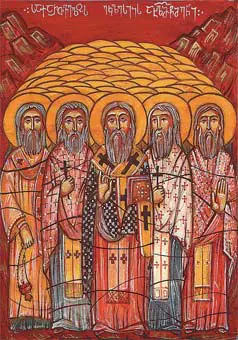
Holy Martyrs Metropolitan Nazar; Archpriests German and Hierotheos; Priest Simon; Protodeacon Besarion (+1924); and All the New Martyrs (XX)
Metropolitan Nazar (in the world Ioseb Lezhava) was born in 1872 in the village of Didi Jikhaishi in Imereti. His forebears had been clergy, and the future metropolitan grew up from childhood in the setting of faith and Church.
Nazar received his primary education at the Kutaisi church school. In 1892 he graduated with distinction from the Tbilisi Theological Seminary. He was ordained first deacon, and then, on 22 February 1893, priest. After the misfortunes that befell him in his personal life (first his wife died, and then both his daughters), he was tonsured a monk in 1904. In 1905 the hieromonk Nazar was appointed teacher of homiletics at the Velensk school; and in 1907 he was transferred as superintendent of the Klevan church school.
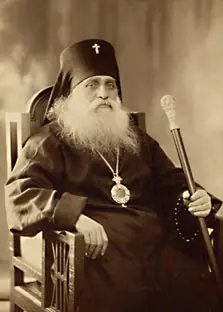
Nazar, Metropolitan of Kutaisi
In 1910 the hieromonk Nazar was raised to the rank of hegumen. In 1911 he became abbot of the desert of John the Baptist. On 1 December of the same year Archimandrite Nazar was raised to the rank of bishop and installed as Metropolitan of Kutaisi.
The ministry of Nazar, Metropolitan of Kutaisi and Gaenati, fell in a very difficult time: in 1905 Georgian churchmen raised the question of restoring the independence of the Church of Georgia, which provoked a sharp reaction from Russia.
The struggle for the autocephaly of the Apostolic Church of Georgia continued in 1906 too. The Holy Synod of Russia was obliged to bring the question of the Church of Georgia before the Russian church council. At this council the question was decided in the negative.
After the revolution of 1917 the Georgians again raised the question of the Church’s independence, and on 12 March 1917 the autocephaly of the Church of Georgia was solemnly proclaimed in the cathedral of Svetitskhoveli at Mtskheta; and a meeting of churchmen held in Tbilisi on 16 March resolved that from then on divine service in the Sioni cathedral should be celebrated in Georgian. Metropolitan Nazar was at the centre of all these events.
Archpriest German Jajanidze
The short period of the autocephaly of the Orthodox Church of Georgia and of national independence gave way to new years of repression. The new regime brought new rules. In 1921 private ownership of land was abolished, and the churches and monasteries were stripped of the lands that belonged to them. The monastery of Gelati, part of Metropolitan Nazar’s diocese, also found itself in a grave situation. The age-old monastery, which was called “a new Athens and a second Jerusalem”, ceased to exist in the spring of 1923.
The years 1922–23 are the hardest period in the history of the Church of Georgia. On the initiative of the Bolshevik government twelve hundred churches were destroyed, church treasures were wiped out, a great many unique manuscripts were burned, and many clergy and people of national outlook were repressed.
Priest Simon Mchedlidze
On 23 February 1921, because of the advance of the Red Army, at the proposal of the Menshevik government and by decision of the Council of the Catholicosate, the treasures of Sioni and Svetitskhoveli were moved to Kutaisi. On the instructions of Patriarch Leonide four boxes of the treasures were buried beneath the balcony of Nazar’s metropolitan residence at the foot of the Bagrati cathedral.
After the occupation of the country the Bolsheviks traced the treasures and arrested Metropolitan Nazar. He was charged with taking part in agitation against the government and with hiding the property of Sioni and Svetitskhoveli. To the question for whom the treasures were being kept, the metropolitan answered at the trial: “For the Church and for the Georgian nation.” The court sentenced Nazar to the supreme penalty — shooting. Afterwards this was commuted to imprisonment and the confiscation of his personal property.
Archpriest Hierotheos Nikoladze
In April 1924, under an amnesty, after two years of imprisonment Metropolitan Nazar was released. He returned to his diocese, where a very grave situation awaited him. The metropolitan was not allowed into his residence, which had been turned into a warehouse. He was obliged to take refuge with his brother’s family.
Metropolitan Nazar bore without complaint his cross, with which the labour of self-sacrifice for the faith was to make the hierarch shine. Beside Vladyka Nazar stood the clergy of the diocese, who lightened his labour as hierarch and who were also cruelly persecuted by the authorities.
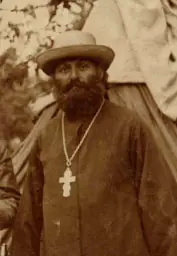
Protodeacon Besarion Kukhianidze
The Georgian people could not reconcile themselves to the atheist regime. In 1924 preparations began in Georgia for an armed rising. On 28 August, the feast of the Dormition, the rising broke out in Kutaisi and soon spread over all Georgia. Officers of the Georgian Extraordinary Commission found the headquarters of the rising in the monastery of Shiomghvime and arrested its leaders. The Soviet authorities’ reprisals took on an unlimited character, and a great many innocent people were punished and shot as a result.
On 27 August, the day before the rising of 1924, a delegation from the village of Rodinouli came to Metropolitan Nazar and asked him to consecrate the village church. At the appointed time Metropolitan Nazar came to the village with clergy. They consecrated the church. At night, while the metropolitan was a guest in a family at Simoneti, Chekists suddenly fell upon him and the clergy accompanying him, bound their hands and feet, beat them with rifle butts, then tied them to an ox-cart and brought them to the village soviet.
The next day the prisoners were taken to the Kutaisi NKVD and shut up in a dark cell with other prisoners. Without any trial a “special troika” shot Metropolitan Nazar in the forest of Sapichkhia, and with him four clergy: Archpriest German Jajanidze, Archpriest Hierotheos Nikoladze, the priest Simon Mchedlidze and the deacon Besarion Kukhianidze.
In 1994 an enlarged church council called with the blessing of Ilia II, Catholicos-Patriarch of All Georgia, considered this event among many other questions and decreed that, in the persons of those slain with Metropolitan Nazar, every Orthodox Christian killed in Georgia by unbelievers for the Church and the nation be canonised, and that they be called by the name of New Martyrs.



