
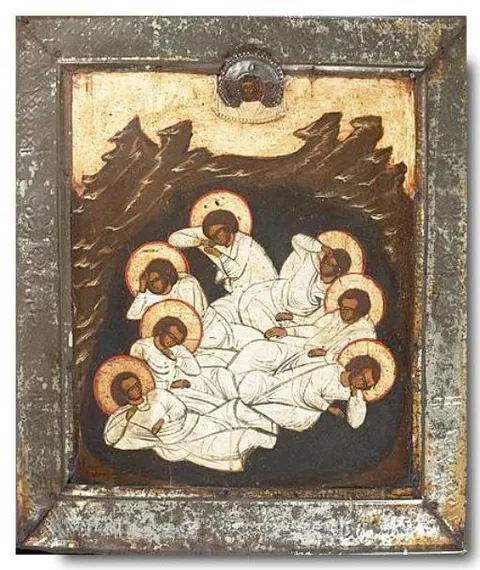
The Seven Youths of Ephesus: Maximilian, Iamblichus, Martinian, John, Dionysius, Exacustodian (Constantine) and Antoninus (+c. 250)
The seven youths of Ephesus, Maximilian, Iamblichus, Martinian, John, Dionysius, Exacustodian (Constantine) and Antoninus, lived in the reign of the lawless Decius (249–251). Saint Maximilian was the son of the head of the city of Ephesus, and the other six young men were sons of other nobles of Ephesus. They had been friends from childhood and served in the army together. When the wrathful emperor came to Ephesus, he ordered everyone to appear to offer sacrifice to the idols. In answer to the order a great multitude of people gathered at the pagan temples. “The city was wrapped in an evil smoke, and the land was held in the darkness and stench of their sacrifice, which they offered to vain gods.”
The Christians who did not obey the king’s command were seized and given over to cruel torments. The soldiers found them even in their hiding places, put them to death by torture, and then dragged the holy bodies through the streets of the city, hung them on the walls for the birds to tear, and set the severed heads on stakes to frighten others… Because of the reign of lawlessness sorrow gripped the faithful. The youths of Ephesus too grieved, who “had given themselves to vigil and prayer”. At last the enemies of the truth denounced them too, reporting to Decius: “Those who are far off thou bringest near to offer sacrifice to the gods, and behold, those near thee despise thy kingship and thy commandments.”
The enraged autocrat summoned the soldiers and ordered them to offer sacrifice to the idols at once. Maximilian answered for his friends too: “We have a hidden God, of whose glory heaven and earth are full, and to Him we offer in secret the sacrifice of our confession and sweet-smelling incense… We will not offer before the idols the stench of defiled smoke, nor will we give over the purity of our souls and bodies to the defilements of the devil.”
Decius ordered the confessors’ military belts to be taken off as a sign of their disgrace. But he did not arrest them: as he was preparing to go on campaign, he hoped that by the time he returned to Ephesus the young men would come to their senses and repent of their conduct.
As soon as they were given time, Maximilian and his friends distributed their property to the poor, left the city, and took refuge in a cave on Mount Ochlon: they wished to prepare themselves for martyrdom by secluded prayer and fasting until Decius returned. The youngest of them, Iamblichus, used to go into Ephesus disguised in the clothes of a beggar to buy bread. On one such outing he learned that the emperor had already returned and that they were being sought. Maximilian urged his friends to appear before the tribunal of their own accord, but, by God’s will, all seven fell asleep “in a sweet death”: “they perceived not their lying down to sleep nor the going forth of their souls. And so they slept upon the earth and commended their souls to God.” When the lawless ruler learned where the blessed ones were, he ordered the entrance of the cave to be walled up with stones, so that the youths inside would perish of hunger and thirst, “for the king and the whole city thought that the saints were alive.” Two secret Christians, the eunuchs Theodore and Vargos, placed among the stones a sealed casket containing two tin tablets with the names of the holy youths and an account of their labours and of the circumstances of their death.
Almost two centuries passed. The persecution of the Christians ceased, but in the time of the pious King Theodosius the Younger (408–450) heretics appeared who denied the resurrection of the dead at the Second Coming of Jesus Christ. And at just this time, to convert those who had gone astray and to strengthen the faithful, the Lord willed to work a miracle: at His prompting, the owner of the land on which Mount Ochlon stood decided to build a fold for his sheep. His servants rolled away the stones and rocks heaped up at the mouth of the cave, and the entrance was cleared. The youths of Ephesus awoke from their long sleep. Their bodies were completely incorrupt. The saints did not even know how much time had passed since they fell asleep, and they sent Iamblichus into the city once more to buy bread. When the youth drew near to Ephesus, he was seized with amazement: the sign of the cross was set up over the gates; in the city the name of Christ was spoken freely… All this made him wonder whether he had lost his way and come to some other place; he wanted to hurry back quickly, but when he handed the bread-sellers a large silver coin with the image of Decius, he was detained for finding and hiding away “a treasure of the ancient kings”.
The blessed one was brought to the head of the city, with whom the Bishop of Ephesus happened to be at the time. Listening to the youth’s confused answers, he thought: “God wisheth to show us some revelation today by the hand of this young man,” and together with the city authorities and the people he followed Iamblichus to the cave. At the mouth of the cave, among the heaps of stones, the hierarch found the sealed casket; he opened it and read the inscriptions made on the tin tablets. All together glorified God, “and so they went into the cave and found those saints sitting with very great joy, and their faces shone like the sun.” The bishop, the head of the city and the multitude of the people bowed down before the saints, “and gave thanks to God, who had made them worthy to see this glorious sight.” Everyone understood that by awakening the blessed martyrs from their age-long sleep the all-merciful Lord had revealed to the Church the mystery of the resurrection of the dead. The Emperor Theodosius himself came to Ephesus and talked with the youths. “The king looked upon them and glorified God, and his heart rejoiced in confession.” During the conversation, before the eyes of all, the God-pleasers “again bowed their heads to the ground and fell asleep”, this time until the general resurrection of the dead. The emperor wished to prepare golden coffins for the saints’ bodies, but that same night the youths appeared to him in his sleep and said: “Our bodies rose from the earth, and not from gold nor from silver. Therefore leave us in our place, where we are, in that cave, upon the earth, for God will raise us up again hereafter from the earth.”
The seven youths of Ephesus are commemorated a second time on 22 October. According to tradition the saints fell asleep a second time on that day; according to another account they first fell asleep on 4 August and awoke on 22 October.



