
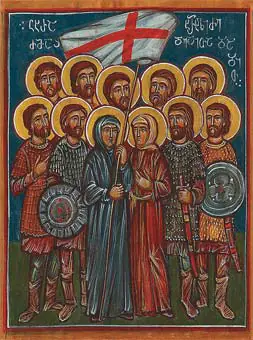
The Nine Kherkheulidze Brothers with Their Mother and Sister, and with Them Nine Thousand Georgians, Fallen on the Field of Marabda (+1625)
On the feast of the Annunciation in 1625, on the field of Martqopi, the Georgians utterly destroyed the army of Shah Abbas. Of thirty thousand Persians only three thousand escaped death. Many famous commanders of Shah Abbas fell in the battle of Martqopi.
This victory united Kartli-Kakheti. The Georgians’ victory encouraged other peoples conquered by the shah too, and “unrest broke out everywhere”… The infuriated Shah Abbas moved against Georgia a huge Persian horde commanded by Isa Khan Qorchibashi. The Georgians encamped with an army of twenty thousand around Kojori and Tabakhmela. The number of the Iranians encamped on the field of Marabda was over fifty thousand.
The dawn of 1 July 1625 came. The Georgian host made ready for Communion: as was the custom, before battle began the warriors received the holy Blood and Body of Christ for the forgiveness of sins and as a pledge of success in battle.
Beside the warriors the clergy too stood armed, for this also had become the rule: Georgia, standing on the edge between being and not being, was defended with cross and sword by layman and monk. Domenti Avalishvili, bishop of Mroveli, came before the army with the holy chalice in his hands. The army cried out with one voice: “If today thou takest up the sword for battle, order another to give us Communion; and if not, it is better from thee.” The bishop of Mroveli pondered and said: “Today the battle is for the faith and the commandment of Christ, and not for me; therefore I will do no other than, having taken up the sword, shed my blood before yours.”
The bishop of Ruisi blessed the host, and himself, clad in armour, took his place in the vanguard. The nine Kherkheulidze brothers were set as guards of the banner of Gorgasali, David and Tamar.
The attack began at dawn. The picked cavalry went ahead, the infantry followed behind. Twelve thousand Persian muskets and the cannon thundered, but no one could stop the knights fighting for the fatherland and for Christ: the Georgians broke into the enemy camp and fell upon the army, and there arose the clash of spears and “the crash of swords and maces upon helmets”.
The courage of the few Georgians turned the Qizilbash back, but the experienced commander-in-chief Isa Khan Qorchibashi did not give up the fight. Meanwhile Shah-Bende Khan, beglerbeg of Azerbaijan, arrived with a relieving force… The Georgians wavered. To this was added one fateful accident: Teimuraz Mukhranbatoni fell, his breast pierced by the enemy. “All thought it the death of the lord of the Kakhs, and the Kakhs and the Kartlians fled” — for the death of the king meant the end of the war. Too late the Georgians realised their fatal mistake. The ranks of the Iberians thinned. Pierced to the heart there fell David Jandieri, Aghatang Kherkheulidze, Baadur Tsitsishvili, and the bishops of Rustavi and Kharchashni.
The Georgian banner passed into the hands of the nine Kherkheulidze brothers; the nine brothers fell heroically on the field of Marabda; then the youngest, their only sister, took in her hand the banner that had come through Didgori and Basiani, and when she too sank to her knees, their mother raised the symbol of the Georgians’ immortality.
Until sunset King Teimuraz fought, who that day “broke every weapon of war, and nothing was left him. Even his rings were broken by the blows of his fist”. The Georgians, weary and drained by the heat, fought heroically to the last drop of blood, but in vain: the battle that had begun at dawn ended late at night in defeat for the Georgians.
On the battlefield lay, pierced through the breast, nine thousand Georgians who had given themselves for Christ and the fatherland, among them: David Jandieri, Aghatang Kherkheulidze, Teimuraz Mukhranbatoni, Baadur Tsitsishvili, the bishops of Rustavi and Kharchashni, the nine Kherkheulidze brothers, their mother and their only sister, nine Machabelis, seven Choloqashvilis… The Church of Georgia numbered among the saints the sons of the fatherland who gave themselves for faith and fatherland.
“Lives of the Georgian Saints”, Tbilisi, 2004.
Nine sons had the mother, nine brave men, arrayed with sword and helmet. She blessed the banner of Kartli for the horsemen, when the treacherous foe fell upon us.
The bold ones charged into the fire, they planted in themselves nothing but valour. The spirit of Georgia adorned them; each one made his sword rage.
One was wounded, and the banner shook… The mother appeared, trusting only in the strength of her arm; she gave her prayer in aid to her son the standard-bearer, and handed the banner to the next son.
She cried out: let the staff not tremble, at the breast of Georgia I nursed you. Cut down the foe, hold back the wind! — like a bell-tower she rang with hope.
She cried out, she tore her hair, with self-sacrifice she urged the horsemen on; through nine right hands the banner passed, and came back to the mother unbowed.
The mother’s voice and blood do not grow cold; she washed her face with the mist of Kartli; like a mountaintop the mist adorned her; her hair became like rain.
Barefoot before the army went the burning mother Ketevan. She steeled the one who toiled for the fatherland; the dagger of Kartli cleft the darkness.
Rising, she throws off her veil. From the fortress of Gori she calls the horseman still: “For the fatherland, the fight for the fatherland!” — the mother of Georgia rings out in the wind.



