
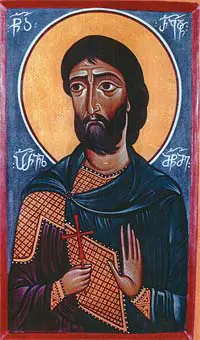
Protomartyr Razhden, Martyred in the Village of Tsromi (+457)
The holy Protomartyr Razhden was a Persian nobleman by origin. When the holy King Vakhtang (commemorated 30 November) took as his wife Balendukht, daughter of Hormizd III, king of Persia, Razhden came to Kartli with the queen; he received Christianity and stayed here for ever. King Vakhtang granted him villages and estates and “made him his intimate and counsellor”.
Saint Razhden often went to church and listened to the Holy Scriptures and to sermons. After his baptism he rose still higher in virtue and kindled in his soul the grace of the Spirit poured out upon him. He envied the lives of the martyrs and their end, and prayed that he too, by God’s will, might be counted worthy of the labour of martyrdom and of drinking the draught of immortality. The blessed Razhden, adorned with the service of God, outstripped even those brought up in the service of God from childhood.
King Vakhtang laboured to strengthen the Church: he established the church hierarchy in Georgia, won for the Church of Georgia independence and a firm peace, drove the Persians out of the kingdom and closed the shrines of the Mazdeans.
When the Persians heard of the plight of the magi of Mtskheta, they lost no time: King Peroz moved a vast army against Georgia. Vakhtang Gorgasali had fortified the fortress-cities beforehand, and he himself took his stand at Mtskheta with his army.
The enemy encamped near Mtskheta. A long war began. Bands of Georgian warriors fell upon the Persians unexpectedly and cut them down. So it went on for five months.
In the war Razhden, “valiant and experienced in battle, a chosen warrior”, who was one of the commanders of Vakhtang Gorgasali, won renown. With God’s help he inflicted defeat on the enemy many times. The enraged King Peroz ordered that the Christianised Persian be taken alive.
During one of the attacks the Persians cut Razhden off, suddenly surrounded him, seized him and brought him bound to the king of the Persians. Peroz rejoiced greatly that the chosen horseman of the Georgians had fallen into his hands, and cheerfully addressed the captive: “Rejoice, brave Razhden, peace to thee! Where hast thou been all this time? Why hast thou denied thy fathers’ law and followed a foreign law, which thy fathers did not teach thee, and instead of the shining sun and fire and the other luminaries servest a crucified man whom the Jews put to death, and thou hast counted Him God? Or is not all this so?”
Razhden answered boldly: “Truly it is so, as thou sayest, O king, for I have become a Christian and have left the godlessness of my fathers, and I no longer worship the consuming fire, nor the sun, created to serve men, but the living God, who made the heavens and the earth and all that is in them, visible and invisible, who only hath immortality, dwelling in the light which no man can approach unto, whom no man hath seen, nor can see.”
King Peroz was filled with anger, but he restrained himself, for he thought he would win Razhden’s heart by caresses and honours, and he said to him: “Listen, Razhden, leave these useless words and obey our commands, and we will grant thee honours and glory greater than before, and make thee a sharer in our glory, and thou shalt be our intimate friend and beloved. And if thou do not, we will put thee to death with a bitter death and torments of many kinds.”
Razhden listened calmly to the king, and then answered: “What are thy gifts and honours, O king? Are they not passing, vanishing like a dream and passing away like a shadow? But the soul is immortal and abides immortal; and if I heed thy command and obey thy words, shall not I too die like all men, and afterwards be tormented for ever in the unquenchable fire, and leave thy riches here? But if I die for Christ, I shall become immortal for ever and reign with Him.”
The lawless king was enraged and ordered the saint to be cruelly beaten. The masters of torture threw Saint Razhden to the ground and beat him terribly; they broke his teeth, stained his face with blood, dragged him over a steep rock, then put heavy fetters on him and threw him into prison.
In the dungeon the saint earnestly besought the Lord to grant him the strength of patience, that he might not betray Christ. In prison too the Persians tried hard to win the saint over, but in vain.
The news of Razhden’s capture and torture at once reached Mtskheta. Several Georgian noblemen came before King Peroz and asked him to release Razhden for a short time. Peroz made Razhden swear to come back and let him go to Mtskheta.
Razhden visited the king first. The God-loving king rejoiced, kissed him and greeted him with love. His household was filled with joy, for they had not expected to see him. When his wife learned that Razhden was to go back again, she pleaded with her husband: “Why dost thou so give up thy life and deliver thyself to death, and make us altogether desolate and orphaned? Do their bidding and save thyself and us, that thou mayest not die an evil death and we through thy death be given over to bitter trial and grievous sorrow.” Saint Razhden gently reproached his wife: “Why dost thou become a counsellor of evil to me, woman, like Eve, or like the wife of Job, that I should listen to thee and become like Adam — mortal instead of immortal, corrupt instead of incorruptible, and turned to dust…”
The saint went back again. On his way a troop of horsemen sent to seize him met him. Saint Razhden bravely declared that he was the one they were seeking. The godless seized him, beat him mercilessly with sticks again, bound him, drove him before them and brought him to the king. Peroz tried once more to win Razhden over, promising him great honour and riches, but Razhden answered boldly: “Nothing shall separate me from the love of Christ — tribulation or distress, persecution or bonds, death or life, riches or poverty; nothing shall be able to part me from His love; I am ready to endure all.”
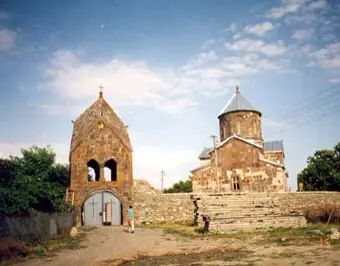
The cathedral of Nikozi, where the holy Protomartyr Razhden is buried
The enraged Peroz ordered Razhden to be sent to the commander encamped at Tsromi, and sent him word: if he obeys, send him away with honour; if not, torture him so that his flesh is not even fit for burial.
The commander at Tsromi had long before heard of Razhden’s valour, and so he rejoiced greatly when he saw him in person, and tried to win him over with sweet words. The saint answered firmly: “Why do you compel me, lawless ones, to forsake the living God, who created heaven and earth and all that is in them?.. I count your honours and gifts as reproach, for they are today and tomorrow are no more. Now do whatever you will, for I am ready to bear every evil for Christ.”
The enraged ruler tortured Saint Razhden cruelly. They beat him about the head and face, smashed his teeth and broke his cheekbones. But the blessed one still gave thanks to God and rejoiced in spirit that he was suffering like Christ.
Saint Razhden, bound hand and foot, was thrown into prison again. The Saviour did not leave him, but comforted and strengthened him. Saint Razhden’s courage for the coming contest grew ever greater.
Many times they tortured him, many times they offered him gifts and honours, but they could not win him over. When at last they lost all hope of converting him, they resolved on death by crucifixion.
“Since he puts his hope in one slain on a tree, let him too end his life on a tree” — so they passed sentence on the saint, and then “they set up the tree and nailed to it the lamb of Christ”. Beside him five robbers were hanged on trees, as Jesus was between two robbers. They shot arrows into the holy martyr as he hung on the cross. The arrows that had been shot they pulled out of his body and thrust in again. His whole body was cut with wounds. The saint’s last words were: “Into thy hands, O Lord, I commend my spirit.” This took place on 3 (16) August 457.
At the time of Saint Razhden’s martyrdom, as on the day of the Saviour’s crucifixion, darkness came down at midday; a fierce wind arose and scattered all who were gathered there, among them the guards whom the lawless ruler had set so that the Christians should not take away the body and bury it, but that the birds and beasts should eat it.
At night the Christians of that place brought a priest, took the holy martyr’s body down from the cross, and secretly committed it to the earth.
A few years later peace was established in Georgia. Saint Vakhtang Gorgasali began to search for the relics of Saint Razhden. No one knew the place of burial except the priest. One night the saint, clothed in glory and splendour, appeared to the priest and said to him: priest, arise, delay no longer; the king wishes to see my relics and to come out to meet me; go and tell him where they lie, and wherever he himself wishes, there let him lay them.
Full of fear and joy, the priest at once went to the king and told him how, when and where Saint Razhden had been buried, how he had appeared to him and what he had commanded.
Hearing this, the king was filled with unspeakable joy and gave thanks to God and to the most blessed martyr. He at once called the bishops of his kingdom and other clergy, and sent them with a great many gifts to the village of Tsromi, where the much-suffering body of the martyr, crowned with his labours, was buried.
They reached Tsromi and with fear and reverence brought up the martyr’s body. An indescribable fragrance spread over the whole place. The saint’s remains were carried with singing, candles, tapers and the fragrance of incense to Nikozi, to the episcopal church built by King Vakhtang. The king and queen came far out to meet them with great longing and faith, and kissed the relics with tears, accompanied by the lords and nobles. They followed the saint’s body on foot.
After this, at the martyr’s wish and call, the king built a beautiful church in the name of Saint Razhden in the fortress of Ujarma, and another church in the plain of Ujarma, which is called Samgori.
“Lives of the Georgian Saints”, Tbilisi, 2004.
Him who forsook the rotten religion of the Saracens and walked in the ways of truth, who endured many afflictions for Christ, illustrious among the faithful, the luminary of Georgia, the great martyr Razhden, let us the faithful praise with divine songs, that by his intercession we may be delivered from trials.
Follower of the true Shepherd and sharer in His divine Kingdom, faithful servant and luminary shining like a star, offered up to Christ, O great martyr Razhden, intercede for us who praise thee.



