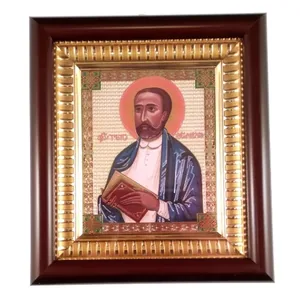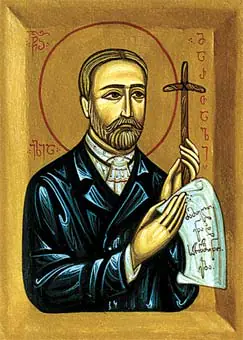
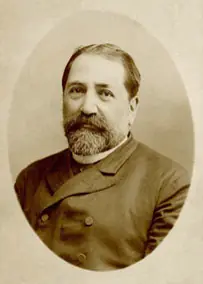
Saint Ilia the Righteous (Chavchavadze) (+1907)
Saint Ilia the Righteous (Ilia, son of Grigol, Chavchavadze) was born on 27 October 1837 (old style) in Kakheti, in the village of Qvareli. He received his first education at home: his mother taught him to read and write, his prayers and sacred history. At eight Ilia was entrusted to Nikoloz Sepashvili, the protodeacon of Qvareli. The three years spent with him left an indelible mark on the saint’s life. Ilia continued his studies first at a private boarding school in Tbilisi and then at the gymnasium for the nobility. His parents died early, and his aunt Makrine took on the guardianship of the orphaned family.
In 1857 Ilia became a student in the law faculty of the University of St Petersburg. During his studies at the university Ilia read a very great deal, and was especially interested in old Georgian books. His academic results were high, but Ilia had no interest in the official certificate of a legal education. He gave up his studies in the fourth year, and in 1861 returned to Georgia deeply and widely learned.
“What new thing shall I tell my country, and what will it tell me?.. Shall I be able to speak a heartfelt word to it, and with this word heal its heartache, raise the fallen, bring comfort to the comfortless, wipe the tears of the weeping, lighten the toil of the labourer?” the twenty-four-year-old youth asked himself. After this there was not a single day, not a single minute, when he did not think of Georgia. The nation had to be awakened, the true word had to be spoken… And Ilia did not shrink from bitter reproof.
Ilia held that “as that vagrant is not counted a man” who “no longer remembers who he is, where he comes from and where he is going, so he is not worth mentioning who… does not remember his own history”; and so he reminded his fellow countrymen of their past glory, of the Georgians’ self-sacrifice in defence of faith and fatherland: “What have we not lived through, what enemies have not fallen upon us, what woe and lamentation, what bloodshed, what gnashing of teeth have we not passed through, what millstone has not turned upon our heads — and we withstood them all, we held out against them all. We kept ourselves, we saved our country, our land and water. The Tamerlanes bathed us in our own blood, and still we remained and came back to life. The Shah Abbases made us tear our little ones with our own teeth, and still we recovered and came to ourselves; the Agha Mohammed Khans threw us down on our faces, left not a stone upon a stone, slaughtered us, butchered us — and still we stood up on our feet, built again and straightened our backs. We held out against Greece, Rome, the Mongols, the Arabs, the Ottoman Turks, the Persians, believer and unbeliever, and the banner of Georgianness, torn by spear-points, arrows and bullets, soaked in our blood, we kept in our hands; we let no one carry it off, gave it up to no one, let no one defile it. Is it not a sin if this banner is now eaten by the moth and gnawed by the mouse?.. The times promise us this” (“What Shall I Tell You? How Shall I Gladden You?”)…
The national interest compelled Ilia to take on the task of historian: he delved into the chronicles, searched, investigated, and gave a fitting answer to those who insulted Georgia’s dignity and falsified history. In this respect his cycles of articles “Here Is History” and “The Cry of the Stones” are worth noting. Of special importance too were his “Home Surveys”, which reflected current life — the programmatic articles of “Iveria”, whose aim Ilia saw as “the restoration of our fallen identity, setting it on its feet and protecting it from every danger that may come”.
The great Georgian public figure often repeated: “If the language is ruined, the nation falls too.” He cared for the purity of the language and fought to defend its rights in the schools. In 1881, when the highest authorities of the Caucasian educational district resolved to drive the Georgian language out of the schools, he showed in the article “On Mr Yanovsky’s Letter” that “without the mother tongue the opening of a child’s mind is utterly impossible; then the school is not a means of opening the mind… but of shutting it up, of crushing it”… This stand bore fruit. Those minimal rights that the Georgian language kept in the schools were the result of the struggle of Ilia together with other Georgian public figures.
Ilia breathed life into many national causes as well: he founded the Society for the Spreading of Literacy among Georgians and the repository of old Georgian manuscripts and antiquities, and laid the foundation for collecting examples of folk literature. He was one of the initiators of the founding of the Georgian Land Bank.
At the very beginning of his work Ilia the Righteous declared: “Three divine treasures have been left to us by our fathers and forefathers: fatherland, language, faith. If we do not look after these too, what kind of men shall we be, what answer shall we give to our descendants?” We see him also among those who fought for the autocephaly of the Church of Georgia: in October 1905 he attended a meeting of the clergy held in the building of the school of the church of Saint Nicholas, devoted to the question of the autonomy of the Church of Georgia, and he led a group of public figures who asked the Viceroy of the Caucasus to support the Georgians’ struggle to recover autocephaly.
Ilia’s work so irritated and alarmed the misguided followers of the satanic teaching created to fight against the Church and against every national identity that they resolved to destroy Ilia physically…
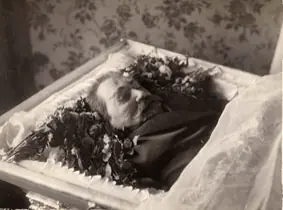
On 30 August 1907 the carriage travelling from Tbilisi to Saguramo, in which Ilia and his wife Olga Guramishvili were riding, stopped near the forest of Tsitsamuri. The roar of gunfire shook the majestic surroundings. Ilia leapt up: “Stop, you wretches, I am Ilia!!!” he cried, but a bullet from a Berdan rifle stopped his heart, which was full of love for Christ and for the homeland.
All Georgia wept over the body of Saint Ilia.
The Caucasian military court sentenced Ilia’s murderers to hanging. Ilia’s widow, Olga Guramishvili, herself appealed to the governor-general of Tbilisi to pardon the murderers: “I deeply believe that if my husband were alive today, he would forgive those who condemned him to death and would count them his unhappy, misguided brothers… It is as if I have remained in this world only to complete that labour of fervent love for people to which my husband gave his whole life — to forgive those unhappy, misguided neighbours whom he himself would have forgiven. My days are numbered; it now depends on you to act so that at the hour of the end of my life I may feel the highest blessedness that a human soul can attain in this passing world — union with God, which Christ knew when, stretched out on the cross, at the hour of death, lit by the light of divine love, He besought the Creator to forgive those enemies, ‘for they know not what they do’.”
And Ilia had forgiven his murderers in his own lifetime, in the famous poem “Prayer”:
“Our Father, which art in heaven, on bended knee, with tender heart I stand before Thee; I would not ask for riches nor for glory, I would not so dishonour holy prayer… But I desire that my soul be enlightened from heaven, that my heart be kindled with the love Thou hast commanded, that even for my enemies, though they plunge a dagger into my heart, I may beseech Thee: ‘Forgive them, they know not, O God, what they do!’”
In 1987 the Holy Synod of the Church of Georgia considered the labours of Ilia Chavchavadze for the nation and the Church and decreed: “That Ilia Chavchavadze be numbered among the saints and be called Ilia the Righteous.”