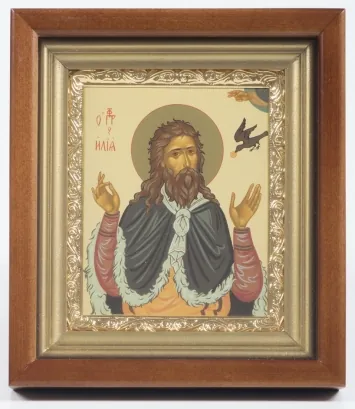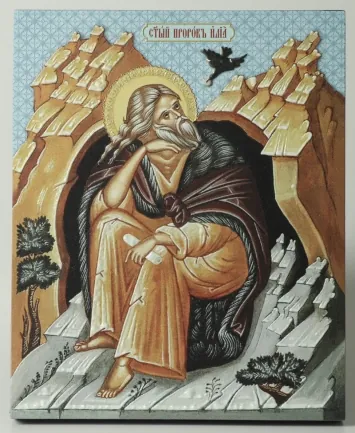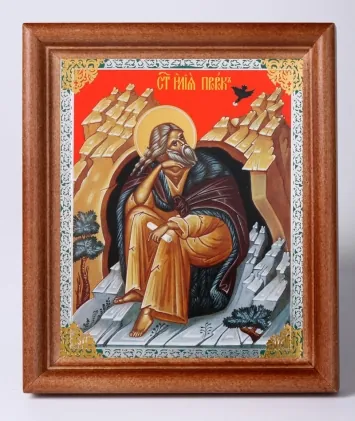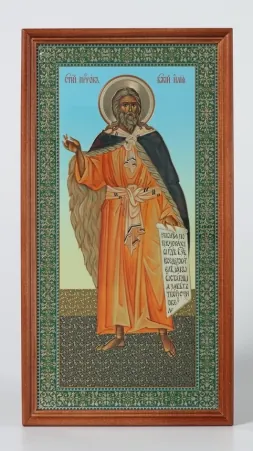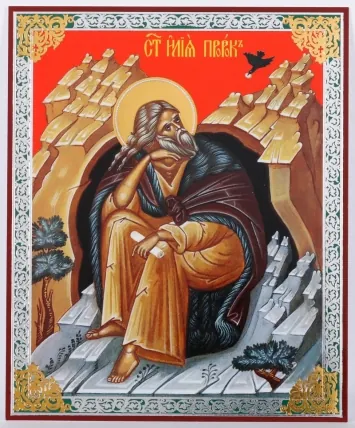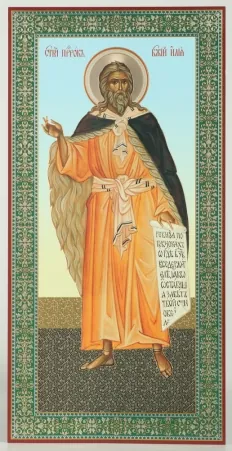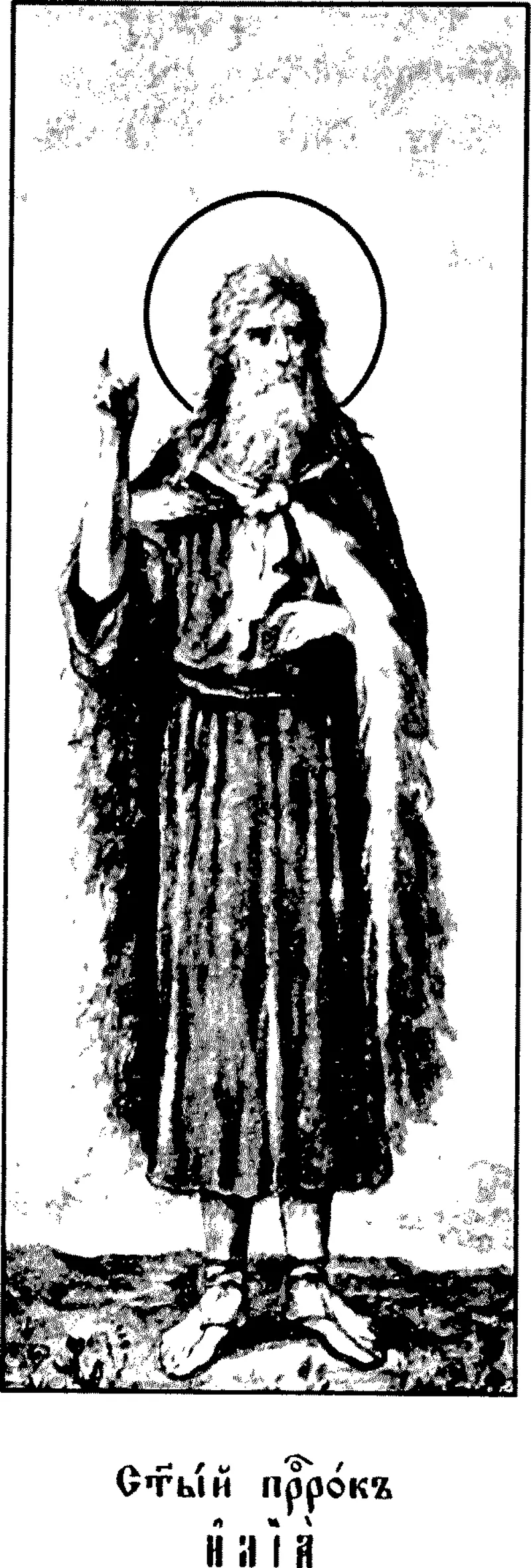
The Prophet Elijah the Tishbite (IX c. before the Nativity of Christ)
The Prophet Elijah, one of the greatest prophets, sprang from the tribe of the Levites more than nine hundred years before the Nativity of Christ. The blessed one’s surname, the Tishbite, comes from the name of his native city, Tishbe (this city, by one supposition, lay in Galilee, and by another near the river Jordan, in the land of Gilead). According to Epiphanius of Cyprus, when Elijah was born his father saw a mysterious vision: comely youths were wrapping the newborn in flames of fire and feeding him with fire.
From his youth Elijah dedicated himself to God: he withdrew into the desert and spent his days in strict fasting, prayer, and contemplation of God’s providence. The Lord called him to prophetic service in the reign of the lawless King Ahab. By this time Israel was sunk in lawlessness: the people had turned their backs on the Law and bowed their necks to idols. An especially devoted champion of idolatry was King Ahab’s wife, the pagan Jezebel, who persuaded her husband to build an altar to Baal. Horrified by the corruption and degeneration of his people, Elijah stood before Ahab, denounced his lawlessness, and called him to repentance and to return to the true God. The prophet declared to him that for breaking the covenant made with God, drought and famine would fall upon Israel as a punishment, and would cease only through Elijah’s prayer. Elijah’s words were fulfilled: the heavens were shut, the parched earth gave no fruit, the people suffered terribly… The Lord commanded Elijah to go to “the brook Cherith, that is before Jordan.” Here ravens brought Elijah food twice a day, morning and evening. When because of the long drought the spring of Cherith too dried up, the prophet at God’s command went to the village of Zarephath near Sidon. Here he lodged in the house of a widow, whose flour and oil miraculously did not run out while Elijah was there. At this time the only son of the widow of Zarephath fell ill and died. By the power of prayer the prophet raised the boy from the dead and gave him back to his mother.
After three years of drought, when the famine had reached its utmost limit, Elijah appeared before King Ahab, who had gone out with Obadiah, the governor of his house, to look for pasture for the cattle. Ahab, in the grip of superstition, saw in him a bringer of misfortune and said to him: “Art thou he that troubleth Israel?” “Not I, but thou and thy father’s house, in that ye have forsaken the Lord your God and have followed Baalim,” the prophet answered, and asked him to gather the people living in Israel and the priests of Baal, who were under Jezebel’s special protection, on Mount Carmel. Ahab agreed, and on the appointed day eight hundred and fifty priests gathered on Mount Carmel. Elijah proposed that they offer sacrifice to their gods on equal terms (without lighting a fire on the altar). In vain the priests ran round the altar from morning till evening, begging Baal to send fire. “Cry aloud: for he is a god; either he is talking, or he is pursuing, or peradventure he sleepeth, and must be awaked,” Elijah told them. In the evening the prophet himself restored the ancient altar on Carmel built of twelve stones, which symbolised the renewal of the people’s covenant with God; he had a trench dug round the altar and filled it with water poured over the sacrifice and the wood. In answer to Elijah’s prayer fire came down miraculously from heaven, which consumed the wood and the sacrifice together with the stones of the altar, and dried up the water in the trench. The astonished people with one voice confessed the true God: “The Lord, he is the God; the Lord, he is the God!” (3 Kings 18:39), and slew the priests, as corrupters of the people, at the brook Kishon. After this the prophet said to the king: “Get thee up, eat and drink; for there is a sound of abundance of rain” (3 Kings 18:41); the sky was covered with clouds and heavy rain began to fall. King Ahab too glorified God and repented of his lawlessness, but the king’s repentance proved short-lived. When he told his wife what had happened, Jezebel was terribly enraged and ordered Elijah to be put to death: the persecution of the Lord’s chosen one was renewed. The prophet went first to the kingdom of Judah, to the city of Beersheba, and then withdrew into the Arabian desert and, full of deep sorrow, cried out to heaven: “It is enough; now, O Lord, take away my life; for I am not better than my fathers” (3 Kings 19:4). By God’s will a radiant angel stood before him, strengthened him with food, and indicated that he had a long journey ahead. Strengthened in soul and body, Elijah set out through the desert of Sinai for Mount Horeb, which he reached after forty days. Here he took refuge in a cave. Suddenly the blessed one heard the voice of the Lord: “What doest thou here, Elijah?” “I have been very jealous for the Lord God Almighty,” Elijah answered, “for the children of Israel have forsaken Thee, thrown down Thine altars, and slain Thy prophets with the sword; and I, even I only, am left; and they seek my life, to take it away” (3 Kings 19:10). The Lord commanded the prophet to come out of the cave and stand on the mountain. First a great wind arose and the earth shook. After the earthquake came a fire, but God did not reveal Himself to Elijah in the wind, nor in the earthquake, nor in the fire. After the fire a cool breeze blew, and Elijah felt the nearness of God. By these signs the Lord showed His chosen one that He wished to convert mankind by patience and mercy, and not by terrible punishment. Sensing the presence of God there, the prophet came out of the cave and, in reverent fear before the incomprehensible God, covered his face with his mantle, as Moses had done when God appeared to him on Mount Horeb. After this Elijah received God’s command to go by the same road to Damascus and anoint Hazael king of Syria and Jehu king of Israel, and to appoint Elisha a prophet. Of these the holy Prophet Elijah was able to carry out only the last; the first two he bequeathed to his disciple Elisha. The Lord comforted Elijah, disheartened by the general apostasy: He told him that there were still seven thousand men left in Israel who had not bowed down to the idol of Baal.
By the Lord’s will the Prophet Elijah was taken up to heaven in a chariot of fire. According to the teaching of the Church, before the Second Coming he is to come with Enoch to denounce the Antichrist, and is to endure bodily death as well (Rev. 11:2–9). According to church tradition, Elijah’s mantle is buried in Georgia, in the cathedral of Svetitskhoveli, in the side chapel dedicated to the holy Prophet Elijah.