
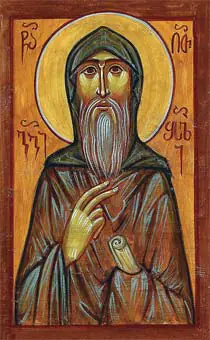
Our Venerable Father George the God-clad, the Recluse, Teacher of St George the Athonite (X)
Saint George the God-clad, wishing for solitude and withdrawal from the turmoil of this world, left Georgia and settled to labour on the Black, or Wonderful, Mountain. At that time there were a great many churches and monasteries there. Everyone was trying to establish himself in the place, and misunderstandings between monks of different nations were not rare. The holy father found refuge in the clefts of an inaccessible mountain and settled there to labour.
The monks who laboured there knew well of the holy life of George the Recluse. Today we know very little about him, but it is clear that he was at one and the same time a very great ascetic and a worker in the world, raised above everything national and yet a very great patriot. His title — the God-clad — speaks best of all about his person.
When the great father George the Athonite (commemorated 27 June), who had left Georgia secretly, had venerated the monasteries of the Black Mountain and the graves of Saint Symeon the Stylite and his mother, blessed Martha, he began to seek a spiritual father, for he knew that without a teacher “there is no life for the soul and no progress in the monastic life”. On the Wonderful Mountain he found a holy monk shut away in a cleft of the rock, “like a spotless turtle-dove and a guileless dove, a heavenly man and an earthly angel”. This was George the God-clad, a monk “set apart from the flesh and from fleshly cares, in mind departed unto God”. Saint George the Recluse took the Venerable George as his disciple, settled him in the monastery and kept him for three years in toil and labour, in fasting and vigil.
Three years later the blessed monk saw that his disciple “was perfect in all things, in stature, wisdom and understanding”; he blessed him with the schema “and with this he completed his monasticism”.
With his teacher’s blessing Saint George venerated the holy places of Jerusalem and returned again to the Black Mountain. George the Recluse blessed the holy father George the Athonite to go to Athos and continue the work of Saint Euthymius the Athonite (commemorated 13 May), translating the divine books from Greek into Georgian, and he encouraged him with words filled with unshaken faith and hope: “My son, He who delivered that holy one (Euthymius the Athonite) from death and loosed his Georgian tongue is able to help thee too, for He greatly pities and loves our nation.”
The Venerable George went to the holy mountain of Athos, but instead of translating books he did the work of a novice for seven years. When George the Recluse learned of this, he sent his disciple to Athos and “sent George a great reproach” for “not having done his will”. George the Athonite, in accordance with his teacher’s wish, received the rank of the priesthood and afterwards set his hand to the work of translation as well.
Although Saint George the Recluse lived a hermit’s life, he made a very great contribution to the development of Georgian sacred literature. He had close ties with the Georgian fathers labouring on Athos, from where, in his words, “the good God, the lover of mankind, has made the whole East shine with divine light and adorned anew the holy churches of Kartli”. He set Saint George the Athonite on the path of literary work. At his request and by his commission George the Lesser wrote the life of his teacher, Saint George the Athonite. Saint George the Recluse copied the lives, translated by David of Tbeti from Greek into Georgian, of Martha, the mother of Symeon the Wonderworker, and of Saint Barlaam the Syro-Caucasian.
Saint George the Recluse died in 1068, after the death of his renowned disciple.



