
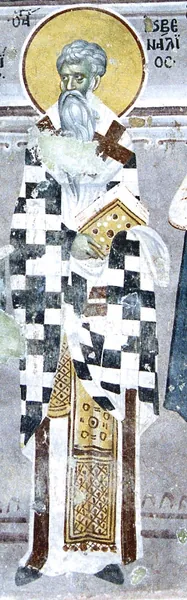
St Juvenal, Patriarch of Jerusalem (+c. 458)
Saint Juvenal, Patriarch of Jerusalem, governed the Church of Jerusalem in 420–458. He was a friend and fellow ascetic of Euthymius the Great. At that time many heresies troubled the life of the Church in the East. The venerable father too fought boldly against them. In 431 the Third Ecumenical Council met in the city of Ephesus and condemned the heresy of Nestorius, who denied the divine nature of the Saviour. The council was presided over by Saint Cyril of Alexandria (+444, commemorated 9 June). Among those of one mind with him was the Patriarch Juvenal. In 451 the Fourth Ecumenical Council was held in the city of Chalcedon to refute the new, Monophysite false teaching of Eutyches, which asserted that after the Incarnation the one, divine, nature of Christ had entirely swallowed up the other, human, nature.
The holy fathers, among whom was the Venerable Juvenal, rejected the heresy of Eutyches and confirmed the Orthodox teaching that the divine and human natures of Christ are unconfused and undivided. The heretics nevertheless went on raging. At their head stood Theodosius, who demanded that the Patriarch Juvenal publicly condemn the decree of the Council of Chalcedon. The holy chief shepherd refused to carry out the insolent demand of the heretics. Then the lawless drove the blessed one from his throne. Theodosius himself occupied the holy see. The banished confessor went to Constantinople, to the holy Patriarch Anatolius (449–458; commemorated 5 July) and to the Emperor Marcian. The autocrat, who deeply revered the saint, managed within two months to restore him to the patriarchal dignity. The blessed father returned to Jerusalem.
The Venerable Juvenal laboured greatly to heal the rift of schism that had opened in the Church. After the defeat of the heretics and the restoration of the unity of the Church, the holy patriarch reposed in peace (+458).



