
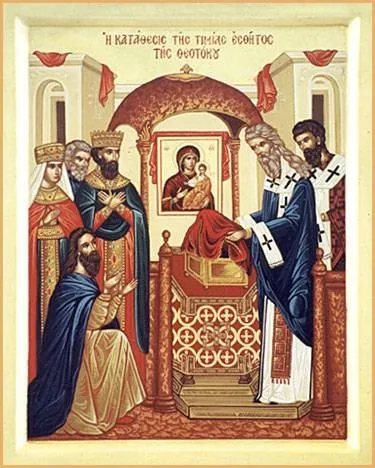
Deposition of the Precious Robe of Our Most Holy Lady the Mother of God at Blachernae (V)
The Deposition of the Precious Robe of Our Most Holy Lady the Mother of God at Blachernae. In Byzantium, in the reign of Leo the Great, the Macedonian (457–474), two brothers close to the king, Galbius and Candidus, set out from Constantinople for Palestine to venerate the holy places. In a small village near Nazareth they stayed the night with an old woman. In the house the guests’ attention was drawn by burning candles and the fragrance of incense. When asked what holy thing she kept, the hostess for a long time would not answer, but the brothers insisted, and the woman was forced to reveal that she was guarding a precious holy thing, the robe of the Mother of God, from which many miracles and healings had come.
Before her Dormition the All-holy Virgin had given one of her garments to a pious Jewish virgin of this family and asked her, when her death drew near, to hand it on to another, likewise a virgin. So the holy thing was passed down in this family from generation to generation. The precious coffer with the holy robe was translated to Constantinople. The Patriarch Gennadius (+471; commemorated 31 August) and the Emperor Leo approached it with reverence and kissed it. At Blachernae, on the seashore, a new church was built in honour of the Mother of God. On 2 July 458 Saint Gennadius of Constantinople, having placed the holy thing in a new coffer, translated it with fitting honour to this church. Later the holy omophorion of the Mother of God and part of her belt were placed in the coffer of her precious robe. The feast unites two events: the deposition of the robe of the Mother of God and of her belt at Blachernae.



