
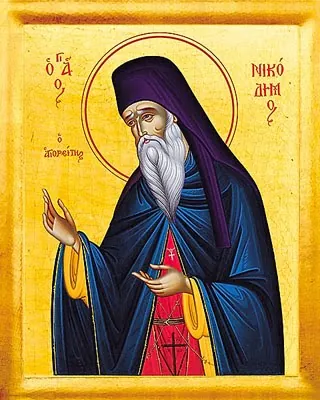
St Nicodemus the Hagiorite (+1809)
Saint Nicodemus the Hagiorite (in the world Nicholas) was born in 1748 on the Greek island of Naxos. He was twenty-six when he went to Mount Athos, and there, in the monastery of the Nativity of Saint John the Baptist (Dionysiou), he was tonsured a monk with the name Nicodemus.
At first Nicodemus carried out the obediences of reader and secretary. Two years after his arrival at the monastery Macarius, Metropolitan of Corinth, visited Athos. He charged the young monk with preparing for publication the manuscripts of the Philokalia, which he had discovered in 1777 in the monastery of Vatopedi. Work on this book laid the foundation of Nicodemus the Hagiorite’s long literary labours. Saint Nicodemus moved to the skete of Pantocrator, to the experienced elder Arsenius of the Peloponnese, under whose guidance he studied Holy Scripture and the writings of the holy fathers attentively. In 1783 Nicodemus was clothed in the schema and gave himself up to complete silence. When Macarius of Corinth came to Athos again, he laid a new obedience on the zealous monk: the editing of the works of the Venerable Symeon the New Theologian. Nicodemus left the labour of silence, set his hand again to literary work, and from then on laboured diligently in this field until his death.
Shortly before his end Nicodemus went to live with the icon-painting hieromonks Stephen and Neophytus Skourtaioi. The saint asked the monks to see to the publication of his works, which, weakened by illness, he could no longer manage himself. Here, with the Skourtaioi, the blessed father commended his soul to the Lord in peace on 1 July 1809.
According to the testimony of his contemporaries, the Venerable Nicodemus was simple, meek, unselfish and wonderfully collected. He had an astonishing memory: he knew the whole of Holy Scripture by heart, and many passages from the writings of the holy fathers.
Saint Nicodemus’s works are many and varied. Among his ascetic instructions the book Unseen Warfare is especially notable; to him belong also an Instruction on Confession, the introduction to the Philokalia, short lives of holy ascetics, and an interpretation of the seven Catholic Epistles… The venerable father compiled a New Selection of Lives of the Saints and a New Synaxarion in three volumes; he prepared for publication the Pedalion, a new edition of the Greek book of canons, which contains the rules laid down by the apostles, by the Ecumenical and local councils, and by the holy fathers.



