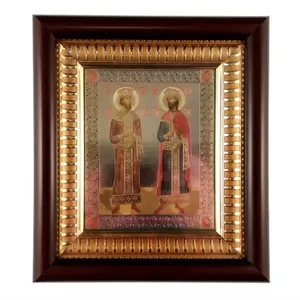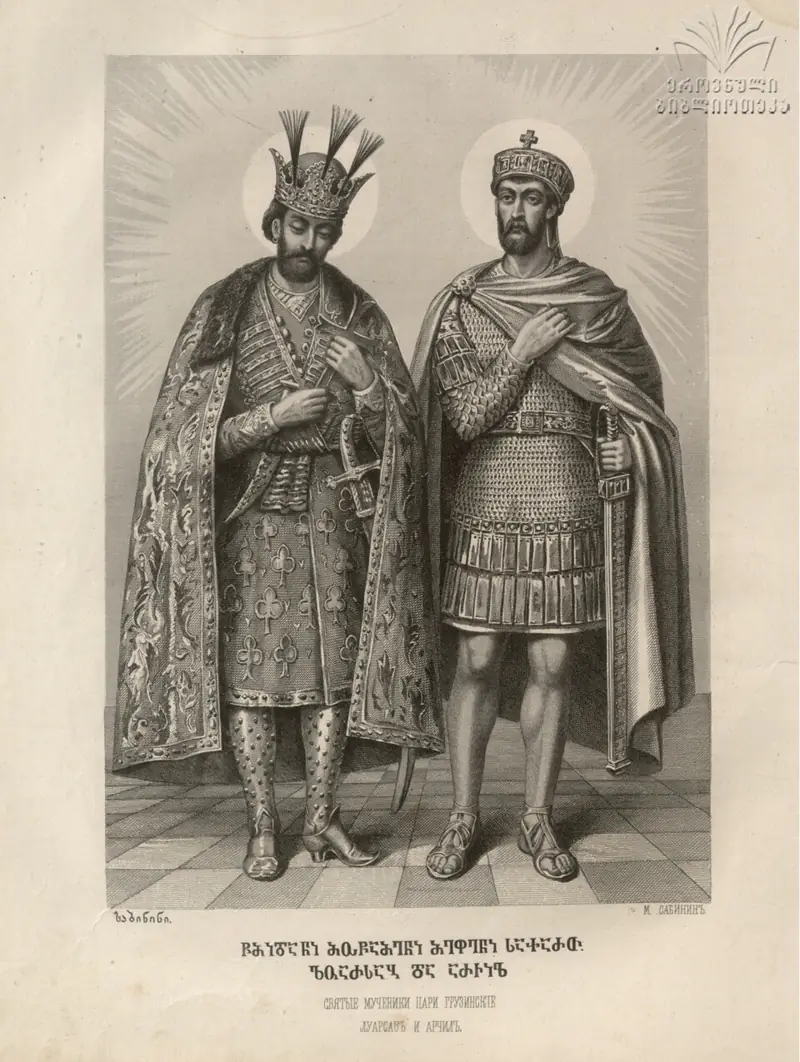
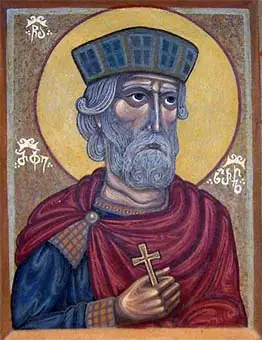
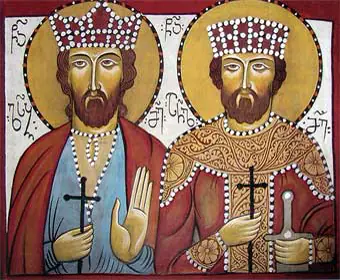
Holy Martyrs Archil (+744) and Luarsab (+1622), Kings of Georgia
The holy martyr King Archil ruled the kingdom of Kartli in the hardest of times for our country. His reign was an unyielding struggle against lawless conquerors and a tireless care for the unity of Georgia. Archil’s father, Adarnase, eristavi of Kartli (one of the builders of the Jvari of Mtskheta), set Archil’s elder brother Mir as ruler of Kartli. Archil stood by his elder brother in everything and cared for the kingdom in the fear and love of God. In Mir’s reign Murvan the Deaf invaded Kartli; the bloodthirsty butcher shattered “all the buildings and strongholds of Georgia” and drenched the country in blood. Mir and Archil took refuge in Abkhazia and fervently begged the all-holy Theotokos for help. The Lord heard the prayer of the righteous: one night the all-holy Theotokos appeared to Saint Archil and commanded: “Arise and fight against these lawless ones, for the angel of the Lord shall go before you, and the Lord shall fight for you.” Mir and Archil with a small force, “trusting in God and with the help of the all-holy Theotokos”, fell upon the enemy camp. The encounter ended in victory for the Georgians. On the fleeing lawless ones God sent a fierce wind and heavy rain; the rivers flooded and swept away the host of the Hagarenes. Those of the invaders who survived hurried to Constantinople, but the wrath that came upon them from on high drowned them in the sea.
King Mir, wounded in the battle, soon fell ill; before his death he handed the kingdom over to his brother Archil, asked him to protect his seven surviving daughters, and charged him to bury him at Mtskheta.
King Archil fulfilled Mir’s charge and buried him in the upper church of Mtskheta; six of his seven daughters he gave in marriage to Georgian nobles with a fitting dowry, and the seventh, Gurandukht, he married to the Byzantine emperor.
For twelve years Archil sat at Kutaisi and strove in every way to unite all Georgia; then he moved to Kartli and set about rebuilding that most beautiful region, laid waste by the Arabs; he joined to himself Kakheti, the highlands, Egrisi, Abkhazia and Samtskhe-Javakheti. The rule of the Arabs in fact did not reach beyond the surroundings of Tbilisi and Mtskheta.
The country ravaged by Murvan the Deaf had not yet recovered when an Arab army under the command of Chichum-Asim again laid Kartli waste and turned towards Kakheti. There was no sense in resisting, and King Archil resolved “to lay down his life for the salvation of the Christians”. “Better my death than the churches of Christ destroyed again and this land laid waste,” said the king, and he came before Chichum-Asim to ask for peace. Chichum-Asim rejoiced at the king’s coming, greeted him with honour, and “praised his goodness and the perfection of his stature and the beauty of his face”.
For several days Chichum entertained the king of the Georgians splendidly, and then he demanded that he leave the saving faith and accept the faith of the Saracens, “promising him very great gifts” in return. The anointed of the Lord, filled with the Spirit from on high, said: “If I believe thee, I must die a death after which I must be tormented… Our God and our Saviour laid down His life for our salvation, and so I do not fear death. If thou kill me, I too shall rise after death, as our God did, and shall glorify Him again.”
The enraged Chichum ordered “that he be seized and sent to prison with much affliction and distress, for he thought that perhaps the fear of torments would bend his unshaken mind”; yet he could not bring himself to put the valiant and handsome king of the Georgians to death.
In prison the devout King Archil earnestly besought the Lord to grant him strength to endure the torments.
There came before Chichum-Asim an Armenian prince of Gardabani who had turned Muslim, the murderers of whose uncle Archil’s father Adarnase had spared from punishment. The Armenian bore a grudge on account of the grandfather and resolved to take vengeance on the grandson.
The Armenian said to Asim: great prince, Archil is the son of King Stephanoz, a kinsman of King Vakhtang, who was the grandson of King Mirian; he was with his father when he hid the royal treasury of Kartli, and he also knows where Heraclius, the king of the Greeks, buried his treasure.
Chichum-Asim called the king of the Georgians out of prison and said to him: at first I esteemed thee for thy goodness and beauty, but now I have learned that thou art the son of great kings, and so I will exalt thee before me. Let thy kingdom and the treasury of thy fathers be thine, only show me the treasure of the king of the Greeks, which he carried off from Persia and buried in Georgia. And change thy faith, become a Saracen, and I will make thee spasalar and give thee the kingship of Kartli. In answer Saint Archil said to Chichum: “Know, thou tyrant: I will not forsake my Lord, I will not deny the name of Christ, nor exchange the eternal life for the passing one, nor a kingship of time for timeless communion with Christ. As for the treasure, I know nothing of it, for I was small when King Heraclius passed through our land; and at the invasion of Murvan the Deaf my father and my brother took out our treasure and buried it in a fortress of the Greeks.”
Asim asked him: “Wast thou there when the Saracens were defeated in Abkhazia?” Saint Archil answered fearlessly: “The living God, the Creator of heaven and earth, who came down from heaven to earth for the salvation of men and by His death slew our slayer and granted us immortality — He, the mighty and almighty, struck them down and crushed them.”
These words filled the lawless Chichum with wrath. “Since thou dost not want life for thyself and what is better for thee, and puttest thy hope in one who died, it is fitting that thou too die an evil death,” said the enraged lawless one.
The saint asked for a little time to pray; he knelt, and with raised hands gave thanks to the Creator, besought the Saviour to keep the Church well and to strengthen Christianity in Georgia, prayed for his family, and calmly bowed his neck to the sword.
At night Georgian aznaurs secretly carried away the body of the holy King Archil and buried it at Notsqora, in the church he himself had built. This took place in 744.
The holy martyr King Luarsab was born around 1592; he was the eldest son of George X, king of Kartli. After King George’s death in 1606 the fourteen-year-old Luarsab ascended the royal throne. In the same year George III was anointed king in Imereti and Teimuraz I in Kakheti.
In 1609 the Turks, together with the Crimean Tatars, attacked Kartli. King Luarsab was then at the fortress of Tskhireti with a small suite and would probably not have escaped the enemy’s sudden blow, but the priest of Kvelta, Saint Theodore (commemorated 8 June), whom the lawless ordered to show them the shortest road to the king’s residence, led them in exactly the opposite direction. Meanwhile the king gathered an army and crushed the enemy at Tashiskari. The king was seventeen at the time. Zaza Tsitsishvili and Giorgi Saakadze distinguished themselves by special courage in the battle.
Giorgi Saakadze invited the king, glad of his victory, to his house. At the feast King Luarsab took a liking to Giorgi’s sister, and despite the opposition of the court he soon married her.
Later events sowed enmity between King Luarsab and Giorgi Saakadze. The latter fled from Georgia and asked Shah Abbas for refuge. The shah, known for his cunning, spun every kind of intrigue against Georgia: first he married Luarsab’s sister Lela (Tinatin), and then he also “became kin” to Teimuraz, taking his very beautiful sister Elene as his wife. The shah offered the holy King Luarsab the kingdom of Kakheti if he would kill Teimuraz, and promised Teimuraz the kingdom of Kartli as the price of killing Luarsab.
The Georgian kings saw through the shah’s guile. With God’s help Georgia this time escaped the horror of fratricide.
Alarmed by the Georgians’ unity, the shah invited Luarsab and Teimuraz to join him, supposedly for hunting and pastime. The kings took counsel and resolved to fight; on the field of Narekvavi they swore to one another before “Christ God to lay down their lives and to die for Christ”. They were sure of the Georgians’ victory, but through treachery they were defeated and took refuge in Imereti.
Shah Abbas laid Kartli-Kakheti horribly waste and encamped at Gori. From here he sent word to King George to hand over his guests, and promised a vast treasure in return. George III rejected the treacherous shah’s offer; he sent Catholicos Malakia and Paata Abashidze to the khan, through them asked forgiveness, and sent word: “We beseech thee, do us honour and give the kings their own kingdoms, and let them serve thee as they served thy fathers before, and do you depart.” When Shah Abbas saw that he could achieve nothing by force, he resorted to cunning: he summoned Luarsab’s tutor, Shadiman Baratashvili, and asked him: bring Luarsab to me, I will do him no harm; but Teimuraz is my mortal enemy, him I cannot forgive. And he sent with him a sword inlaid with gold as a sign of friendship and support for Luarsab.
Luarsab knew the shah’s “friendship” well, but his royal conscience decided otherwise: “If I do not go, he will take my lands from me and lay them waste; what grace is there in that for me?”
Shah Abbas received the king with flattery and honour and treated him as a friend, but a little later he appointed a new ruler in Kartli and stationed troops there. He took Luarsab first to Karaia, supposedly for hunting, and from there to Persia.
At Karaia Luarsab amazed everyone by his stature and valour. The sight of his game filled the shah with envy. Luarsab’s sister Tinatin, who was the khan’s wife, begged her handsome and splendid brother to make himself look poor in the eyes of Abbas, who was burning with envy; but the king smiled sadly and said: “I know that he will not let me go again; therefore it is better to show good than bad.” During Great Lent, at the shah’s feast, Luarsab would not eat the fish that was offered: today you want to make me break the fast with fish, tomorrow you will offer me meat, and then you will demand that I deny Christ too — so he laid bare the shah’s hidden intention. The shah, mad with anger, ordered the king outright to deny Christ and confess Allah. Even if you gave me the whole world, I still could not do your bidding, for I have been baptised in the name of Christ and I believe only in Him — so Saint Luarsab boldly answered.
The captive crowned king was taken to Shiraz and thrown into a dungeon. For seven years mullahs came to him in prison every day. “O king! Have pity on thy youth and do not resist the shah’s command; forsake thy faith and believe in Muhammad, or else bitter torment and death await thee!” they said to the saint. “Whatever you wish to do with me, do it, and carry out the khan’s command,” Luarsab answered.
The khan sent word to the king of the Georgians for the last time: “Either deny Christ, or a cruel death awaits thee.” And Luarsab, who had spent seven years of imprisonment in prayer and fasting, “unshaken by evils and looking for that blessed hope and the glorious appearing of the great God and our Saviour Jesus Christ”, this time by his silence declared his consent to a martyr’s end.
The shah was at last convinced that nothing could shake Luarsab’s faith; in his rage he sent executioners to the prison and ordered the king to be tortured to death.
The torturers came to carry out the order. The king understood that the hour of his departure from this world had come, and he said to the executioners: “Give me time to pray to the Lord, and then carry out what that lawless one has commanded.” Saint Luarsab knelt before the icon of the Theotokos and cried out fervently: “O our Lady Theotokos, on Thee I set all the hope of my life; Thou art my protector, Thou art my comforter; grant me help in this my contest, intercede for me before Thy Son, and number me with the holy martyrs, that I too may glorify the Father and the Son and the Holy Spirit.”
As soon as he had finished his prayer, the executioners entered the dungeon and pitilessly strangled the devout king with a bowstring. At night a wondrous light stood over the holy martyr’s unburied body. The next day the holy martyr’s body was buried in the prison yard.
This took place in 1622.
A thousand years separate Saints Archil and Luarsab, but the Church of Georgia appointed their commemoration on one day because of the likeness of their labour and martyrdom. Catholicos-Patriarch Leonide (+1921) ascribes the almost identical martyrs’ end of these two kings to “the one and the same woe, the one and the same bitterness of our martyred and much-suffering homeland in almost every age”, and laments that “the holy bones of Luarsab are to this day still in Persia, and Archil’s grave no one has seen, unless perhaps a Pshav or a Khevsur of Ertso”.