
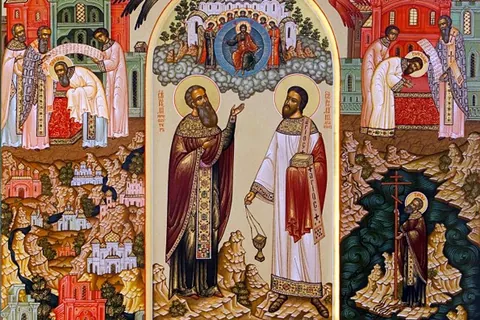
Venerable Julius the Presbyter and Julian the Deacon (V)
The Venerable Julius the Presbyter and Julian the Deacon were blood brothers. For his pious life Julius was ordained priest, and his brother deacon. Burning with a sincere desire to spread the Christian faith far and wide, the brothers from Myrmidonia preached in the remote places of the east and west of the Roman Empire. There were still many idol-temples here, and sacrifices were offered in abundance. The blessed Julius and Julian converted many pagans to the law of Christ by their grace-filled word and by miracles sent from God. Having come to Constantinople, they asked the Emperor Theodosius the Younger (408–450) for permission to build Christian churches on the sites of the idol-temples.
With the patriarch’s blessing and the emperor’s permission the saints built many churches. When Saint Julius felt his end approaching, he hastened to seek a site for the building of the hundredth and last church. Coming to the shore of Lake Mukoros, he noticed in the middle of it a beautiful island, which, it turned out, no one could approach because of the multitude of snakes nesting on it. The venerable father decided to build a church here. Standing on his outspread mantle, he sailed across to it and set up a cross on the shore; then he commanded all the snakes to gather together and leave the island, giving up the place to the house of God and to the servants of the Lord.
Saint Julius founded on the island a church dedicated to the Twelve Apostles. At this time his brother Julian finished building a church near the city of Gaudianum; he died there and was buried in the grave he had prepared beforehand.
The Venerable Julius died on the island and was buried there in the church of the Twelve Apostles which he had built. Many miraculous healings took place at his tomb. The blessed brothers joined the heavenly Church in the first half of the fifth century.



