
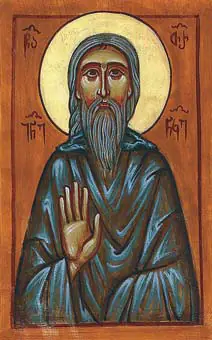
Saint John (Tornike) the Athonite (X)
Saint Tornike was the spasalar of Kartli. The renowned knight, successful in battle, valiant and matchless, was especially loved by King David the Kuropalates; but he who was pleasing to God chose the better part: he took upon himself the labour of monasticism and went to Mount Olympus to seek Saint John (commemorated 12 July). On Olympus he was told that the venerable father had settled on the mountain of Athos. Tornike hastened to the Holy Mountain and “received the blessing of monasticism from the hands of John”. The venerable fathers settled in the lavra of Saint Athanasius.
After John had tonsured Tornike, so many Georgians gathered in the lavra of Athanasius that John, with Saint Athanasius’s blessing, built a separate church for the Georgians in the name of John the Evangelist. Together with the church the Georgians built cells too, “and they abode there a long time like angels of God”.
At this time the general Bardas Skleros rose against the young emperors of Greece, Basil and Constantine. The Empress Theophano said: “We have no helper save David the Kuropalates,” and sent an eminent man, a sebastophoros, to the Holy Mountain, and asked the Georgian fathers: “The godless Skleros has risen against us and has seized all the dry land. Now we beseech your holiness that John Tornike come to our majesty without any excuse.” Tornike put the request far from him: “I have renounced the world once, and I will not turn back again.” Athanasius and John asked Tornike to go to David the Kuropalates and help the emperor of the Greeks.
After long entreaty Tornike heeded the fathers’ plea. Basil and Constantine fell at the holy father’s feet in gratitude, and the empress said to him: “What thou hast done for these orphans, may God repay to thy soul.”
Tornike took the opportunity and “rebuked the empress for many things”. She accepted the rebuke with humility and said to him: “Holy father, whatever your fatherhood commands me, I will not transgress your command; only — may God strengthen thee — take the labour upon thyself and, in whatever way thou wilt, go before the Kuropalates and tell him all our distress; and I trust in God that you will drive out that godless Skleros and deliver us from distress.”
Tornike came to Georgia and presented the letters of entreaty to the Kuropalates. The king greatly rejoiced to see his former spasalar, granted the empress’s request, and appointed Tornike himself commander of the auxiliary army. The holy father firmly refused, but since they would not let him be, he agreed and took command of the Georgian host. With God’s help and under Tornike’s command the Georgian army of twelve thousand inflicted a crushing defeat on Skleros, the adversary of God and of the emperor, and drove him out of Greece.
After the victory Tornike gladly hastened back to the mountain of Athos, “and the fathers came out joyfully to meet him, and kissed him, and gave thanks to God, who had brought him back in peace”.
The Georgians, who had multiplied on Athos through the prayers and labours of the venerable fathers John and John the former Tornike, could no longer be held by the church of John the Baptist and the brethren’s cells, and the holy fathers undertook to build new churches and monasteries. The gift received for the victory over Skleros — great riches — the former Tornike handed over entirely to John, and very soon the Georgians built two more churches on the Holy Mountain, dedicated to the all-holy Theotokos and to Saint John the Baptist.
The former Tornike was distinguished by wonderful obedience: “the renowned and illustrious man cut off all his own will”, entrusted himself wholly to his teacher, “and showed such fervour that, were it possible, he would not have uttered a single word without his command, but Father John ordered and gave out everything, as he wished and wherever it was fitting”.
The ascetic monk, distinguished by humility, simplicity and innocence, used to say to Father John: “Father, thou knowest thyself that I am a great sinner and my death is near; and I am not against the will of your holiness, but after God I have given my will and myself to thee; save my soul as thou wilt.” Since the former Tornike had been a spasalar victorious in many wars, he loved to recall past events. And the brethren of the monastery often got him to tell of “deeds of valour”. Saint John counselled him: “Now leave off talking of these worldly things, and from now on speak with no one save the priest Gabriel alone.” No worldly word ever came from the mouth of the priest Gabriel — only divine and spiritual things. Saint John the former Tornike fell weeping at his teacher’s feet and cried out: “Why didst thou keep silent until now and not rebuke me, O holy and God-clad father?” Father John raised the old man up and said to him: “May the Lord forgive thee, but now be on thy guard!” After this no one ever heard John-Tornike talk; he passed the remaining days of his life in silence and hope in God, and gave up his soul to the Lord in peace.



