
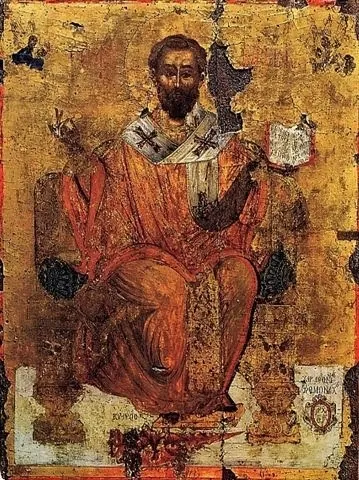
Holy Apostle Barnabas (I)
The holy Apostle Barnabas was born on the island of Cyprus into a family of rich Hebrews. The newborn child was named Joseph. When he grew up, his parents sent him to Jerusalem to study and entrusted him to be taught by Gamaliel, a renowned teacher of the law in those days. Saul (later the Apostle Paul) studied with the saint and was his friend. He heard the word of God from Jesus Christ Himself and joyfully followed Him. The apostles of Christ gave Joseph the name Barnabas, which in Hebrew means “son of consolation”. Barnabas was one of the seventy closest disciples of Jesus. After the Saviour’s Ascension he sold the land he owned and laid the money at the apostles’ feet (Acts 4:36–37).
Barnabas gave up everything for the love of Christ, while his childhood friend Saul was filled with hatred for Christ and mercilessly persecuted and tormented His followers; but the Lord willed to enlighten the mind of Saul too by a divine revelation. After this Paul came to Jerusalem and wished to join the disciples of Christ, but they avoided him in fear as an enemy. Then Barnabas told the apostles of the miracle that had happened on the road to Damascus, and the wall of mistrust melted (Acts 9:26–28). The love of Christ united the old friends Barnabas and Paul once more. They preached together in Antioch, where the disciples were first called Christians. Before the famine that was expected, they collected generous offerings there and returned to Jerusalem.
“Now about that time Herod the king stretched forth his hands to vex certain of the church.” He killed James the son of Zebedee with the sword, and then, to please the Jews, had Peter seized too. At that time an angel miraculously freed Barnabas and Paul from prison, and they took refuge in the family of Barnabas’s aunt Mary. When God punished Herod, whom the people had deified, “and he was eaten of worms, and gave up the ghost,” the persecution of Christians stopped and the apostles returned to Antioch. With them went Mary’s son John, who was later called Mark. By the inspiration of the Holy Spirit the prophets and teachers laid their hands on Barnabas and Paul and sent them out to preach (Acts 13:2–3). The apostles travelled through the whole island preaching. In Paphos they were received by the proconsul Sergius, who “desired to hear the word of God.” Disputing with the apostles and seeking to turn the proconsul away from the faith was “a certain sorcerer, a false prophet, a Jew,” named Bar-jesus. Paul exposed this child of the devil, full of guile and mischief, and rebuked him: “Thou shalt be blind, not seeing the sun for a season,” after which the sorcerer lost his sight. The astonished proconsul believed in Christ (Acts 13:6–12). From Paphos Paul and Barnabas went first to Perga of Pamphylia, and then to Antioch of Pisidia. Driven out from there by the outraged Jews, they made for Iconium, but soon left this city too, for they learned that the Jews meant to stone them. After this the apostles preached the good news of the faith of Christ in Lystra, Derbe and the villages round about. When the pagans there saw the miracles worked by the disciples of Christ, they thought that gods had appeared to them in human form, “and they called Barnabas, Jupiter; and Paul, Mercurius.” The priest of Jupiter came with the people to the city gates with oxen and garlands to offer sacrifice. Barnabas and Paul tore their clothes, ran in among the people, and cried out in dismay: “Sirs, why do ye these things? For we preach unto you that ye should turn from these vanities unto the living God!” Some time passed, and Jews who came from Antioch and Iconium persuaded these people that the apostles “speak nothing true, but all is lies,” for which the crowd stoned Paul and dragged him out of the city. Everyone thought he was dead, but soon he came to himself and stood up, and then left the city with Barnabas (Acts 14:8–18).
When the question arose whether the converted Gentiles must be circumcised according to the law of Moses, Barnabas and Paul went to Jerusalem, where the apostles and elders received them with love. And they told the assembly “all that God had done with them, and how he had opened the door of faith unto the Gentiles” (Acts 14:27). After long deliberation the apostles decided “that we trouble not them, which from among the Gentiles are turned to God: but that we write unto them, that they abstain from meats offered to idols, and from fornication, and that whatsoever they would not have done to themselves, they do not unto others” (Acts 15:19–20). All this they “wrote by their hand” and sent to Antioch with “men that have hazarded their lives for the name of our Lord” (Acts 15:26), Barnabas and Paul. Then the apostles decided to visit again the cities where they had preached together. Barnabas wanted to take Mark with them too, but Paul did not agree; the apostles parted: Paul and Silas set out for Syria, while Barnabas made for Cyprus with John (Acts 15:36–41).
Barnabas increased the flock of Christ on Cyprus, and then went to Rome, where he may have been the first to preach Christianity;
The Apostle Barnabas founded the episcopal see in Mediolanum (Milan), and then returned again to Cyprus. The savage Jews stirred up the pagans against him. The apostle was led out of the city and stoned, and his body was thrown into a blazing fire. When the crowd had dispersed and the fire had burned down to ashes, Mark came to the spot, buried the incorrupt body of Barnabas in a cave, and, according to the apostle’s wish, laid on his breast the Gospel of Matthew copied in his own hand.
Barnabas died around AD 62, at the age of seventy-six. The place of his burial was gradually forgotten, although many signs and miracles took place there. At last, in 488, in the time of the Emperor Zeno, he appeared three times in sleep to Anthemius, Archbishop of Cyprus, and pointed out the place of his tomb. The Christians of Cyprus found the incorrupt body of Barnabas and the Gospel lying on his breast. It was after this that the Church of Cyprus was called apostolic. From that time it received the honour of electing its own primate independently.



