
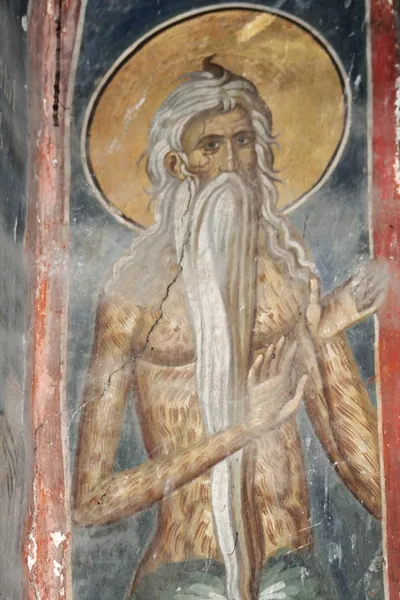
Venerable Onuphrius the Great (IV)
Information about the Venerable Onuphrius the Great and the other desert-dwelling fathers who laboured in the fourth century in the desert of the Thebaid (Egypt), Timothy, John, Andrew, Heraclamon, Theophilus and others, has been preserved for us by their contemporary, the Venerable Paphnutius, a monk of one of the monasteries of the Thebaid.
Once Paphnutius decided to visit the desert-dwelling monks and learn from their own accounts how they lived. The venerable father left his monastery and went deep into the desert; four days later he came to a cave in which lay the incorrupt body of an aged ascetic who had died long before; he buried it with honour and went on his way. Four days after that the holy monk came upon another cave. Footprints left in the sand showed that someone lived there. At sunset a herd of oxen appeared, and among them a man walking, whose long hair covered his naked body like a garment. This was Timothy the desert-dweller. When the blessed ascetic saw Paphnutius he thought the evil one was tempting him and began to pray, but the monk assured him: “I am a living man, a Christian.” The Venerable Timothy received his guest with love and told him: “For thirty years I have lived in the desert, and in all that time I have seen no one of the race of Adam.” In his youth, it turned out, Timothy had laboured in a monastery; then he left the monastery and settled near a city, where he kept himself by sewing. Once a woman ordered a garment from the saint, and the ascetic, overcome by the evil one, fell into sin with her. When he came to his senses, the ashamed monk went deep into the desert and patiently bore every sorrow and illness as a deserved punishment. When he was already ready to die of hunger, by God’s will he was miraculously healed.
From then on Timothy lived peacefully in complete solitude. The Venerable Paphnutius asked the monk to allow him to stay in the desert, but he answered, “Thou wilt not be able to,” blessed him, and gave him dates and water for the journey.
On the seventeenth day the holy father reached a mountain and sat down to rest. Suddenly he saw a monk coming towards him, whose body was covered with wavy hair as white as snow, while round his loins he had leaves wrapped. As it turned out, this unknown dweller of the desert was Onuphrius the Great.
The Venerable Onuphrius had spent sixty years in the uninhabited desert entirely alone. He was brought up in the Thebaid, in the monastery of Eriti. There he learned of the very hard and very lofty labours of the monks living in the desert, burned with the desire to imitate them, and one night secretly left the monastery. A shining ray went before him, which startled him so much that he meant to turn back, but his guardian angel urged him to continue on his way. So the venerable father reached a desert-dwelling monk and became his disciple. When the elder was convinced that Onuphrius had been sufficiently strengthened in the struggle with the temptations of the demon, he appointed him a place for his labours and left him. After this he visited his spiritual son once a year, and several years later, during one such visit, he reposed.
At Paphnutius’s request the Venerable Onuphrius told him of his labours, and told him also how the Lord strengthened and comforted him: by the cave a date palm had grown up, whose sixteen branches bore fruit in turn; a holy spring had gushed up beside it; an angel brought him bread too, so that he was never hungry or thirsty; when troubled by the midday heat he took shelter in the shade of the palm. Every Saturday and Sunday an angel of the Lord gave the desert-dweller Communion of the Body and Blood of Christ. After the morning rule Paphnutius noticed that Saint Onuphrius’s face had changed, and he was alarmed. Onuphrius said to him: “The all-good Lord sent thee here so that thou mightest bury my body. Today I shall end my earthly life and ascend to the eternal Kingdom, to my Christ.” He asked his guest to make his life known to all Christians for their salvation. Paphnutius again asked for a blessing to labour in the desert. “It is not God’s will,” Onuphrius told him; he bade the venerable father farewell and went apart from him. The desert-dweller prayed long and fervently in solitude, then lay down on the ground and fell asleep. His last words were: “Into Thy hands, O Lord, I commend my soul.”
In tears, Paphnutius tore off the lining of his garment, wrapped the body of the great desert-dweller in it, laid it in a long hollowed stone, and covered it with small pebbles. Then he besought the Lord in prayer to make him worthy to stay until his end in the place where Onuphrius the Great had laboured, but suddenly the cave collapsed, the palm withered and the spring dried up. Paphnutius understood that he was indeed not granted the Lord’s blessing for life in the desert, and turned back.
Four days later Paphnutius came upon another cave. Here he met a desert-dweller who had spent more than sixty years in the desert and had seen no one but the two monks who laboured with him. The ascetics spent the whole week in solitude, and on Saturdays and Sundays gathered for the psalms. The day of Paphnutius’s arrival fell on a Saturday, and so the monks gathered as usual. They ate bread brought by an angel, and then spent the whole night in prayer. Before leaving, Paphnutius asked the desert-dwellers their names, but they answered: “The all-knowing Lord knows our names. May we be counted worthy to meet in the heavenly Jerusalem.”
Paphnutius went on his way and entered a very beautiful oasis, full of trees laden with fruit. Four young ascetics came out of the desert to meet him. The hermits told Paphnutius that in childhood they had lived in the city of Oxyrhynchus (Upper Thebaid), had learned to read and write together, and had all burned alike with the desire to dedicate their whole life to the Lord. The youths secretly left the city and after several days reached the desert. Here, moved by divine zeal, they were met by a radiant angel of the Lord, who brought them to a desert-dwelling monk. “We have lived here for six years,” the young men said; “our elder died within a year, and now we are alone. We eat the fruit of the trees and take water from the spring.” The ascetics gave their names. They were John, Andrew, Heraclamon (Heraclammon) and Theophilus. The young desert-dwellers laboured separately all week, and on Saturday and Sunday gathered in the oasis and prayed together. On these days an angel came to them and gave them the Holy Mysteries. Because of Paphnutius the young men stayed in the oasis the whole week and prayed there. On Saturday and Sunday their guest, together with the blessed ascetics, was also counted worthy of Communion from the hand of the Lord’s radiant servant. He heard too the sweet words spoken from his lips: “May the Body and Blood of our Lord Jesus Christ be to you incorruptible food, unending joy and life eternal.”
The Venerable Paphnutius asked the angel too for a blessing to stay in the desert, but the heavenly warrior answered that God had appointed him another path: he was to return to Egypt and tell all Christians of the life of the desert-dwellers.
The holy father bade farewell to the young men and three days later came out at the edge of the desert. The inhabitants of a small skete there received him with love. The Venerable Paphnutius told them everything he had learned about the grace-filled dwellers of the desert; the monks wrote down his account in detail and spread it to other sketes and monasteries. The Venerable Paphnutius gave thanks to the Lord, who had made him worthy to share in the lofty spiritual life of the desert-dwellers of the Thebaid, and returned to his monastery.



