
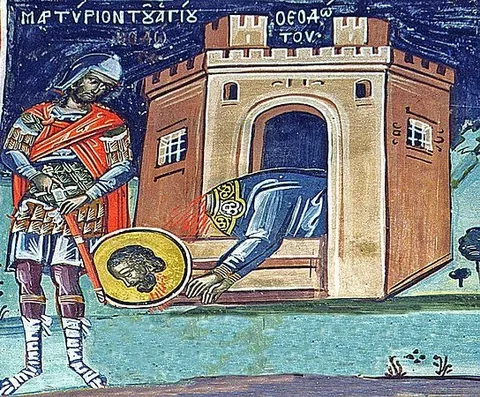
Holy Martyr Theodotus of Ancyra and the Seven Virgins: Alexandra, Tecusa, Claudia, Phaina, Euphrasia, Matrona and Julia (303)
The holy Martyr Theodotus of Ancyra and the seven virgins Alexandra, Tecusa, Claudia, Phaina, Euphrasia, Matrona and Julia (+303) lived in the city of Ancyra in the region of Galatia and met a martyr’s end for Christ at the beginning of the fourth century.
During the persecution of Christians by the Emperor Diocletian, Theotecnus, known for his cruelty, was appointed to Ancyra. Theotecnus warned the Christians to offer sacrifice to the idols, or else they would not escape torture and death. Many Christians left their homes and fled the city. Those who stayed were beaten and robbed by the pagans.
Famine began in the land. In these hard days Saint Theodotus took the confessors of Christ into his house and fed them, and gave the plundered churches what was needed for celebrating the Divine Liturgy. The saint went fearlessly into the prisons, helped those punished without guilt and encouraged them before the end that awaited them, and buried with honour the bodies of Christians which he ransomed from the soldiers. When the Christian churches in Ancyra were plundered and closed, the Divine Liturgy was celebrated in Saint Theodotus’s house.
At that time seven virgins met a martyr’s end for Christ. The eldest of them, Saint Tecusa, was Saint Theodotus’s aunt. Saints Tecusa, Phaina, Claudia, Matrona, Julia, Alexandra and Euphrasia had dedicated themselves to the Lord from their youth. Brought before Theotecnus’s tribunal, the martyrs boldly confessed Christ. Stones were tied round the saints’ necks and they were drowned in a lake. The next night Saint Tecusa appeared to Saint Theodotus in his sleep and begged him to take their bodies out of the lake and bury them in Christian fashion. The saint took his friend Polychronius and other Christians, and in the pitch-dark night they set out for the lake. At that moment the holy Martyr Sosander appeared to the guards on the shore of the lake. The frightened guards fled. The Christians buried the martyrs’ bodies in the churchyard. When the governor learned what had become of the saints’ bodies, he flew into a rage and ordered all the Christians to be seized and tortured. Polychronius was caught with the others. He could not endure the torture, and declared that Saint Theodotus was behind it all. The saint was brought to trial; they showed him the instruments of torture, and at the same time promised him great honour and wealth for denying Christ. Saint Theodotus glorified Jesus Christ and confessed Him as God and Saviour. The enraged pagans went on torturing the saint, but the power of God shielded him and he remained alive. The holy martyr was thrown into a dungeon. The next day the governor resumed his torture, but understood that he could do nothing, and ordered him to be beheaded. The sentence was carried out, but a whirlwind that arose did not let the soldiers burn the saint’s body. By God’s will the priest Fronto passed by that place; he loaded the holy body onto a donkey and buried it in a place Saint Theodotus had chosen beforehand. Later a church was built over the saint’s tomb. Saint Theodotus met his end in 303 or 304.
The saint’s life and martyr’s end, and also the passion of the holy virgins, were described by Nilus, a contemporary and fellow struggler of Saint Theodotus, who lived in Ancyra during the persecution of Christians.



