
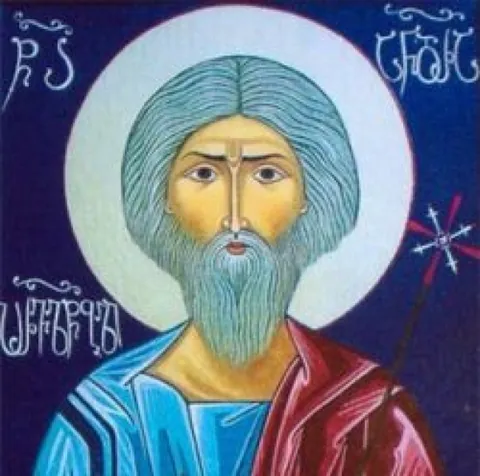
Holy Apostle Andrew the First-called (I)
Saint Andrew, brother of the Apostle Peter, was the first whom the Lord Jesus Christ called, and so he is called the First-called. Saint Andrew loved the Lord from his youth, and when the voice of Saint John the Baptist rang out in Israel like thunder, the blessed apostle became his closest disciple. When the Saviour appeared, Saint John said to Andrew and John the Theologian: “Behold the Lamb of God!” At these words both followed Jesus. Then Andrew went to his brother Peter, told him the good news that he had found the Messiah, brought him too to Jesus, and made him His disciple. Having become disciples of Christ, the brothers still went on with their usual work and lived by fishing. Once the Saviour, walking by the shore of the Sea of Galilee, called them: “Follow Me, and I will make you fishers of men.” After this they were never parted from the Son of God, and became witnesses of His miracles, His death and His Resurrection from the dead.
After the Ascension of the Saviour, “when the apostles cast lots” for their preaching, the conversion of Iberia fell by lot to the Mother of God; but since the time of her repose was drawing near, the Son of God commanded her to remain in Jerusalem and to send Andrew the First-called to Georgia with His icon not made by hands. The All-holy Virgin called the saint and made known to him the will of God; then she asked for a board, “washed her face and laid it upon her face.” The image of the Mother of God with the Child Jesus appeared on the board. The Queen of Heaven gave this holy thing to Andrew and blessed him, who was setting out on a great labour. Saint Andrew passed through Greece and Asia Minor, and then made for the shores of the Black Sea, and “entered the land of Kartli, which is called Didachara.”
In the village of Didachara the ruins of a church have survived to this day which, according to tradition, Saint Andrew the First-called built himself.
Many trials befell the blessed one at the hands of the unbelievers, but through the intercession of God and of the precious icon he bore everything with thanksgiving, “until he had turned them all and brought them to the faith.” In the place where the apostle set down the icon of the Mother of God a “very fair and great” spring gushed forth. This miracle enlightened the minds of many pagans, and they took up the saving teaching of Christ. The apostle appointed priests and deacons for the newly converted. “He established for them the order and the bounds of the faith,” built a church of the Most Holy Mother of God, and placed in it a copy that had passed miraculously onto a board from the icon given by the Queen of Heaven. After this the chosen one of the Lord crossed the Persati mountain and set up a cross there (and it is for this reason that the mountain was called the “Iron Cross”). Then the apostle came to the village of Atskuri, which was formerly called Sosangeti. At that time the ruler of this region was a widow, Samdzivari, who had an only son. Just then her son had died. The widow was told that there was a man there who prayed to an unknown God. This news kindled hope in her heart, and she called the apostle to her. Saint Andrew raised the widow’s only son from the dead. The rejoicing woman with thanksgiving believed in the Lord Jesus Christ, was baptised with her son, and wrote to the princes of Samtskhe, telling them of this and summoning them all to her. “When the Meskhians heard this wondrous tidings, they gathered swiftly from every side, and there was a very great multitude of people.” The servants of the idol-temple came too. The people split in two: some cried, “It is meet to worship Him who hath wrought such a miracle,” while others remained faithful to the false gods. To settle the dispute they decided to bring the icon of the Mother of God into the idol-temple and then lock the door. Those who hoped in the Saviour were to pray to Christ, and the idol-worshippers to their own deity. Guards were posted at the locked temple. In the morning, when the door was opened, all saw “the idols cast down to the ground and shattered like dust, while the icon of the All-holy Mother of God shone like the sun in glory and honour.” Saint Andrew set up a church in Atskuri and placed the icon of the Mother of God not made by hands in a small side-chapel; then he parted from his newly converted flock and continued on his way: he was in Klarjeti, in Artaan-Kola, in Parthia and in Armenia, and then went to Jerusalem.
From Jerusalem Andrew returned again to Georgia with Simon the Canaanite and Matthias. They entered Kartli, strengthened Christianity, and “went westward, passing through the land of Tao as far as the Chorokhi”; they were in Samegrelo and Svaneti. Simon and Andrew went to Abkhazia: “And the great Andrew with Simon... entered the land of Abkhazia and preached to them the word of the knowledge of God, and many received that preaching with joy; and there the blessed Andrew left Simon the Canaanite with other disciples, and himself went up into the land of Jiketi.” The native people of Jiketi not only refused to accept his preaching but even decided to kill the apostle. Seeing their stubbornness and coarse minds, the apostle left them and went away. The holy Apostle Andrew was also in the land of the Scythians, present-day Russia. He went up the river Dnieper as far as the place where the city of Kiev now stands.
The last city in which the apostle preached was Patras (Greece). Through the saint’s prayer a great many people in this city were converted to the law of Christ, but the head of the city, Aegeates, remained faithful to the false deity. The godless ruler ordered the chosen one of the Lord to be crucified. The saint met the sentence with joy and went up onto the cross of his own accord. To prolong his torment, Aegeates ordered that the blessed one should not be nailed to the wood but tied to it. For two days the holy apostle preached to those gathered round. At last the people, shaken by the saint’s grace-filled words, demanded that he be taken down from the cross. The godless Aegeates gave the order to release the saint, but Andrew fervently besought the Lord to make him worthy to die on the cross. For a long time the soldiers tried in vain to take him down. The saint “lifted up his eyes to heaven and gave thanks to the Lord, and blessed the faithful, hanging upon the cross.” And so, giving thanks to God, the saint met his end. The wife of the governor of the city took the apostle’s body down from the cross and committed it to the earth with honour. Some centuries later, in the reign of Constantine the Great, the holy apostle’s incorrupt relics were brought with honour to Constantinople and laid in the church of the Holy Apostles beside the relics of the Evangelist Luke and the Apostle Timothy.
Often, because of the misfortunes of our history, the apostolic origin of our Church has been called into question. This is borne out by an episode described in the life of Saint George the Athonite, in which Saint George defended the independence of the Church of Georgia before the Patriarch of Antioch with these words: “Holy master, thou sayest: I sit upon the throne of Peter, the chief of the apostles. But we are the portion and the flock of the First-called, the brother who called him, and by him were we converted and enlightened. And one of the holy twelve apostles, Simon the Canaanite I mean, is buried in our land, in Abkhazia, in the place called Nikopsia. By these holy apostles were we enlightened. And since we have come to know the one God, we have never denied Him. Nor hath our nation ever inclined to heresy, and all apostates and heretics we anathematise and curse. Upon this foundation of Orthodoxy, and upon the commandments and preaching of those holy apostles, we stand firm.”
Let us pray to our helper and protector, Saint Andrew:
O holy Apostle Andrew, called first of the apostles, pray to God for us, that He may grant peace to the world and great mercy to our souls!



