
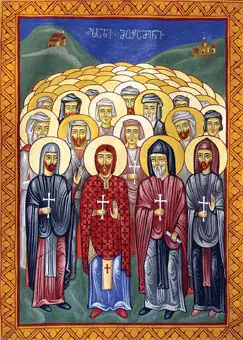
The 300 Horsemen, the Priests and All the Orthodox Laz Martyred by Muslims for the Faith of Christ at Dudikvati and Papati (Modern Turkey) (XVII–XVIII)
Lazeti is an inseparable part of the Colchian heartland. It is one of the main arteries that define the statehood of Georgia, and the most ancient hearth of our culture. It was from here that the holy Apostle Andrew began the conversion of the Georgian nation, the lot of the Theotokos.
After the fall of the Byzantine Empire and the Empire of Trebizond (1453), the Ottomans tried for three whole centuries to root out Christianity and national awareness among the Laz. For its part, Rome strengthened the work of its missionaries in this region. Caught between these two fires, the Laz firmly kept Orthodoxy, but in the course of time some “took refuge” with the Catholics and the Monophysites, the overwhelming majority of whom afterwards entirely lost their religious and national awareness. The Georgians who were forcibly converted to Islam kept their language, part of their national and cultural traditions, the memory of their forefathers’ Christianity, and their love for Georgia.
With the blessing of Ilia II, Catholicos-Patriarch of All Georgia, a tradition was begun of meetings and contacts between the Laz living in Turkey and natives of the various regions of Georgia. The Laz living in Georgia returned to the Christian faith. They laid before the Holy Synod of the Church of Georgia materials on the martyrs’ end, in the seventeenth and eighteenth centuries, of thousands of Laz for the faith and for Georgia, among which two events that took place in 1600–1602 are especially worth noting: three hundred Laz warriors, who had risen up against the forcible conversion of the Laz to Islam by the lawless and had encamped on one of the mountains, were taken captive by the enemy. The enemy promised the captives freedom and other earthly honours in exchange for denying Christianity. The Laz, renowned in battle for courage and endurance, showed the greatest steadfastness in the faith. All three hundred warriors were beheaded and thrown into the river, after which the place was called Dudukveta (the beheading). The river dyed with the martyrs’ blood was also named Dudikveta.
In the same way the clergy living in a monastery of fathers on another mountain met their end. After many kinds of suffering and torture they were beheaded. The people called this mountain the mountain of Papati (of the priests).
The session of the Holy Synod of the Apostolic Church of Georgia of 18 September 2003, on the basis of these materials, decreed that the Orthodox clergy and lay people slain on the hills of “Papati” and “Dudikvata” in the seventeenth and eighteenth centuries, and also every Laz martyred for Christianity, be numbered among the saints and be called the holy Laz martyrs slain for the faith and for Georgia at Dudikveti and Papati.



