
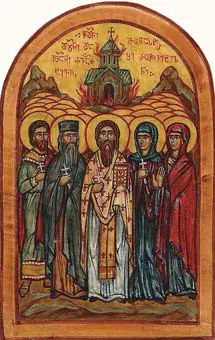
The Holy Mothers and Fathers Martyred in the Monastery of Kvabtakhevi in the Time of Tamerlane (+1386)
In the reign of Bagrat V, grandson of George the Brilliant, the Lord sent down punishment upon our country for its sins: Tamerlane of Samarkand invaded Georgia seven times with a countless host, “which the mountains and the plains and all the regions and lands of Georgia could not contain”. The enemy ravaged many churches and monasteries and wiped them from the face of the earth. Seven times the Georgians suffered “from him by the sword, by captivity and by fire, and by the uprooting of buildings from their foundations”.
Tamerlane took King Bagrat captive, laid Kartli waste, and carried the king and queen off to Shirvan together with other nobles. The lawless Timur tried in every way to force the king to abandon Christianity, promising him in return that he would keep the title of king and be set free together with the other captives.
For a long while they could not bend Bagrat, but at last, “made powerless and bereft of all human help, he fell away from the faith that was fitting”. Then hope in God rose up in him again; by deceit he won Tamerlane’s favour and obtained leave to return to Kartli with his dignity preserved. At Bagrat’s request Timur sent with the king an army of twelve thousand, which was supposedly to help him convert his kingdom to Islam.
Having drawn near to Khunani, Bagrat called his son George with his host, and they “cut down with swords Tamerlane’s horsemen, not one of the barbarians escaping”.
The news of the destruction of his army and Bagrat’s treachery enraged Tamerlane, and, “roused to take the field against us”, he set out to take vengeance on Bagrat. The Georgians repelled the enemy’s first onslaught, but Timur called up a supporting army, attacked the exhausted Georgians with fresh strength and forced them to retreat.
The Tatars laid waste Tbilisi, Nisani and Kalisi, burned the towns and villages of Kartli, destroyed the holy churches, and “plundering thus” reached the beautiful monastery of Kvabtakhevi.
At Kvabtakhevi the enemy was met by “monks from the monasteries round about, many fathers and mothers, of the aznaurs, and priests and deacons, and the brethren of that monastery itself”. Besides the clergy, “the multitude of lay people from the villages near by was not small”.
The barbarians broke down the doors of the monastery and plundered it; “they carried off the vessels and brought out no small riches from the treasuries of the monastery, for that monastery was very rich”. The old and the infirm, whom it was impossible to lead away captive, they cut down with the sword.
Having entered God’s inheritance, the godless defiled the holy church: they bared their swords and “hewed without mercy that rational vineyard, or orchard of the garden of God”, and left the bodies of the Lord’s worthy servants as food for the birds of the air and to be torn by “the beasts of the earth”.
When the barbarians had finished killing and binding captives, they began to mock the holy priests, monks, virgins and nuns: they hung bells on them, while they themselves, maddened by the devil, “began to leap and dance”. “Woe to us, the monks!” the martyrs lamented with sobbing and wailing.
After this the barbarians said to all who were there: either deny Christ, or we will shut you up bound in the church, pile wood round you and burn you. The captives answered: “We have been given into your hands for our sins, which we committed and angered our Creator and God, and not for any righteousness of yours; we trust that He will cleanse us by this temporal punishment and give us rest in the timeless eternity. Nothing shall separate us from the love of Christ: neither tribulation, nor distress, persecution, nor famine, nakedness, nor sorrow, nor sword; we have nothing more to offer to God at this time.”
The martyrs encouraged one another and sang the words of the psalm: “For thy sake are we killed all the day long; we are counted as sheep for the slaughter.”
When the martyrs were led to the doors of the church, they addressed the Lord thus: “I will come into thy house, and in thy fear will I worship toward thy holy temple. Lead me, O Lord, in thy righteousness; because of mine enemies make my way straight before thee.”
The lambs of God said to the barbarians: “Kindle our flesh, servants of evil, that our souls, burning with divine fire, may shine brighter than the sun in the kingdom of the heavenly Father; do not delay our offering, that we may be made a spectacle unto the world, and to angels, and to men — although as yet only the Lord sees our desire and comforts us for our righteousness.”
The torturers brought yet more wood and kindled a yet greater fire. The flames rose high, sparks fell thick, “the mountains echoed the roar of the furnace”, while the blessed souls of those who were being wholly burnt sang: “O ye fire and heat, bless ye the Lord; praise and exalt Him above all, ye servants of the Lord; praise and exalt Him above all for ever.”
So were the spotless lambs offered up to God.
The traces of the martyrs’ burnt bodies were imprinted on the floor of the church, “and even unto this present day their burnt forms are seen upon the floor within the holy church, and lie there still”.



