
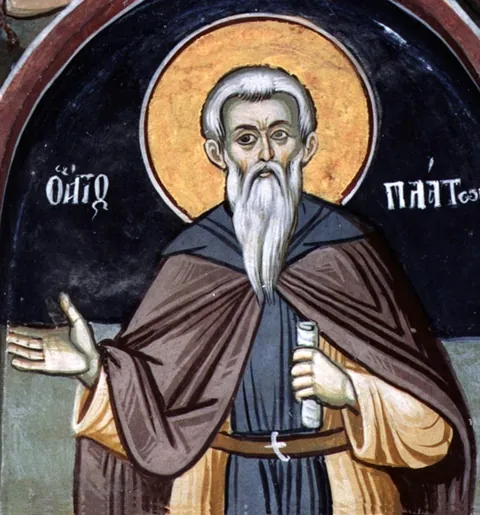
Venerable Plato the Confessor, of Studios (+814)
The Venerable Plato (+814) was born in 735 into the family of the pious Christians Sergius and Euphemia. Orphaned early, the boy was brought up by relatives, who gave him a good education. On coming of age Plato began an independent life. At first he took up the management of the estate he had inherited and by his industry amassed great wealth; then, burning with love for Christ, he gave away all his property to the poor, set his slaves free, and withdrew into a monastery.
By the fervour of his prayer, his love of labour and his humility he won the love of the whole brotherhood. In his free time the Venerable Plato restored collections of the writings of the holy fathers and copied books needed for divine services. In 770 Theoctistus, the superior of the monastery, died. The brethren chose the Venerable Plato as the new abbot, although he was only thirty-five. After the death of the Emperor Constantine Copronymus (775) the saint went to Constantinople. He declined the offer of the metropolitan see of Nicomedia, and withdrew with his nephews, Saint Theodore (+826, commemorated 11 November) and Joseph (+830, commemorated 26 January), to the wilderness of Sakkoudion. On a mountain they built a church in the name of Saint John the Theologian and founded a monastery, whose superior the Venerable Plato became. The venerable father took part in the work of the Seventh Ecumenical Council of Nicaea in 787, where he denounced the iconoclast heresy and defended the rule of the veneration of the holy icons.
Grown old, Plato handed over the headship of the monastery to the Venerable Theodore.
In 795 the Emperor Constantine VI (780–797) forced his wife Maria to take the veil, and decided himself to marry his kinswoman Theodote.
Although the holy Patriarch Tarasius condemned this marriage, Joseph, a well-known priest of Constantinople, disobeyed Tarasius’s order and married the emperor.
When the Venerable Plato and Theodore learned of this, they declared the emperor cut off from the Church and sent letters about it to all the monasteries. The enraged emperor ordered Saint Plato to be thrown into prison and the Venerable Theodore to be exiled to Thessalonica. The blessed fathers were set free only after the emperor’s death, in 797. The Venerable Theodore moved to Constantinople and became abbot of the monastery of Studios, while the Venerable Plato lived in the same monastery as a simple monk, in obedience to his nephew.
When the new Emperor Nicephorus (802–811) arbitrarily restored the excommunicated cleric Joseph to the Church, the Venerable Plato and Theodore again boldly denounced his unlawful act. For this the venerable fathers were punished again. After four years of imprisonment and the death of the emperor, in 811, they were set free. The Venerable Plato returned to the monastery of Studios.
He spent three more years in the monastery and reposed in the seventy-ninth year of his life, on 8 April 814, on Lazarus Saturday.



