
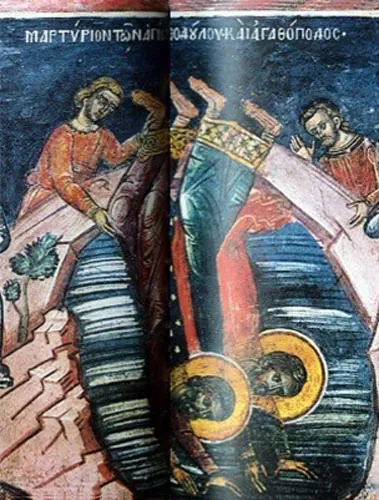
Martyrs Agathopodes the Deacon, Theodulus the Reader and Others (+c. 303)
The holy Martyrs Agathopodes the Deacon and Theodulus the Reader (+303) lived in Thessalonica in the time of the Emperors Diocletian (284–305) and Maximian (284–305). The holy deacon Agathopodes was a very old man, while Saint Theodulus the reader was young. They were distinguished by a God-pleasing life and piety.
Once Saint Theodulus saw in his sleep a stranger clothed in shining garments who handed him something. When he woke, he was holding in his hand a ring bearing the image of a cross. Theodulus understood that this was a sign of coming martyrdom. By the power of the cross engraved on the ring he healed many sick people and converted pagans too.
When the Emperor Diocletian issued the decree on the persecution of Christians (303), many believers went into hiding, but Saints Agathopodes and Theodulus fearlessly went on preaching.
Faustinus, the governor of Thessalonica, ordered the Christians to be brought to him. He was struck by the good looks of Saint Theodulus and advised him to perform the prescribed sacrifice. Theodulus answered that he had long since abandoned a lawless life, and that he pitied Faustinus, who was preparing eternal death for his soul. The governor offered the martyr a choice: a peaceful life, or death. The saint answered that he chose eternal life and did not fear a passing death. When Faustinus saw Theodulus’s firmness, he decided to bend Saint Agathopodes, and told him that the young Theodulus had offered sacrifice to the idols; but the holy deacon did not believe him.
The governor ordered the martyrs to be thrown into prison. In prison the martyrs so prayed and preached the word of God that many prisoners were converted to the law of Christ. Eutinus, the head of the prison, denounced the Christians to the governor.
Faustinus again summoned the holy martyrs to the tribunal. Before Theodulus’s eyes former Christians were forced to offer sacrifice to the idols. “You have overcome the weak, but you can do nothing to the faithful soldiers of Christ!” the saint said to the governor.
By the governor’s order the courageous confessor of Christ was led out to execution. The executioner drew his sword. The martyr joyfully cried out to the Lord: “Glory to Thee, O Lord, Father of my God Jesus Christ. I thank Thee that Thou hast made me worthy to die for Thy name.” But Faustinus ordered the prisoners to be taken back to prison. In prison the saints had the same dream: the ship in which they sat sank, while they themselves came out onto the shore in shining garments. The martyrs gave thanks to God for preparing a martyr’s end for them.
In the morning Faustinus for the last time offered the martyrs to turn to paganism, but again received a refusal in reply. Then, by the governor’s order, stones were tied round the saints’ necks and they were thrown into the sea (+303).
The sea cast the saints’ bodies up on the shore in shining garments, without the stones and ropes. The Christians buried the holy relics with honour.



