
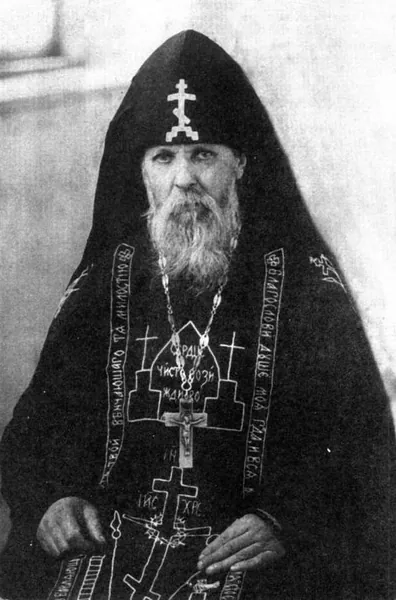
St Seraphim of Vyritsa (+1949)
In 1866, in the Yaroslavl district, a son, Vasily, was born into the family of the peasants Nicholas and Chionia Muraviev. The boy was ten when his father died of consumption. A kind neighbour took the orphan to Petersburg and found him work in a trading shop. Many of his fellow countrymen worked there and did well in business. One dream glimmered in the boy’s heart: somehow to go to a monastery. He even tried his luck: he asked his master for leave and went to the Lavra of Saint Alexander Nevsky. The abbot was not there, and he went to talk with a well-known schemamonk. The venerable father counselled him: “Stay in the world, make a good Christian family, bring up your children, and only after that, you and your wife, dedicate yourselves to the Lord.” The humble and obedient boy took the monk’s answer as God’s answer and went on working. All by himself he learned to read and write; the gifted youth succeeded in everything he put his hand to. At sixteen he was made junior steward, and a year later senior steward, which meant being his master’s deputy. Vasily sent all his wages to his mother in the village.
His future wife had wanted to become a nun from her youth. Once her relatives took her to the Iveron convent, to the Venerable Pelagia. The holy mother advised Olga: “Marry, and only afterwards go to a monastery, together with your husband.” The girl submitted to God’s will, and in 1890 she married Vasily Muraviev. His master gave Vasily a considerable sum of money to start a business of his own. He took up the making of furs. His trade went well, and his goods were sold in many European cities. He became a millionaire, but did not forget the monk’s blessing. He did a great deal of good, gave alms and helped the needy. He donated a large part of his income to churches and monasteries.
The Muraviev family had first a son and then a daughter, who died on her first birthday. After this the young couple lived as brother and sister. The family was spiritually encouraged by Saint Barnabas of Gethsemane. Because of his commercial affairs Vasily often travelled abroad. It is said that on his last stay abroad he made a pilgrimage to Mount Athos, and there a burning desire for the monastic life arose in him. One incident helped him to leave this world for good: returning from abroad, he was driving home in a carriage. It was winter. In one place he saw a ragged peasant sitting on the pavement and crying out: “Not as thou wilt, but as God wills.” Vasily questioned him. It turned out that in the village the poor man had a father sick with typhus, a wife and seven children waiting for him. The neighbours were afraid to go near them. His father had advised him: “Sell the horse and buy a cow; perhaps that way we shall somehow get by.” The man had sold the horse, but robbers had taken the money from him. “I would rather die of hunger in the street than go home empty-handed,” he had thought... Vasily took the peasant to the market, bought him two horses and a cart, loaded it with provisions, tied a cow behind as well, sat him on the cart and put the reins in his hands. The poor man could not believe his eyes and refused the gift. Vasily said to him: “Not as thou wilt, but as God wills.”
Returning home, before going in to his wife, Vasily called for the barber. The barber asked his master to sit in the chair, but Vasily paced up and down in agitation, saying over and over: “Not as thou wilt, but as God wills.” Suddenly the barber fell on his knees before him: “Master, how did you learn of my intention, sinner that I am?” And he confessed that he had meant to kill and rob Vasily. Vasily ordered him to leave the city, while he himself gave away the greater part of his property, much of it to monasteries. Such stories are told too: once a thief crept into Vasily’s house. He gathered up the valuables and wrapped them in a bundle, but when he came out into the street everything spilled out onto it. At that moment Vasily came up and, as if nothing had happened, had the frightened thief tie up the valuables again, and even hoisted the bundle onto his back.
Father Seraphim often used to say: “If you lose something, do not grieve; if you find something, do not rejoice too much.” Even while he was a layman many came to him for advice and for prayer; the grace of knowing hidden things was given to him by God already then. Once he told a certain lady: “Soon there will be a revolution, and the factories and plants will be taken from their owners. It is better that your husband should then hand over the factory himself and ask for the right to work at any job.” Everything came to pass, and the former owner of the factory saved himself by this.
In 1920 Vasily was tonsured a monk with the name Barnabas in the Lavra of Saint Alexander Nevsky. Within a year he was ordained hieromonk, and in 1927 he took the great schema and was given the name of Saint Seraphim of Sarov in his honour. This did not happen by chance: he always felt the support and help of Saint Seraphim. The hard life of a monk began. The traces of the spiritual combat that Father Seraphim waged with the fallen angels can be seen in his photographs of that time: a stern expression, and divine grace before which the demons trembled. It is worth noting that Father Gury (Komissarov), a millionaire in the world like himself, lived in the same cell with Father Seraphim. These venerable fathers, who had come to hate the world, had only one desire and one care: not to anger the Lord by even the smallest sin. Their extreme humility astonished even their disciples. In that terrible time Father Seraphim remained calm; entrusting himself to God’s will, he comforted people and wiped away their tears. Once Archbishop Alexy of Khutyn (later Alexy I) came to him for advice: he had been promised help to escape abroad. “To whom are you leaving Russia?” Saint Seraphim asked him. “Vladyka, fear nothing. Russia needs you. You will be Patriarch of all Russia and will govern it for twenty-five years. After His Holiness Patriarch Tikhon we shall not have a patriarch for a long time. Metropolitan Sergius will be chief shepherd of the Russians for only one year, and after him you will be our patriarch. There will be a terrible war. It will bring the people of Russia to God. Though they are closing churches now, the time will come when they themselves will open them.”
Father Seraphim’s labours were hidden from men, but the wellspring of grace flowing from him drew believers from all over Russia. “I am like a storehouse where people pile up their sorrows,” he would say. One night the brotherhood of the monastery was arrested, and most of them were exiled to Solovki. Many of them met a martyr’s end. Father Seraphim was arrested too. He was cruelly beaten, and several of his ribs were broken. In 1933 he was released, because the doctors established that he would not live long anyway. The authorities allowed him to settle in Vyritsa. This small town lies near Petrograd. It was there, in the small two-storey house of a spiritual child, that the venerable father spent the rest of his life.
He gathered his spiritual children around him. He warned them all: “There will be war and hunger, so settle in Vyritsa.” Many people came to Father Seraphim for spiritual consolation, and many of them were healed in body too through the venerable father’s prayer. A woman brought her daughter to the venerable father. The child’s left arm was withered. Saint Seraphim took pity on the little one, caressed her and patted her aching shoulder, and at that moment the girl felt the blood begin to move in her withered arm. Later this girl became his most devoted spiritual daughter.
In Vyritsa Father Seraphim’s former wife lived with him too. After Father Seraphim had been tonsured a monk she took the veil with the name Christina; later, when she took the great schema, she was called Mother Seraphima, and after her convent was closed Father Seraphim gave her shelter.
Nothing was hidden from the holy father. His disciple, Mother Seraphima, used to be called the “angel of death”, because he often sent her to believers to warn them: “You will die soon; prepare for the life of the world to come.” Many of his spiritual children wrote him letters from prisons and from exile, and the venerable father comforted them by letter in turn. One of the letters of that time is known to our readers under the title “It Was from Me”, in which Saint Seraphim left not only to his spiritual children but to future generations too a hymn to God’s immense love for man. In the little town the comings and goings of people did not go unnoticed, and the militia too kept visiting the holy father. Once they wanted to arrest him, but Father Seraphim’s granddaughter, Margarita, stood in their way: “Only over my dead body will you take my grandfather. He is very ill and will not survive the journey.” The security service doctors confirmed what the girl had said.
Meanwhile the Second World War drew near. “Be sure to come to me on Friday, or else on Sunday the war will begin and you and I will not see each other for a long time,” he said to one of his spiritual children. And indeed the war began. The holy father calmed the people of Vyritsa: “Do not stir from here; no one will touch this place.” In September 1941 the Germans entered Vyritsa and opened the churches closed by the Bolsheviks. Along with strict fasting and his monastic rule, Father Seraphim took on a great labour: to save his beloved Russia he stood for a thousand nights on a stone under the open sky, beseeching the Lord. In this Saint Seraphim became like Saint Seraphim of Sarov, his heavenly patron. In 1942 Mother Seraphima dreamed that Father Seraphim, dressed in boots and a white coat, was driving away armed Germans. They were running across a snowy field, trying to escape the wrath of the venerable father. And in the morning Father Seraphim said to her: “You saw it, didn’t you? Go now and dry my boots and my coat.” Indeed, he had stood all night on the stone in the garden praying. The coat he needed as camouflage, so that the neighbours would not see him. God alone knows how much Saint Seraphim endured then. He was led by the hand to his stone of prayer; his granddaughter would fix an icon to the apple tree nearby, and the grandfather would kneel down. And yet everything ached, his body had withered and taken on the colour of wax. But by this prayer and fasting, by this labour, he saved his homeland. When Metropolitan Elias of Lebanon came to Russia after the war, he told how the Mother of God had saved Russia in that war. The Mother of God Herself told the bishop the names of the righteous through whose prayers God had had mercy on Russia. Among them she named Saint Seraphim and several of his spiritual children.
In 1945 Father Seraphim’s disciple, his former wife Mother Seraphima, died and was buried near the church in Vyritsa.
After the end of the war many people asked Saint Seraphim to tell them where their relatives who had gone missing were; many had no roof over their heads and could not find one. After Father Seraphim’s prayer a home would turn up for them, and their daily bread. The deaf, the blind, the crippled, the drunkard: every kind of sufferer was healed through Saint Seraphim’s prayer. Saint Seraphim’s counsels and prophecies are also worth noting, many of which have not yet been fulfilled. Father Seraphim said: “The time will come when forty people will hang on to one believer, so that he may pull them out of the pit.” “The Lord will wait even a thousand years, that at least one man may be saved.” The venerable father also foretold the revival of faith in Russia: “The old monasteries will be renewed, Leningrad will again be called Saint Petersburg, and the time will come when you will hear prayers, sermons and spiritual counsels on the radio.” Once a spiritual child asked him about the future of Russia. Saint Seraphim had him look out of the window: ships of various countries stood in the Gulf of Finland. “How are we to understand this?” he asked his elder. And he answered: “A time will come when a spiritual revival will begin in Russia. Many churches and monasteries will be opened; foreigners themselves will come on such ships to be baptised. But it will not last long: fifteen years, and then the Antichrist will come. The East will gather strength, and everything will become unstable. Numbers are on their side, and not only that: sober, hard-working people work there, while here they only drink. The East will be baptised in Russia; the whole heavenly world is praying for the conversion of the East.”
“The time will come when Russia will be divided into parts; first they will divide it up, and then they will begin to plunder its wealth. The West will help in every way to break Russia apart. The Far East will fall into the hands of the Japanese, and Siberia into the hands of the Chinese, who will move into Russia, marry Russians, and in the end, by cunning, take the territory from Siberia to the Urals. When China wishes to go further, the West will oppose it and not allow it. Many countries will make war on Russia, but she will hold out, though she will lose the greater part of her territory. This is the war of which Holy Scripture tells and the prophets speak. It will be the cause of the unification of mankind. People will understand that it is impossible to go on living like this, and they will elect a common government: this will be a sign that the reign of the Antichrist is drawing near. And then the persecution of Christians will begin. When they go from the cities into the depths of Russia by train convoys, hurry to get onto the first train, because of those who stay behind many will perish. Evil and falsehood will reign. It is so hard, so bad and so terrible — God grant we do not live to see it.”
Once they said to him: “How good it is, Father, that this war is over.” He answered: “No, this is not all; there will be horrors such as there have never been. You will yet see war... If the Russian people do not repent, brother will again rise against brother. A time will come when not persecution but money and the temptations of the world will draw people away from God. And more will perish than in the time of open war against God. On the one hand they will raise up crosses and gild the domes; on the other, falsehood and evil will triumph. The true Church will be persecuted; only through trials and illnesses will people be saved. The persecution will take on the most refined and unguessable character...”
Father Seraphim loved young people very much. At that time they seldom went to church. How he rejoiced when young people came to him! Father Seraphim also spoke of the great role of the young in the future revival of the Church. He said: “A time will come when the morals of the young will fall and decay to the lowest level. Hardly anyone will remain uncorrupted. They will consider everything permitted for satisfying their passions and desires, because they will feel they go unpunished. They will form gangs and groups, and will begin to steal and do wickedness. But a time will come when they will hear the voice of God, understand that it is impossible to go on living like this, and come to faith by various paths. They will take up the yoke of ascetic struggle. Those who were sinners and drunkards will fill the churches. They will feel a great thirst for spiritual life, and many of them will go into monasteries. Those who sin today will bitterly repent. As a candle flares up brightly before it goes out and casts its last light around, so it will be with the life of the Church. That time is near.”
The year 1949 came. Father Seraphim fell gravely ill, and his whole flock prayed for his healing. Father Seraphim calmed them: “Do you really think God would not hear me? If I were to lift up my hands to Him, the Lord would heal me at once. But not as I will: let Thy will be done, O Father, and not mine, from henceforth and for ever. Let every illness come upon me; let Thy will be done!” Father Seraphim grew very weak and could no longer get up from his bed. For twelve days and nights he slept without a break. When he woke, he said to his disciple: “I have travelled through many countries, but I have not seen anything better than our homeland and our faith. Tell everyone that no one should betray Orthodoxy.” Two weeks before his death the Most Holy Mother of God visited him. Father Alexy gave the elder Communion every night, but one day he fell asleep and came late. The elder said to him: “Do not be troubled, my son; the angels have already given me Communion.”
Saint Seraphim of Vyritsa died on 3 April 1949 and was buried in Vyritsa beside his wife, the schema-nun Seraphima, and his spiritual children. Saint Seraphim left these words: “Whoever of you needs my help, come to my grave as to one living, tell me your request, and I will help you.” And so it is: the holy father Seraphim helps and protects the whole of Orthodox Christendom.
Prepared by Kakhaber Kenkishvili, journal “Karibche”, No. 21, 2005.
See the extended version of the life of St Seraphim of Vyritsa.



