
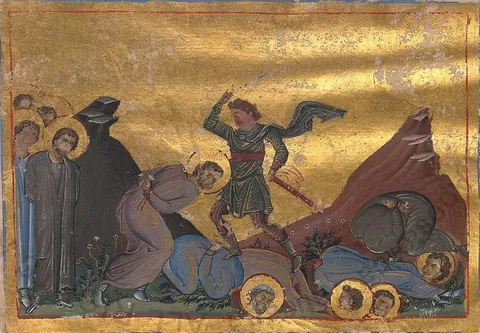
Holy Martyrs Pamphilus the Presbyter, Valens the Deacon, Paul, Porphyrius, Seleucus, Theodulus, Julian, Samuel, Elias, Isaiah and Daniel (+307–309)
The holy Martyrs Pamphilus the presbyter, Valens the deacon, Paul, Porphyrius, Seleucus, Theodulus, Julian, Samuel, Elias, Jeremiah, Isaiah and Daniel suffered in Caesarea in Palestine during the persecution of the Christians unleashed by Diocletian in 308–309. The holy Martyr Pamphilus was born in the city of Berytus (Beirut) and was educated in Alexandria, after which he was ordained presbyter in Caesarea. He laboured much to collate and correct the books of the New Testament, which had been corrupted by copyists. The saint wrote out the final, established texts himself and sent them to those who wished for them. He converted many pagans to the true law. By his labour and zeal a rich library of spiritual books was created in Caesarea, which helped the spread of Christian education. Saint Pamphilus was actively helped by the aged deacon Valens, deeply learned in Holy Scripture, and by Saint Paul, burning with love of Christ and hope in Him. Urban, the governor of Caesarea in Palestine, shut all three of them up in prison for two years, and his successor Firmilian tried them and sent them to work in the gold mines of Cilicia together with some 130 other Christians. Five Christian brothers accompanied the saints to their place of exile. On their way back, in Caesarea, they were detained and imprisoned for confessing Christ. Standing before the tribunal together with Pamphilus, Valens and Paul, the young men introduced themselves to the judge by the names of Old Testament prophets, Elias, Jeremiah, Isaiah, Samuel and Daniel, and declared that they were from Jerusalem, by which they meant the heavenly Jerusalem. Firmilian had heard nothing of such a city, since Jerusalem had already been destroyed by the Emperor Titus in 70, and in its place the Emperor Hadrian (117–138) had built a city called Aelia Hadriana. Firmilian tortured the young men for a long time, trying to make them reveal where the unknown city was and to turn them away from the true faith. But when he could do nothing, he beheaded all five together with Pamphilus, Valens and Paul.
Before their martyrdom Porphyrius, the eighteen-year-old servant of the presbyter Pamphilus, met a martyr’s end. When the young man, distinguished by meekness and obedience, learned that the confessors had been sentenced to death, he asked permission to bury their bodies after the sentence had been carried out, for which he was put to death and burned in the fire.
Inspired by the holy struggle, a pious Christian, Seleucus, a former soldier, came to Pamphilus, who was being made ready for death, and told him of Porphyrius’s blessed end. For this the saint was seized at once and put to death with the other condemned men.
One of the governor’s servants, Theodulus, a secret Christian already advanced in years, kissed the martyrs before they were led out to execution and asked them to pray for him, for which he was crucified.
A young man from Cappadocia, Julian, knelt before the holy bodies of the martyrs, scattered near Caesarea to be torn by wild beasts, and kissed them. The soldiers noticed the God-loving young man, arrested him, and by Firmilian’s order burned him in the fire. The bodies of the lambs of Christ lay under the open sky for four days, but neither beasts nor birds touched them. Terrified by this miracle, the pagans allowed the Christians to carry away the holy relics and commit them to the earth.



