
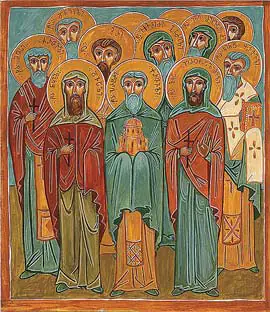
Saints Prokhore the Georgian (XI); Luke of Jerusalem (son of Mukhai) (+1273); Nicholas Dvali (+1314) and All the Georgian Martyrs and Venerable Fathers Who Lived in the Georgian Monastery of Jerusalem
Saint Prokhore was born around 985–990. The saint was brought up in a monastery from childhood. The young ascetic, outstanding in every way, was tonsured a monk with the name Prokhore and soon ordained hieromonk. From about 1010–1015 the saint went to Jerusalem, to the Lavra of Saint Sabbas. Then, at the command of Ekvtime son of Grdzeli, he “began to build near Jerusalem a monastery, which they call the Monastery of the Cross”.
According to tradition, Lot, the nephew of Abraham, planted three trees in this place — a cypress, a pine and a fir. Afterwards these saplings were miraculously joined together and grew into one great tree. When the Temple was being built this tree was cut down at Solomon’s command, but it was not used in the building. According to holy tradition, it was from this tree that the cross was made on which our Saviour Jesus Christ was crucified. In the fourth century this land was granted to King Mirian (commemorated 1 October). In the fifth century Vakhtang Gorgasali (commemorated 30 November) built the Monastery of the Cross here, which was destroyed more than once in the seventh to eleventh centuries.
For the restoration of the monastery Bagrat the Kouropalates, king of Georgia, gave Abba Prokhore great sums of money.
The venerable Prokhore adorned the monastery in every way. He gathered around him eighty monks, for whom he appointed a rule and canons like those of the Lavra of Saint Sabbas.
After Saint Prokhore’s long labours his body grew weak from toil and old age; he appointed one of his disciples, named George, as steward of the monastery, while he himself, accompanied by two disciples, withdrew into the desert, and after a little while, around 1066, he committed his soul to the Lord.
Saint Luke of Jerusalem came from an honourable and distinguished Georgian family. After her husband’s death his mother left her children, was tonsured a nun and settled in Jerusalem to labour there. When Saint Luke reached the age of twenty he went to Jerusalem, was also tonsured a monk and soon ordained deacon as well. The venerable father soon learned the Arabic language. When the brethren saw his “twofold wisdom” and holiness, they elected him abbot of the Monastery of the Cross. The blessed Luke governed the monastery well for three years.
The devil, who desires the ruin of men, was inflamed with envy against the father who was pleasing to God and stirred up against him a Persian full of wickedness, Sheikh Khidar, who was influential at the sultan’s court. He obtained the Monastery of the Cross from Sultan Pendukht. Having seized the monastery, the wicked Persian “fell upon our brethren the Georgians like a beast and left them nothing”. As abbot, the venerable Luke went to the sultan to intercede. The Christians warned the holy father: “Sheikh Khidar threatens you, so flee and hide.” Luke paid no heed to this warning; on the contrary, he preferred death for Christ to the life of this passing world; he went to Sheikh Khidar and asked him “to let the fathers go and demand of him whatever he wished”. The Persian, filled with wickedness, demanded that he give up Christianity and accept Islam, promising the blessed one in return an emirate and “the lordship of the temple”. Saint Luke firmly confessed Christianity before the sheikh. Offended by his refusal and filled with rage, the sheikh ordered the head of Christ’s faithful servant to be cut off.
After the sentence had been carried out, Luke’s holy severed head turned towards the east, smiled and gave thanks to the Lord. At the order of Sheikh Khidar the saint’s precious body was burned in the fire.
The holy martyr Nicholas Dvali was the son of Orthodox parents. His God-fearing father and mother dedicated him to the Lord from his birth. At twelve the boy Nicholas went to the desert of Klarjeti, was tonsured there and began to labour. Then the saint went to Jerusalem and settled in the Georgian Monastery of the Cross. Burning with the desire of a martyr’s death for Christ, Saint Nicholas boldly preached the faith among the Muslims and at the same time fearlessly exposed their errors.
The lawless seized Saint Nicholas and, after tortures of many kinds, shut him up in prison. The Christians managed to free the confessor from prison. At the abbot’s command Saint Nicholas went to Cyprus, to the Georgian monastery. He prayed to the Lord for a martyr’s end and received a revelation from Saint John the Baptist: he was to go to Damascus.
Having come to Damascus, the saint again boldly confessed Christ before the lawless and exposed their folly. The enraged godless seized the holy confessor, beat him cruelly and threw him into a dungeon. The Christians managed with difficulty to free him from captivity. Newly freed, Saint Nicholas went again to the gathering of the lawless and again condemned their folly, for which they tortured him cruelly, gave him five hundred lashes and threw him into prison. The holy martyr was healed by a miraculous appearance of the Baptist, and two months later he was set free again.
The emir of the city happened to see Saint Nicholas, who was preparing to set out for Jerusalem; he seized him and sent him to the emir of emirs, Dengiz. Dengiz proposed to the saint that he accept Islam. Saint Nicholas boldly confessed Christ.
The emir of emirs ordered him to be put to death. The blessed martyr turned towards the east, bowed his neck joyfully to the sword and said: “Glory to Thee, O Christ God, who hast made me worthy to die for Thee.” The sword cut off Saint Nicholas’s head. The severed head glorified God seven times and cried out: “Glory to Thee, O Christ God!” The Persians who saw this miracle burned the holy body. For three days a pillar of light stood over the place of his martyrdom.
When Saint Nicholas’s spiritual father learned of the martyr’s end of his spiritual son, he glorified God and entreated Him to reveal to him whether Nicholas had been numbered among the holy martyrs. One day, while reading a book, he saw in a miraculous revelation a mountain full of light and fragrance and a radiantly adorned choir of holy martyrs, among whom the great-martyr George shone especially. Saint George called Saint Nicholas: “Nicholas! Come out and see this old man, your teacher, for he has shed many tears for you.” Nicholas greeted his teacher: “See, you have seen me and my place too; from now on do not grieve for me,” he comforted him. Saint Nicholas Dvali suffered martyrdom on Tuesday, 19 October 1314.



