
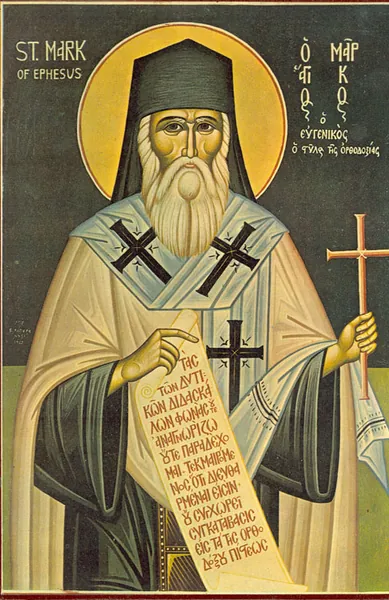
St Mark, Archbishop of Ephesus (+1443)
Saint Mark of Ephesus (in the world Manuel) was born in Constantinople in 1391, into a family of God-fearing Christians. The saint received his elementary education under his father’s guidance, and after his father’s death became a pupil of the best professors of Constantinople, and in a short time acquired a vast store of knowledge from them thanks to his diligence, zeal and excellent mind.
At twenty-four Manuel completed the higher school of Constantinople with the title of votarius, that is, teacher of rhetoricians. He was charged with expounding Holy Scripture in the patriarchal church. Always serious, and at the same time kind and well disposed towards everyone, the young scholar won universal love. Ephrem II, Patriarch of Constantinople (1410–1416), held him dear and brought him close, and the saint also became a friend and trusted adviser of the Emperor Manuel; a brilliant secular career lay open before him, but at twenty-six the young man broke with the vain and passing world, was tonsured a monk with the name Mark, and settled in a remote monastery on the island of Antigone. His teacher became the superior of this monastery, “the wondrous Symeon”.
The time in which Saint Mark had to labour was full of grievous trials: the Turks had conquered the whole of Asia Minor and the Balkan peninsula and drawn near to Constantinople. Mark and his teacher were forced to move to Constantinople, to the monastery of Mangana. Here the holy father gave himself wholly to silence, received no visitors, and went deeply only into Holy Scripture.
In the Mangana monastery Mark was ordained priest. During the bloodless sacrifice divine grace came down upon him in the form of light.
In 1437 the venerable father was chosen Metropolitan of Ephesus. He remarked: “At the command of the Church of Christ, and for her need, I took up the ministry of a bishop, which surpasses my worthiness and my strength.”
At the end of 1437 Mark of Ephesus set out with other Greek bishops for the Council of Ferrara-Florence. The Orthodox hierarchs supposed that the Catholics, who had falsified the common seal of the Christian confession, would turn to the true faith and, to the glory of God, unite with their Orthodox brothers; but their hope proved vain. At the council, held first in Ferrara and then in Florence, no sincere discussion of the disputed questions took place. The Latins gradually turned to threats and intimidation, and even took away the other side’s right to speak. They tried to take advantage of the grave situation in the Greeks’ country and obtain a complete ecclesiastical capitulation from them. And they achieved their aim: the weakened Byzantine hierarchs, with pangs of conscience and in torment, in the vain hope of receiving military and financial help from the Latins, sold Orthodoxy, accepted the Catholic creed, and concluded a shameful union with the Latins. The only one whom the secret and open enemy could not break was Mark of Ephesus. He declared: “There can be no middle ground between truth and falsehood”; “the affairs of the Church are never settled by way of compromise”.
When the cardinals solemnly presented to Pope Eugene IV the act of union signed by the Greek representatives, he immediately asked whether Mark of Ephesus had signed it, and when his signature was nowhere to be found, he said: “So we have accomplished nothing!”
A few days after the signing of the union the pope asked the Greek bishops and hierarchs to condemn Mark of Ephesus as an opponent of the union. The Greek side, worn out by concessions, refused to carry out this demand, and the holy father, summoned to the pope, said: “The councils of the Church held as apostates and condemned those who violated some dogma and preached so. The Church first condemned the heresy itself, and then the chiefs of the heresies and their followers. But I have neither preached any teaching of my own nor brought any novelty into the Church. I have only defended the teaching which the Church received inviolate from our Saviour and has held unchanged to this day. Before the schism the holy Church of Rome too kept this teaching no less than we of the East, and always regarded it as holy doctrine. And if I keep it and do not allow myself to depart from it, then what council will condemn me, since it must first condemn the teaching that I follow? And if the teaching is right and Orthodox, then why should I deserve punishment?”
The emperor and the hierarchs left Florence on 26 August 1439. A few months later Metrophanes, a supporter of the union, was elected to the patriarchal throne of Constantinople. Saint Mark began to be persecuted. He went to Ephesus and cared diligently for his flock, though it was very hard for him, weak in body as he was. He went round visiting the churches damaged by the Turks, ordained priests, helped the oppressed, and protected widows and orphans.
Two years later, by the emperor’s order, the holy father was seized and thrown into prison. After his release the Venerable Mark returned to Constantinople. He saw the mood of the people and the clergy and wrote: “The pseudo-union will soon fall apart.” Soon this prophecy was fulfilled.
Mark of Ephesus died in 1443. The end of his life, full of suffering, was bright and joyful. The saint was buried with honour in the Mangana monastery.



